
Its time to keep an eye on currencies

Key Points
- The U.S. Dollar will soon be entering an unfavorable seasonal period
- This opens an opportunity to play the short side of the dollar and/or the long side of certain foreign currencies
- Currency ETFs allow non-futures traders to play the short side of the U.S. Dollar in a variety of ways
The U.S. Dollar is vulnerable
As discussed in these earlier notes (here and here), the U.S. Dollar is vulnerable on a cyclical basis. Of course, seasonal and cyclical factors are primarily tools for telling you "when to look where and in which direction."
The chart below shows price action for U.S. Dollar futures over the past several years.
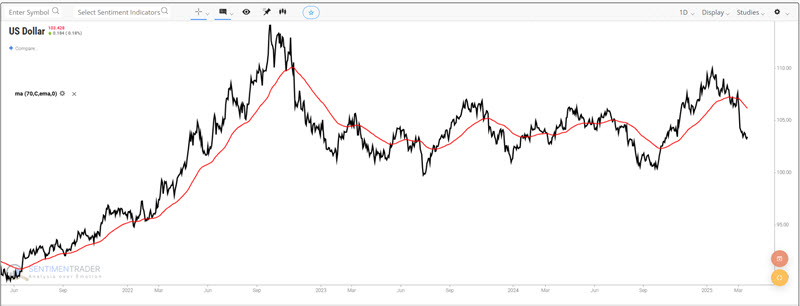
Following an extended advance, the dollar topped out in September 2022 and fell hard into early 2023. It has been trading in a sideways range ever since, most recently falling hard since early 2025.
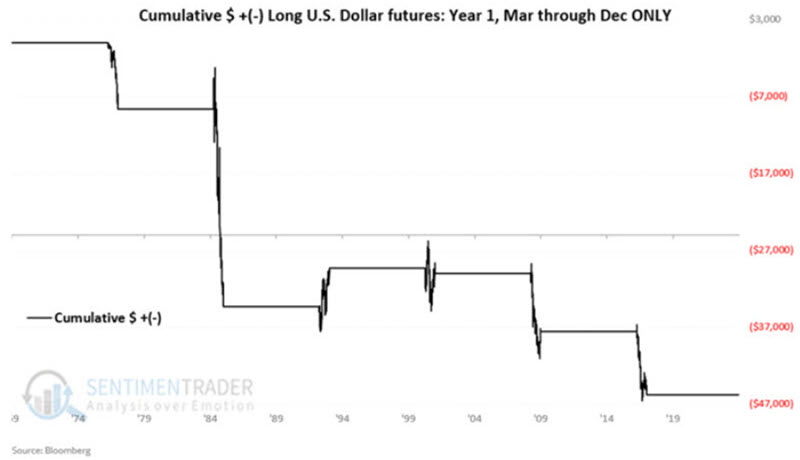
As detailed in this note, 2025 is Year 1 of a new 8-year cycle. During previous Years 1, the U.S. Dollar has shown significant weakness during the March through December months. Of course, there is no guarantee that the dollar will follow this pattern in 2025, but it does suggest a potential opportunity to trade the short side of the dollar in 2025.
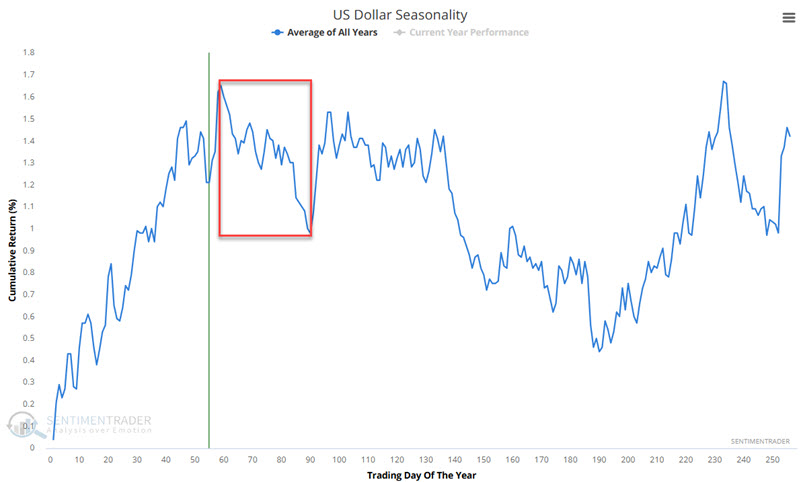
The chart below displays the annual seasonal trend for U.S. Dollar futures. At the close of 2025-03-25, the dollar will enter a period of typical weakness.
The chart below displays the hypothetical growth of $1 invested in the U.S. Dollar only during the Trading Day of the Year (TDY) #59 through TDY #90 period since 1985.
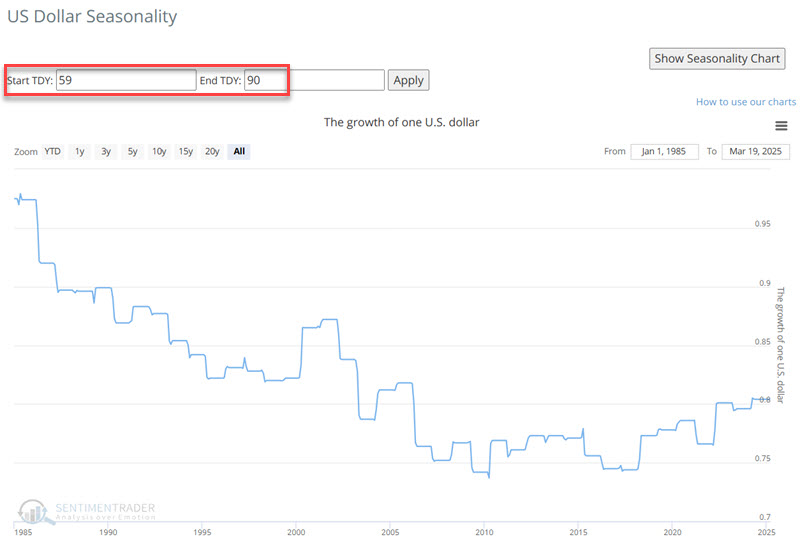
This period has shown more strength in recent years, but the long-term trend is unfavorable. When combined with the 8-year cycle information above, traders should be alert for an opportunity to play the short side of the dollar.
Of course, not everyone is equipped to trade U.S. Dollar futures. Non-futures traders can play the short side of the dollar by buying shares of the Invesco DB US Dollar Index Bearish Fund ETF (ticker UDN). Per the Invesco.com website:
The Invesco DB US Dollar Index Bearish (Fund) seeks to track changes, whether positive or negative, in the level of the Deutsche Bank Short USD Currency Portfolio Index - Excess Return™ (DB Short USD Currency Portfolio Index ER or Index) plus the interest income from the Fund's holdings of primarily US Treasury securities and money market income less the Fund's expenses. The Fund is designed for investors who want a cost-effective and convenient way to track the value of the U.S. dollar relative to a basket of the six major world currencies - the euro, Japanese yen, British Pound, Canadian dollar, Swedish krona, and Swiss franc (collectively, the "Basket Currencies"). The Index is a rules-based index composed solely of short U.S. Dollar Index futures contracts that trade on the ICE futures exchange (USDX® futures contracts). The USDX® futures contract is designed to replicate the performance of being short the U.S. dollar against the Basket Currencies.
What's bad for the dollar is likely good for other currencies
Foreign currencies, in general, trade inversely to the U.S. Dollar. Therefore, traders may be able to play the long side of these markets. In addition, non-futures traders can access these opportunities via ETFs in a stock account (more on this topic later).
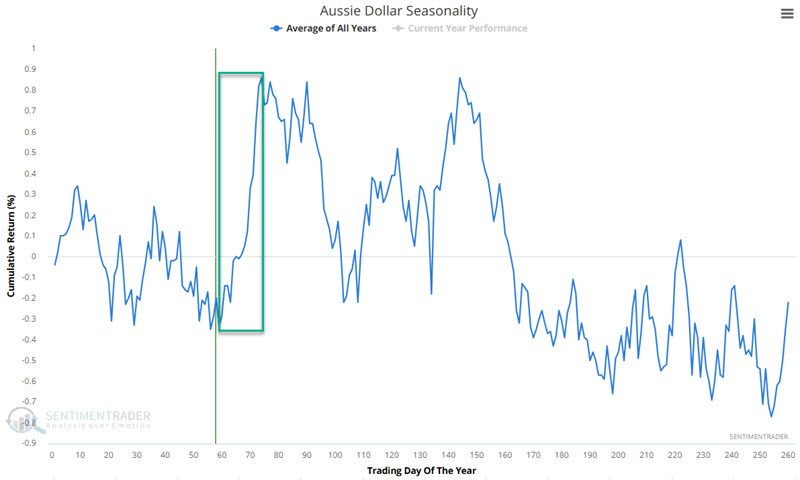
The chart below displays the Australian dollar's annual seasonal trend. At the close of 2025-03-24, the Aussie will enter a period of typical strength.
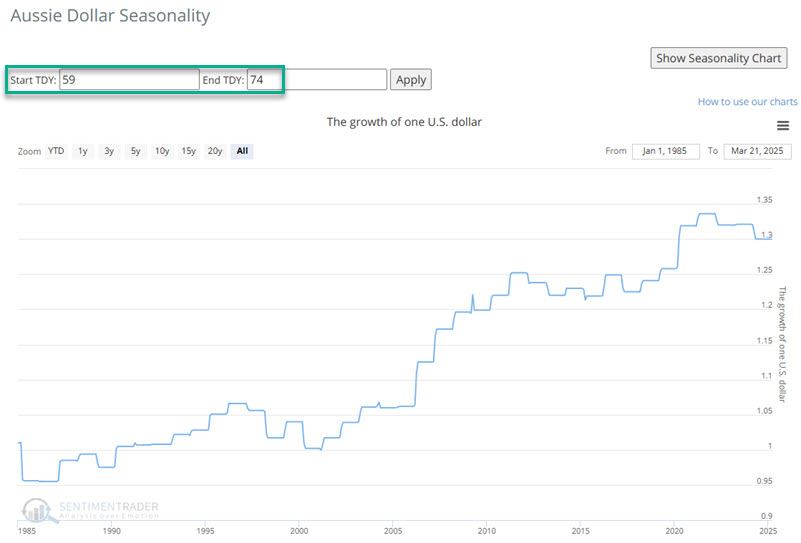
The chart below displays the hypothetical growth of $1 invested in the Aussie only during the Trading Day of the Year (TDY) #59 through TDY #74 period since 1985.
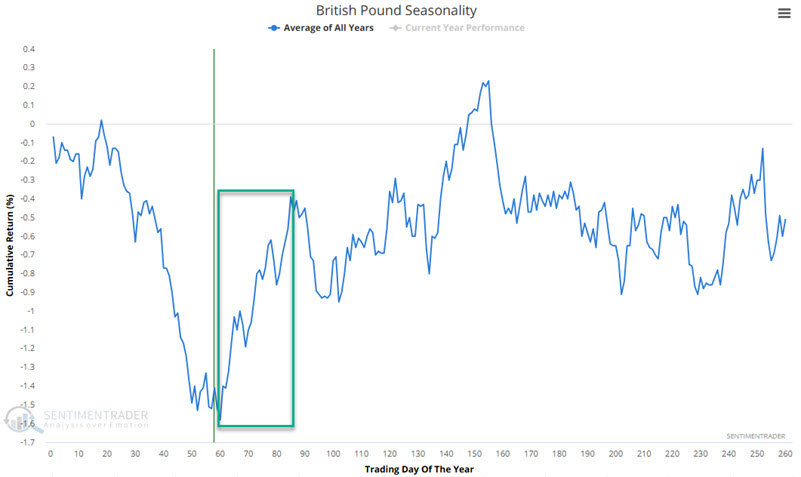
The chart below displays the annual seasonal trend for the British Pound. At the close of 2025-03-25, the Pound will enter a period of typical strength.
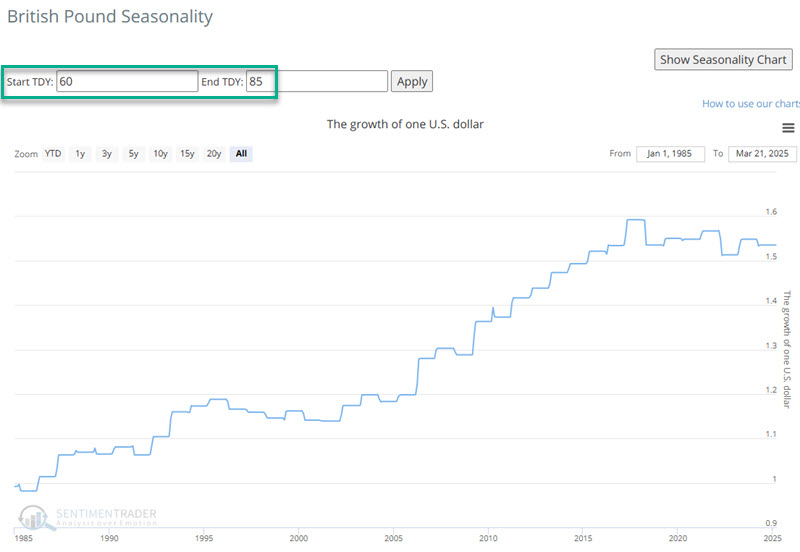
The chart below displays the hypothetical growth of $1 invested in the Pound only during Trading Day of the Year (TDY) #60 through TDY #85 period since 1985.
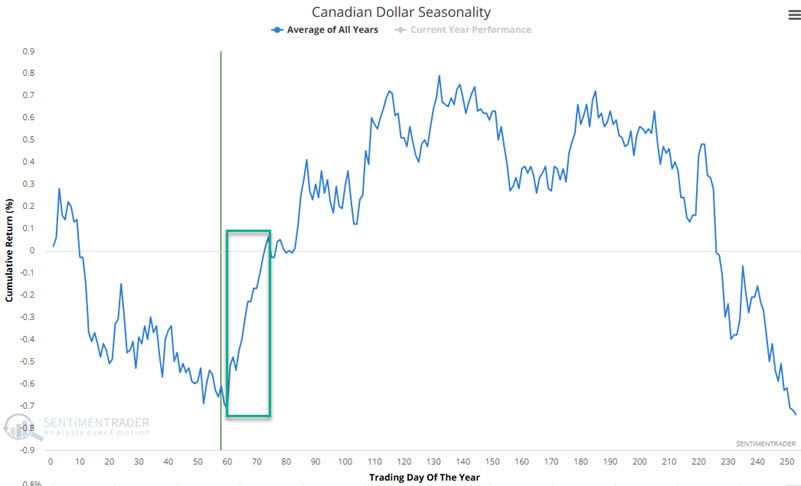
The chart below displays the annual seasonal trend for the Canadian Dollar. At the close of 2025-03-25, this market will enter a period of typical strength.
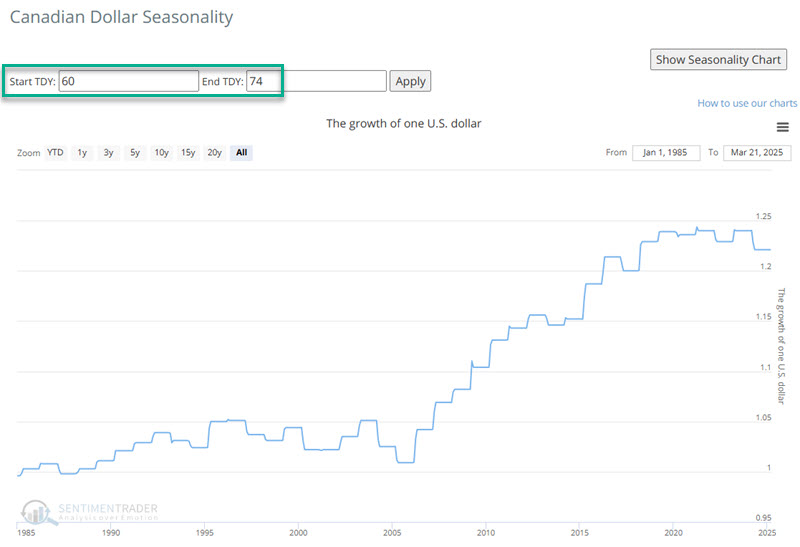
The chart below displays the hypothetical growth of $1 invested in the Canadian Dollar only during the Trading Day of the Year (TDY) #60 through TDY #74 period since 1985.
ETFs for non-futures traders
The table below highlights several ETFs that traders can use to enter either a short position in the U.S. Dollar or a long position in the Australian Dollar, British Pound, or Canadian Dollar.

These ETFs allow traders to trade foreign currencies just as they would individual stocks. Since these particular ETFs are not heavily traded, limit orders may be helpful.
What the research tells us…
Seasonal and cyclical factors should rarely be used as the sole basis for entering a trade. However, combining price action and seasonal tendencies can be a powerful combination. If a market "is doing" what it "is supposed to be doing" - i.e., if seasonality and price action are in agreement - price trading opportunities can emerge. Given the current setups, traders should keep a close eye on the U.S. Dollar and/or various foreign currencies.