Products
SentimenTrader Trading Tools
‍
Backtest Engine
My Trading Toolkit
Correlation Analysis
Seasonality
Market Prediction
Indicators & Data API
‍
Proprietary Indicators & Charts
Market Data API
Strategies & Scanner
‍
50+ Trading Strategies
Smart Stock Scanner
Smart Option Scanner
Research Reports
‍
Research Solutions
Reports Library
Free Resources
Simple Backtest Calculator
Simple Seasonality Calculator
The Kelly Criterion Calculator
Sentiment Geo Map
Public Research Reports
Education
Sentiment Indicators
Technical Indicators
Pricing
Company
About
In the News
Testimonials
Client Success Stories
Contact
Log inLoginSign up
< BACK TO ALL REPORTS

Investors suffer the first real pullback in months

Jason Goepfert
2024-04-22
After six months of mostly ideal conditions for stock market bulls, the S&P 500 suffered its first real pullback. Even so, it remains well above its long-term trendline. After the first pullback from a record, the S&P showed a consistent tendency to rebound, especially when it still remained well above its 200-day moving average.

Key points:

  • The S&P 500 suffered its first pullback of 5% or more in months
  • After record highs, this pullback has been quick, though the index remains well above its 200-day average
  • Similar quick pullbacks after strong rallies showed a consistent tendency to rebound in the months ahead

Stocks have pulled back but remain well above trend

For the first time in six months, average investors are facing meaningful losses. The most benchmarked index in the world has finally entered pullback territory of more than 5% off its record high.

And if one wishes to cherry-pick periods of disaster, one could point to two recent initial pullbacks that spilled over into crushing losses for anyone with a short- to medium-term time frame.
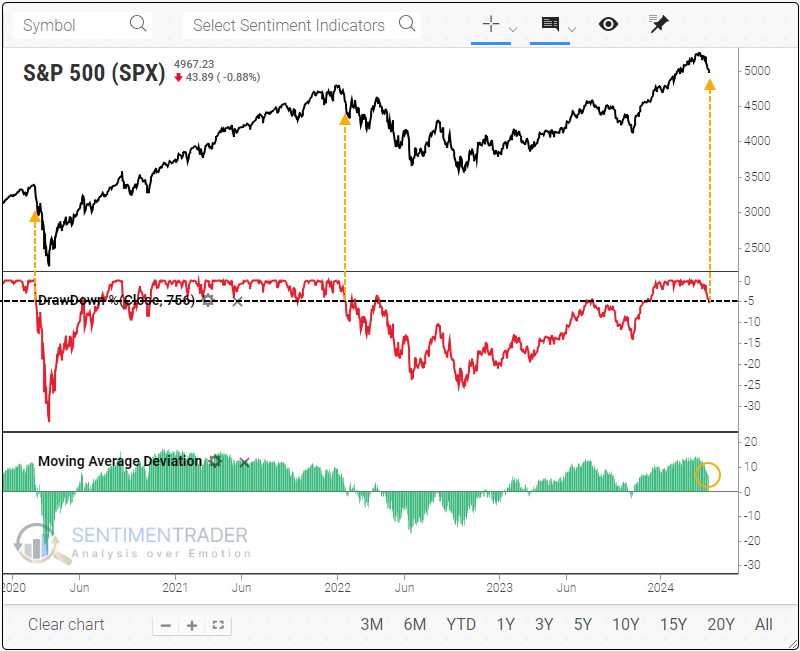
There are some differences, however.

When looking at S&P 500 history since 1928, there have been 67 times when the index cycled from an all-time high to a 5% pullback. After most of those, the index recovered without too much more in the way of losses.

One wrinkle with the current pullback is that it was a bit quicker than average. The median number of days from an all-time high to a 5% pullback was 14 sessions, and the current was 13. When we look at S&P returns after quicker-than-average pullbacks, they were pretty positive, especially over the next month when it rebounded 83% of the time.
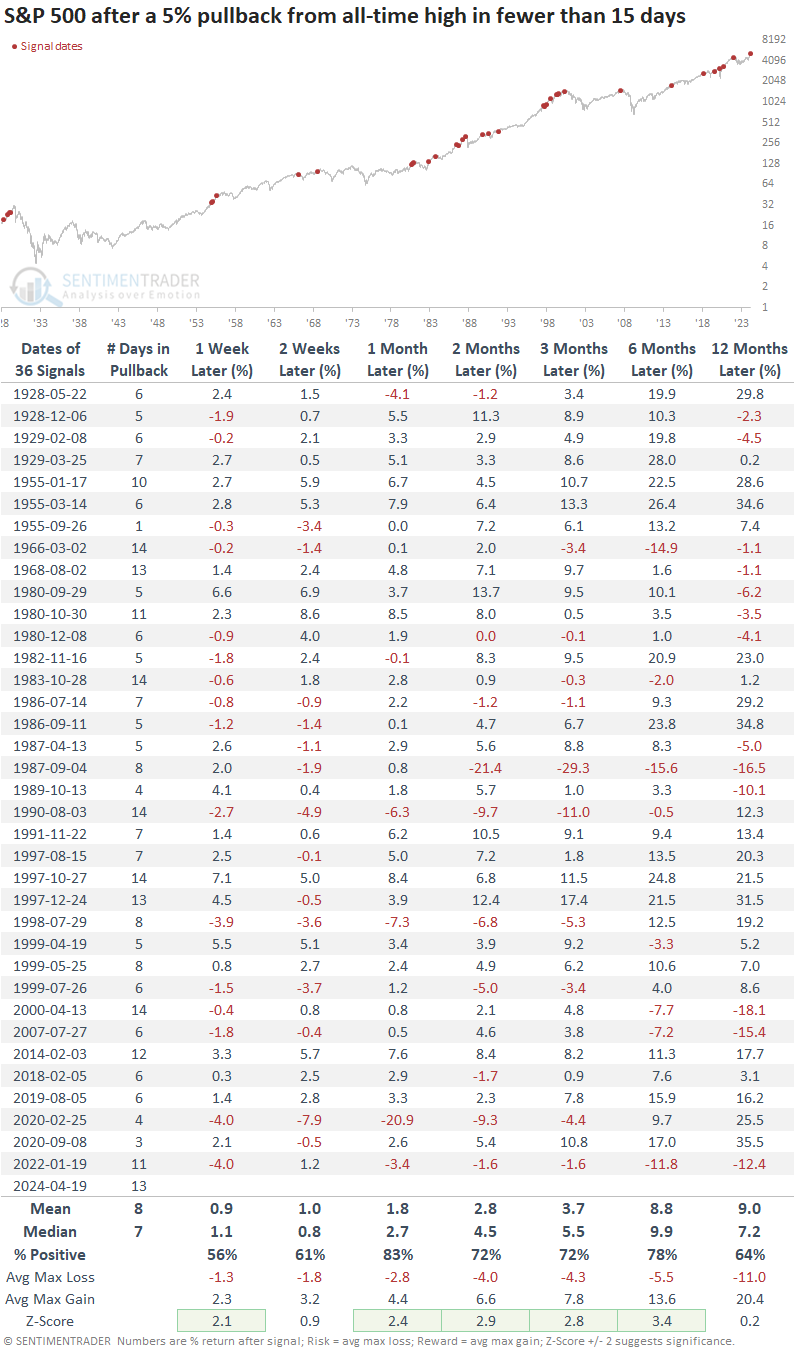
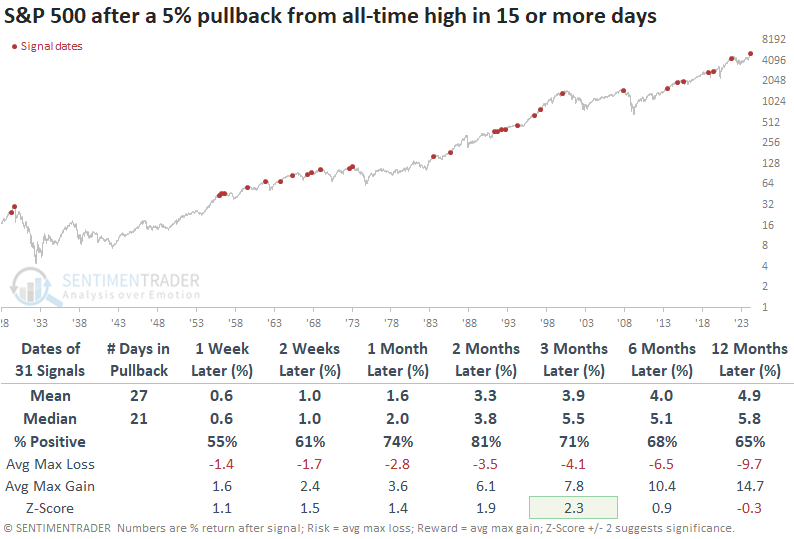
When we look at summary statistics after longer-than-average cycles from high to pullback, S&P returns were quite a bit lower over longer time frames.
What's even more notable about the current pullback is that it was quick but came from an extended run. Even after dropping 5% from its high, the index was still more than 5% above its 200-day moving average. When we further filter the quick signals to only those when the S&P was at least 5% above its average at the time of pulling back, returns improved further.
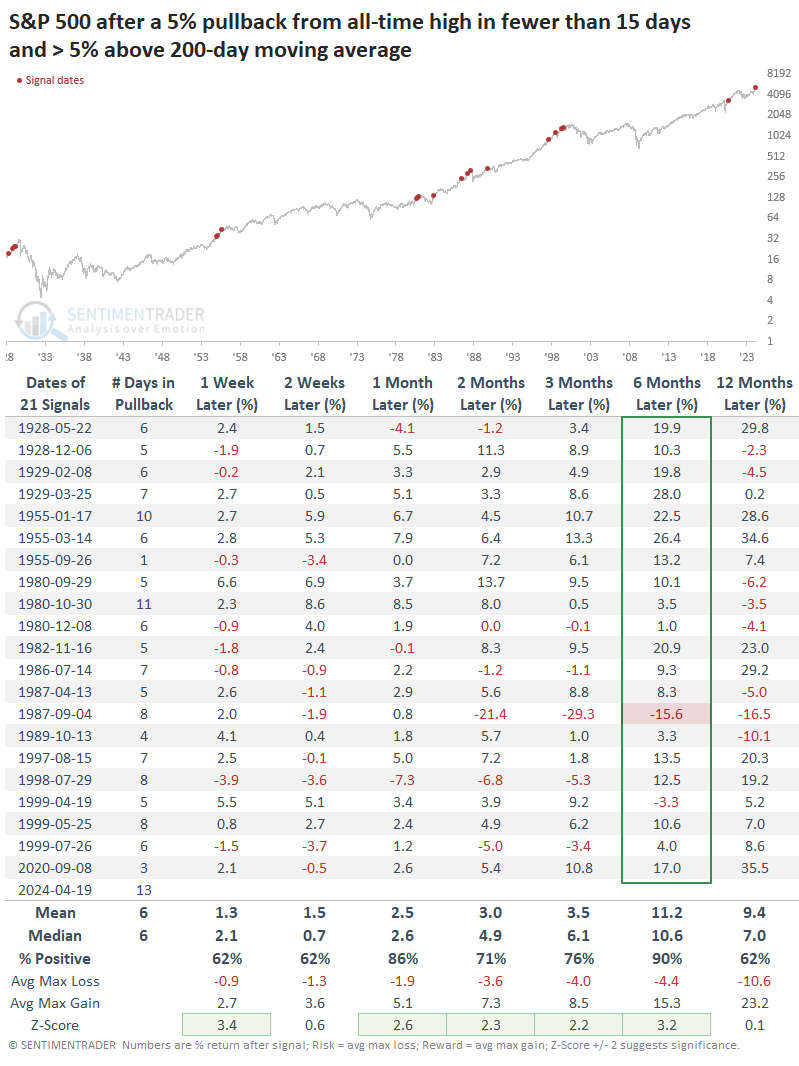
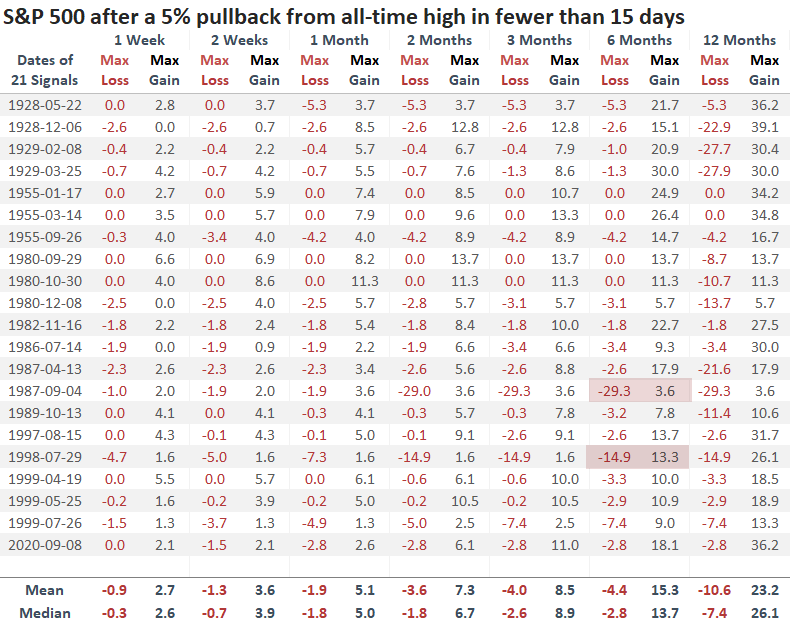
Over the next six months, the S&P rallied 19 out of 21 times. One of those losses was temporary and quickly erased, and it was positive in all earlier time frames. The only actual failure was in 1987 when the index tumbled into the Black Monday crash. So, bears could always hope for a repeat of that exception, I guess.

A table of maximum gains and losses across time frames shows that only two signals, 1987 and 1998, suffered larger losses than gains within the next six months. On average, the probability of missing out on substantial gains was significantly worse than the probability of suffering meaningful interim losses.
What the research tells us...

After month after month of low volatility and consistent gains, it's natural for investors to freak out at the first sign of a change. Our minds immediately go to the worst-case scenario, worried we missed the warning signs all along. After a miserable year like 2022, the dangers of complacency are still fresh in many minds.

When we look back at historical tendencies, however, we can see how rare it would be for anything like that to repeat. When buyers were confident and liquid enough to push stocks to record highs and well above trend, the first real pullback showed a strong tendency to attract more buyers, not sellers.

PRODUCTS
SentimenTrader
Trading Tools
Indicators & Data API
‍
Strategies & Scanner
‍
Research Reports
FREE
RESOUrCES
Simple Backtest
Calculator
Simple Seasonality
Calculator
The Kelly Criterion
Calculator
Sentiment Geo Map
‍
Public Research Reports
‍
Education
Sentiment Indicators
‍
Technical Indicators
‍
Pricing
Bundle pricing
‍
FAQ
‍
Announcements
‍
COMPANY
‍
About
‍
In the News
‍
Testimonials
‍
Client Success Stories
CONTACT
‍
General Inquiries
‍
Media Inquiries
‍
Financial Professionals Inquiries
‍
© 2026 Sundial Capital Research Inc. All rights reserved.
Setsail Marketing
TermsPrivacyAffiliate Program
Risk Disclosure: The information and tools provided are for research and analytical purposes only and are not intended as investment advice. Market analysis involves uncertainty, and outcomes may differ from expectations. Users should conduct their own due diligence and consider their individual circumstances before making any financial decisions. Past performance is not necessarily indicative of future results.

Hypothetical Performance Disclosure: Hypothetical performance results have many inherent limitations, some of which are described below. No representation is being made that any account will or is likely to achieve profits or losses similar to those shown; in fact, there are frequently sharp differences between hypothetical performance results and the actual results subsequently achieved by any particular trading program. One of the limitations of hypothetical performance results is that they are generally prepared with the benefit of hindsight. In addition, hypothetical trading does not involve financial risk, and no hypothetical trading record can completely account for the impact of financial risk of actual trading. for example, the ability to withstand losses or to adhere to a particular trading program in spite of trading losses are material points which can also adversely affect actual trading results. There are numerous other factors related to the markets in general or to the implementation of any specific trading program which cannot be fully accounted for in the preparation of hypothetical performance results and all which can adversely affect trading results.

Testimonial Disclosure: Testimonials appearing on this website may not be representative of other clients or customers and is not a guarantee of future performance or success.