
Investors completed a full sentiment cycle then optimism faded

Key points:
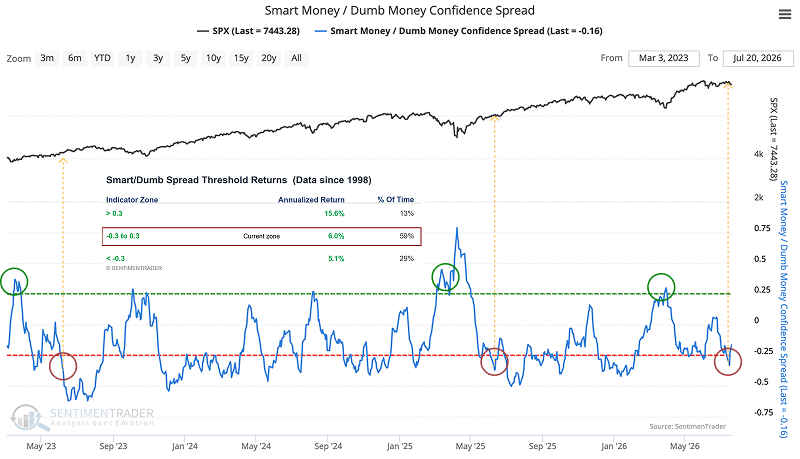
- The Smart Money / Dumb Money Confidence Spread cycled from +0.30 in late March to -0.33 on July 16, a full anxiety-to-optimism migration over 75 trading days as the S&P 500 rallied nearly 19%
- A single-threshold cross is routine, but a full +0.29-to-minus-0.30 cycle has fired only 32 times since 1999, and just 11 times when the S&P sat within 1% of its 52-week high
- History is mixed short-term and tilts positive over 3-to-12 months, but the average maximum loss mirrors the average maximum gain through six months, so this reads more like a two-way regime transition than a direction signal
Investors spent the spring doubting a rally that kept climbing
In late March, investors were still treating stocks with suspicion. The Spread between Smart Money and Dumb Money Confidence sat at +0.30, meaning the crowd was on the cautious side and the "smart money" was confident.
The S&P 500 kept climbing anyway, and by mid-July the mood had turned. On July 16 the Spread touched -0.33, 75 trading days after its March extreme, with the index up nearly 19% over that window. A negative reading isn't a verdict that smart money is bearish. It's a posture reading, and the Spread had spent three months flipping from one pole to the other.