
Introducing the JK Misery Index - Part I

WEBINAR NOTE: Please consider signing up for my live Webinar on Thursday, May 21st. I will be providing greater detail about the model described below, plus will show you how to be an expert on assessing the economy simply using several indicators on our website. I promise that you will learn some things that you don't know right now. Hope to see you there.
Key points:
- Along with our programming team, I am in the process of adding a variety of my own indicators, strategies, and trading models to the website
- This note introduces a model I refer to as The JK Misery Index
- The phrase "Misery Index" was coined in the late 1970s when inflation and unemployment were very high
- The JK Misery Index (JMI) adds interest rates to the mix, and compares the current reading to a longer-term moving average to identify when the latest trend has crossed above a significant threshold
- As I follow it, the JMI presently remains favorable, but has been trending in a worrisome direction, and should be monitored closely for a potential warning sign
The original Misery Index
The term "Misery Index" was coined in the late 1970s and involved adding the current rate of inflation to the current unemployment rate. A chart of this original version appears below.
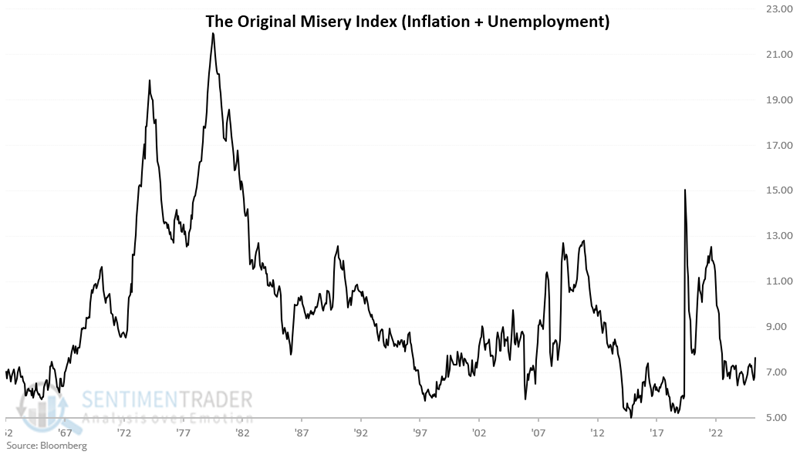
Note the two huge spikes in 1975 and 1980. Once inflation waned starting in the mid-1980's, those peaks were never challenged. The index briefly peaked near 15 in 2020. But the bottom line is that the original Misery Index has not been of much use as an actual stock market indicator for many decades. So an effort was made to incorporate that original data into something more useful.
Building the Raw base for the JK Misery Index (JMI)
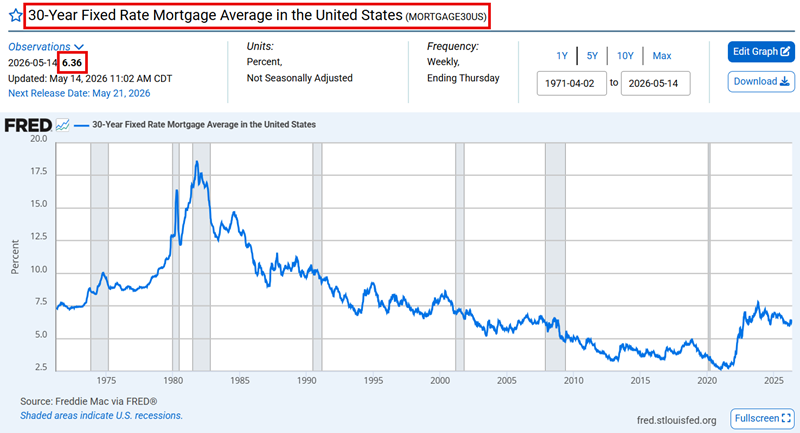
The starting point for the JMI is a raw index that includes the original Misery Index components and adds an interest rate component. While all interest rates have some effect on the economy - and while treasury yields are vitally important - I settled on the 30-year mortgage interest rate, as this helps build a "housing" component into the model. Housing trends are often more a barometer of the overall economy than are treasury yields.
So the three JMI components are:
A = 30-year mortgage rate
B = The absolute value of the 12-month change in the Consumer Price Index
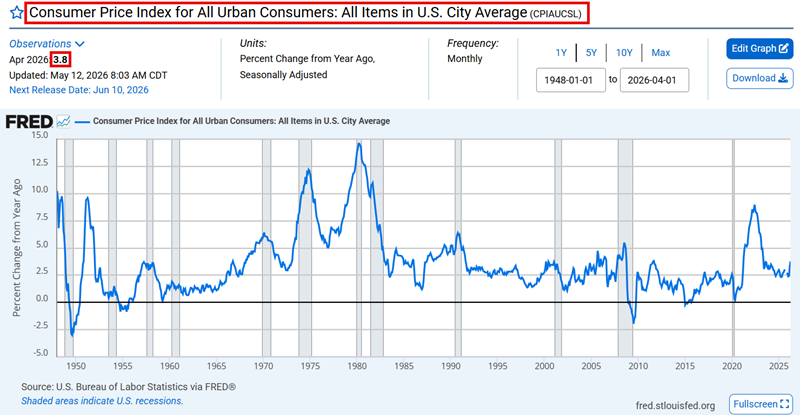
The chart above shows the actual 12-month percentage change in the CPI. The JMI uses the absolute value of that number (i.e., it is always a positive number). This is because large changes in the CPI - whether positive (too much inflation) or negative (too much deflation) - tend to be unfavorable for stocks.
C = The Unemployment Rate
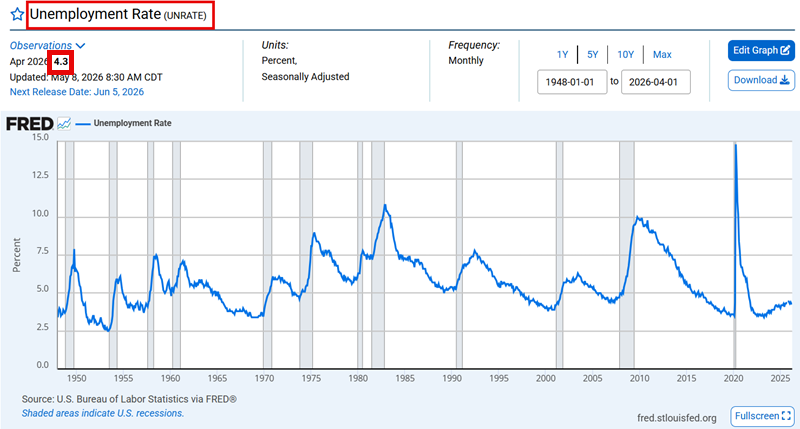
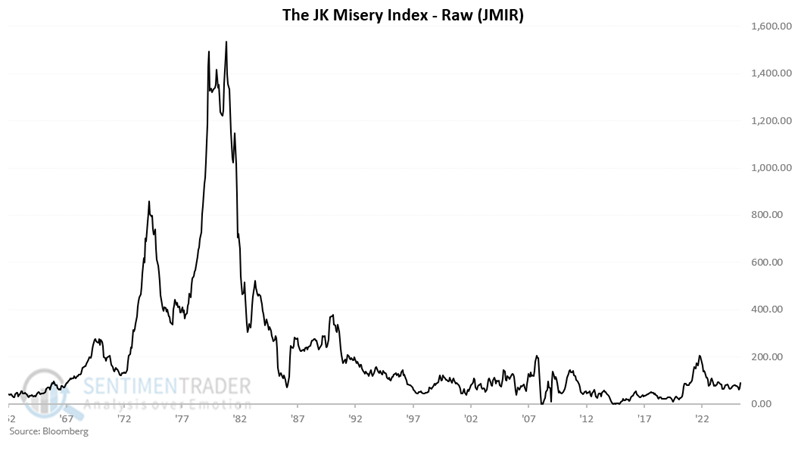
The raw base for JMI simply involves a mathematical calculation involving the three factors above. This raw value (referred to as JMIR) appears in the chart below. Note that at first blush, this version is more extreme than the original Misery Index.
Now, let's try to make this calculation useful for stock market investors.
Identifying trend extremes is key
The next step is to take the raw index above and compare it to its own 14-month exponential moving average. Both of these values appear in the chart below.
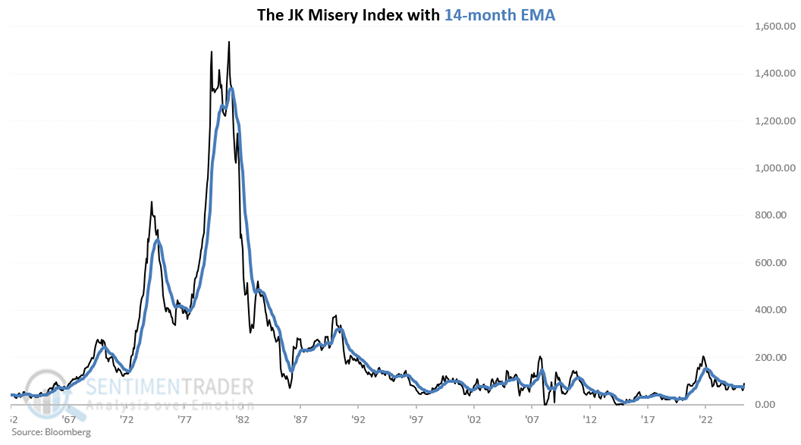
The actual JK Misery Index value is arrived at by subtracting the 14-month EMA of JMIR from the month-end JMIR value. This raw value for JMI appears below.
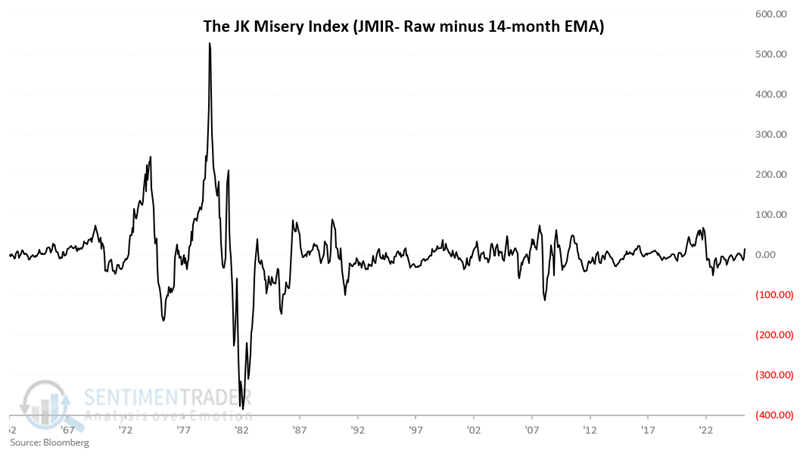
The remaining question is simple. Is the latest JMI value above or below the cutoff value of 35? The answer is revealed by looking at the latest JK Misery Index value under "Stock Market Indicators" on the "Indicators" tab.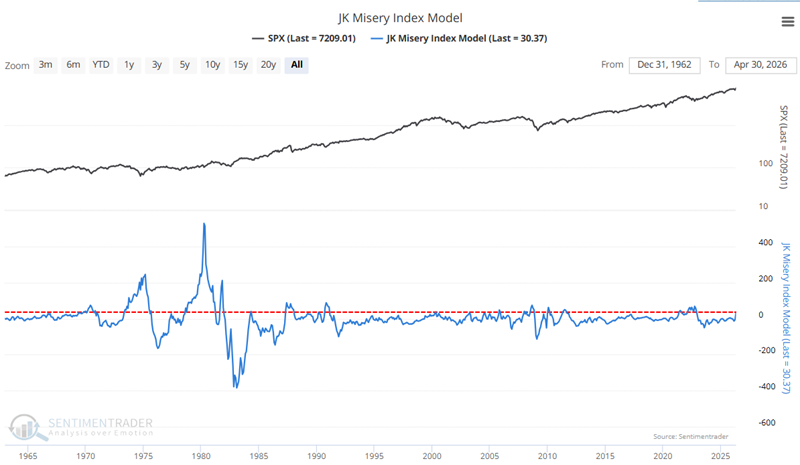
The bottom line:
- Readings below 35 are considered favorable for the stock market
- Readings above 35 are considered unfavorable for the stock market
S&P 500 performance based on JMI readings
In Part II, we will use BacktestEdge to test the JK Misery Index as a standalone trading strategy. For now, let's get a feel for S&P performance when JMI is below or above 35.
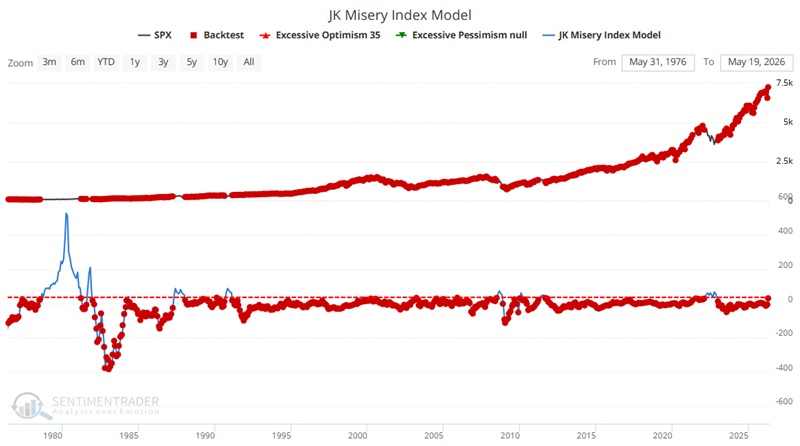
The chart below highlights all months when JMI ended the month below 35. As you can see, this is the most common state of affairs.
Conversely, the chart below highlights all months when JMI ended the month above 35.
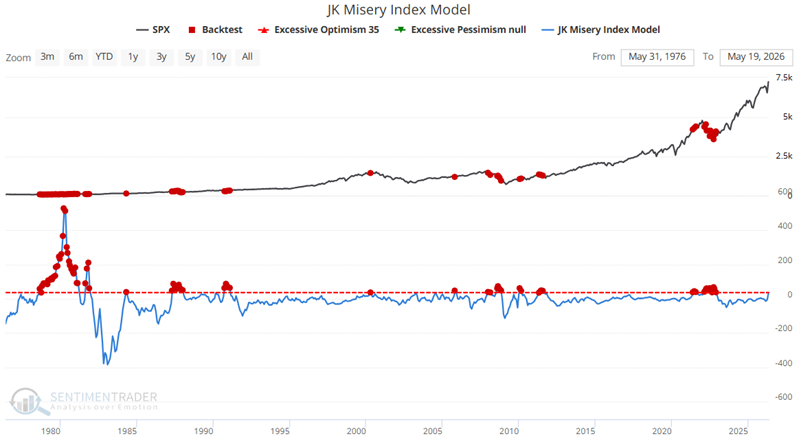
We can observe that JMI readings above 35 are the exception and not the rule. Now let's get a handle on S&P 500 performance:
- The first table below summarizes S&P 500 performance following all months when JMI ended below 35, since 1962
- The second table summarizes performance following all months when JMI ended above 35


Note that during the first year after a cross of the critical 35 level, the stock market has tended to perform much better following crosses below 35 than after crosses above 35.
To put a finer point on it, the chart below highlights only the months when JMI crossed above 35.
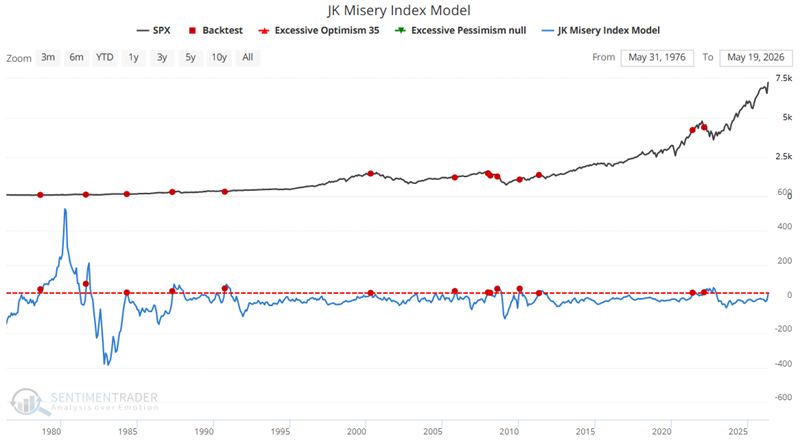
The table below summarizes S&P 500 performance following only the months highlighted in the chart above.

Not every instance is immediately followed by a major bear market. However, the primary point is this: The results displayed in the table above are extremely subpar and far below the historical average. The bottom line: The stock market has shown a strong tendency to underperform after JMI crosses above 35.
What the research tells us…
Part II will look at the results if we were to buy the S&P 500 following each JMI cross below 35 and sell following each JMI cross above 35. For now, the key takeaways are the building blocks that comprise the JK Misery Index. Trends in mortgage rates, inflation, and unemployment are all directly tied to the overall economy. A booming or struggling housing market, soaring or plunging inflation, and large changes in unemployment will all have a meaningful impact on the economy, and by extension, the stock market. The JK Misery Index combines all of these factors into one indicator. Rather than relying on a raw value, however, the index compares the latest reading to the most recent trend to identify significant extremes.