
Into the eye of the seasonal storm?

Key points
- The stock market has sold off in the last three weeks - and some indicators are reaching potentially oversold levels
- However, the S&P 500 is entering its weakest seasonal period of the year
- This does not necessarily mean a continuation of the recent downtrend, but it does argue in favor of caution
Heading into the weakest time of year for stocks
The chart below displays the annual seasonal trend for the S&P 500 Index.
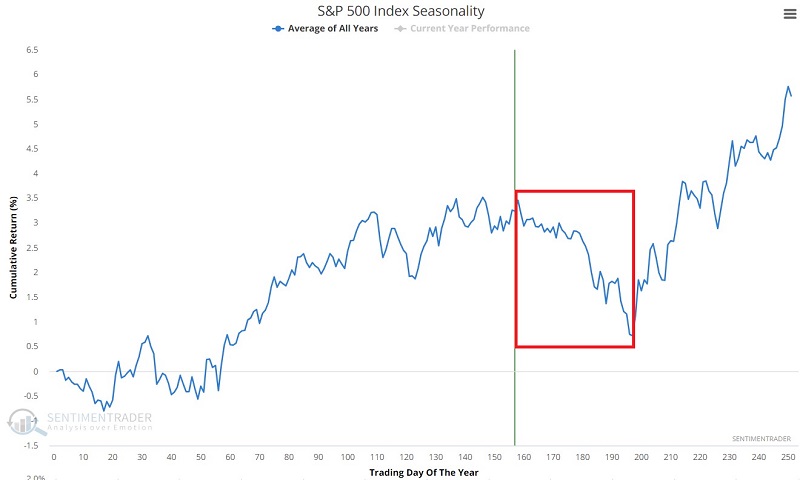
As you can see in the chart above, we are entering what is generally the weakest part of the year for stock market performance. This period extends from the close of Trading Day of Year (TDY) #158 through TDY #197. While this appears pretty ominous in the chart above, it is essential to remember that annual seasonal charts are an average of what has happened in the past and not a roadmap of what will happen this time around. For 2023, this period extends from the close on 2023-08-21 through 2023-10-16.
So should investors heed the gathering storm clouds and board up the windows, or continue to go about their business? To steal a phrase, "It's complicated."
SPX seasonal weakness by the numbers
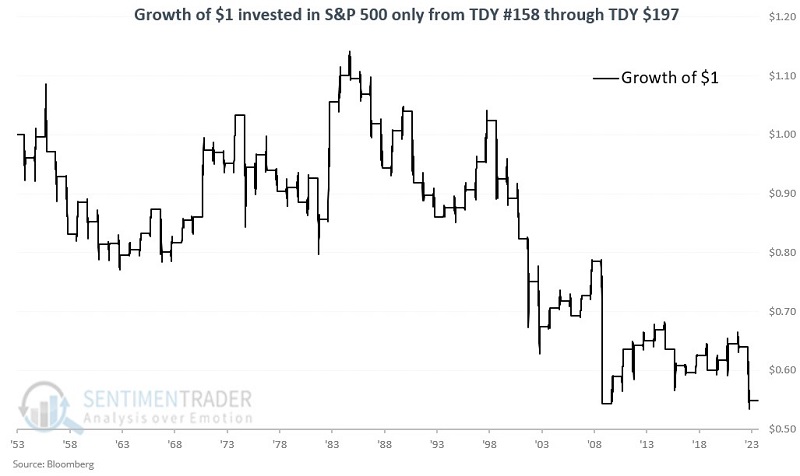
The chart below displays the growth of $1 invested in the S&P 500 Index only from TDY #158 through TDY #197 since 1953.
The table below summarizes SPX's performance during this annual period.
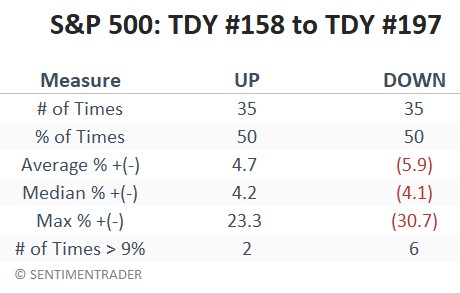
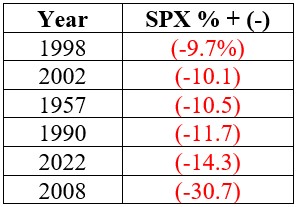
First, year-by-year results are essentially a coin flip, with 35 years showing a gain and 35 showing a loss. That's the good news. The bad news is that the down years tend to be down more than the up years are up. Note also that up years showed a gain over +9% only twice (+23.3% in 1982 and +13.2% in 1970), while down years showed a loss of over -9% six times, as shown below:
What about pre-election years?
Pre-election years have long shown a tendency to be bullish on the whole (no down pre-election years since 1930s). Does the unfavorable TDY #158 through TDY #197 period also show better results than average during pre-election years? The correct answer is probably "Yes, but."
The chart below displays the growth of $1 invested in the S&P 500 Index from TDY #158 through TDY #197 only during pre-election years.
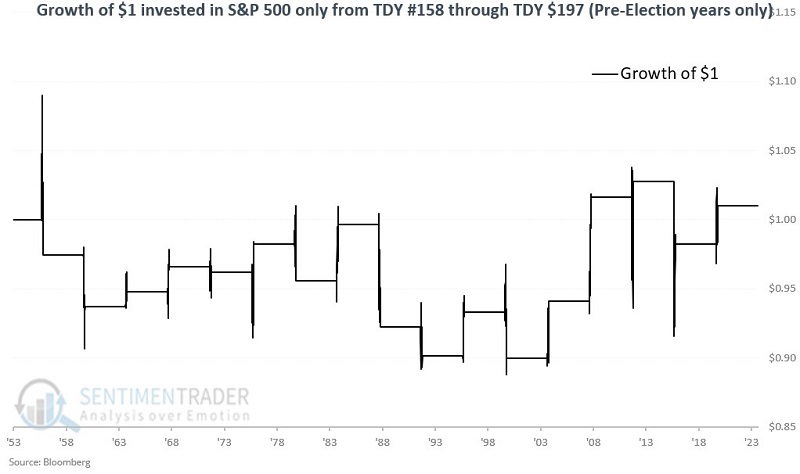
The table below summarizes SPX's performance.
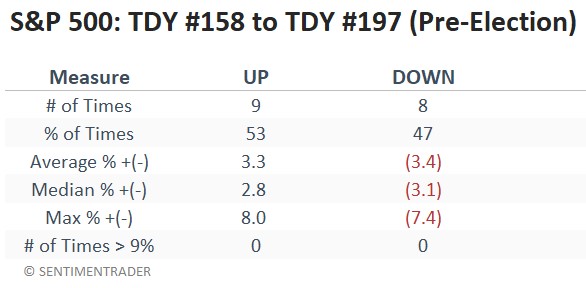
The good news is that pre-election results have tended to be somewhat better than during other years. Nine out of 17 years (53%) have shown a gain, and the net result is a meager cumulative gain of +1% - but a gain nevertheless, rather than a loss. Also, the worst SPX performance within a pre-election year during this unfavorable seasonal period was -7.4%. Not something an investor would hope for, but a far cry better than several other years.
What the research tells us…
The research tells us two things. First, on a year-to-year basis, the weakest seasonal period is essentially a coin flip. However, it also tells us that the overall long-term results skew meaningfully to the downside. "Hope for the best, but prepare for the worst" appears to be an appropriate phrase for the next roughly two months.