
Inflation fires a warning shot across the bow

Key points:
- The latest 12-month percentage change in the Producer Price Index spiked to +9.8%
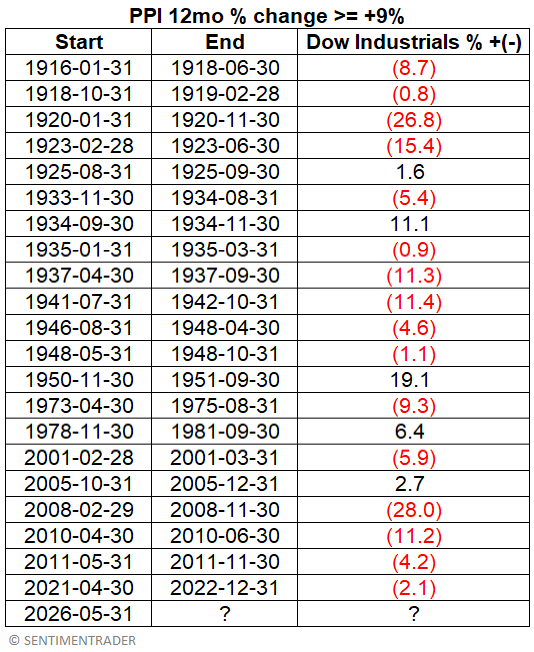
- Historically, readings above +9% has tended to be unfavorable for stocks overall
- In this note, we detail the history of Dow Jones Industrial Average performance over the past 110 years when PPI inflation exceeded 9%
The Producer Price Index 12-month change crosses above 9%
The Producer Price Index (PPI) is a measure from the Bureau of Labor Statistics (BLS) that tracks the average change over time in selling prices received by domestic producers for their output. It acts as a key indicator of wholesale inflation.
Note that the PPI data is typically updated mid-month. However, for testing purposes, all analysis below assumes we update only at the end of each month.
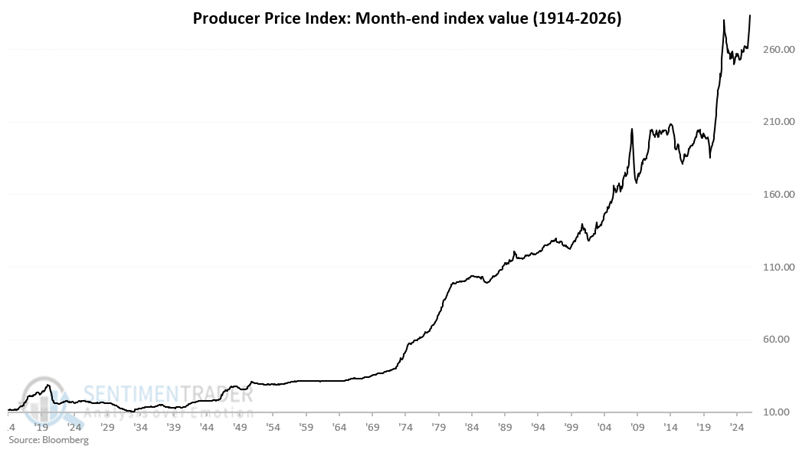
The chart below shows the index's history since 1914. Note that it fluctuates both up and down over time, with an overall long-term bias to the upside.
The real question regarding PPI, however, is not the raw price level but the rate of change. We use the 12-month percentage rate of change as a measure of wholesale inflation. The chart below shows the 12-month % change for PPI since 1914. The horizontal line represents the +9% cutoff. The most recent cross above the +9% level appears at the far right-hand side.
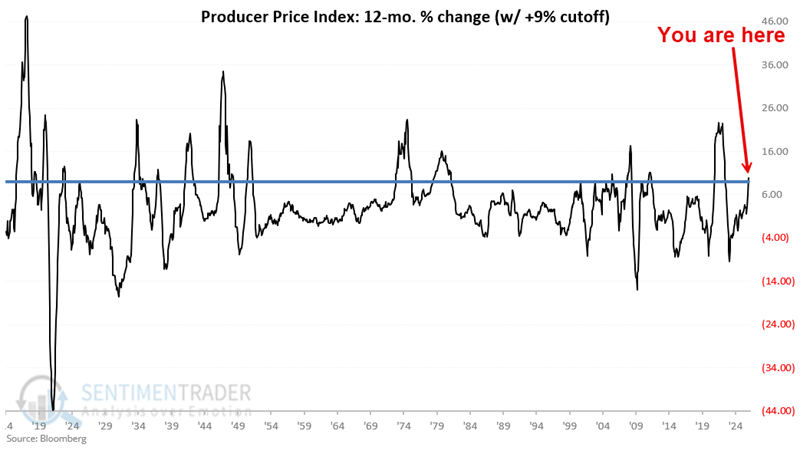
Since 1914, only 16% of all months saw the PPI end a month with a 12-month change of +9% or higher. Now let's look at how the stock market reacted in the past to high levels of PPI inflation.
Dow performance during high PPI readings
The table below displays all periods when the Producer Price Index 12-month % change was +9% or higher, and the performance for the Dow Jones Industrial Average during those periods. Remember that we measure from the end of the month when a cross above 9% was reported until the end of the month when the rate of change drops back below 9%.
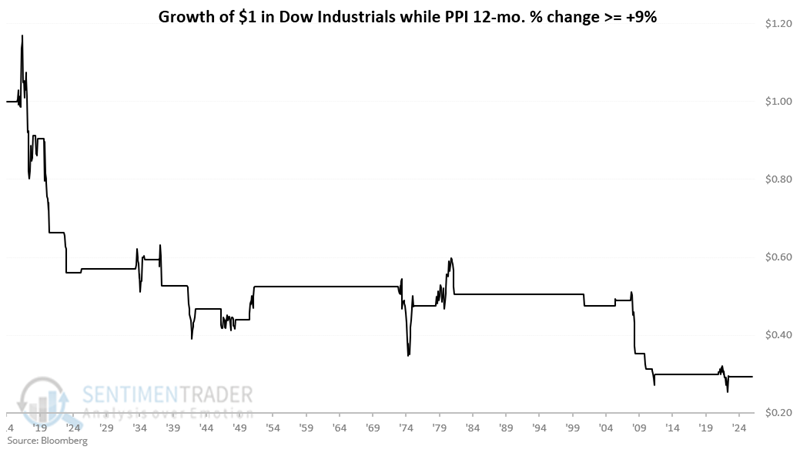
The chart below shows the hypothetical growth of $1 invested in the Dow Jones Industrial Average only during the periods shown in the table above. Ultimately, $1.00 declined to $0.29, a net decline over 112 years of -71%.
The table below summarizes Dow performance during the periods shown in the table and chart above.
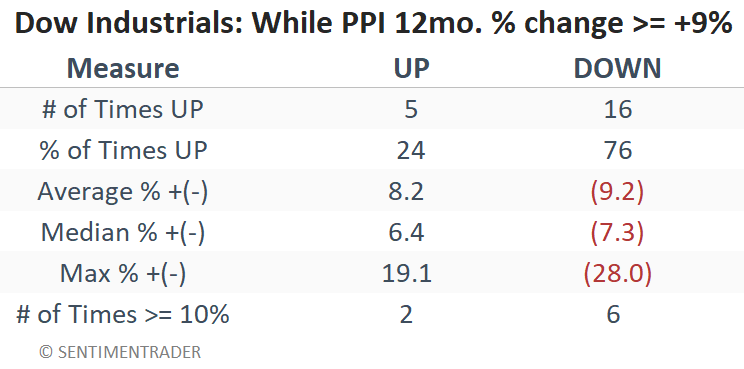
The bottom line: Historically, the stock market has demonstrated a strong tendency for weakness and volatility when the 12-month change in the Producer Price Index has exceeded 9%.
What the research tells us…
The old adage states that "the stock market hates uncertainty." Few things cause more uncertainty than high and/or rising inflation. When inflation is rising, both businesses and households struggle to get a handle on costs and budgets, as uncertainty reigns regarding how much things will cost in the future. The recent spike in PPI inflation above 9% does not by itself constitute a "Sell Everything!" moment. But it does serve as a "shot across the bow" and a serious warning sign of potential trouble for the stock market between now and the time that PPI inflation drops back below 9%.