
Global indexes join the breakout party

Key points:
- A composite that measures 52-week highs for global indexes shows an expansion in breakouts
- Similar participation trends preceded a 92% win rate for a world index over the ensuing three months
- Broadening global participation provides an additional tailwind for the S&P 500's uptrend
There's a noticeable uptick in the number of global indexes breaking out
Over the last few months, our research efforts have highlighted index breakouts and the proliferation of annual highs for stocks in several sectors. Broadening participation signifies a healthy uptrend likely to endure.
Although global indexes have been trending higher, there has been a noticeable absence in 52-week highs until now.
The 10-day moving average of global indexes closing at a 52-week high cycled from 0% to greater than 25%, indicating that more and more international markets are breaking out.
As Bob Farrell was fond of saying, "Markets are strongest when they are broad and weakest when they narrow to a handful of names."
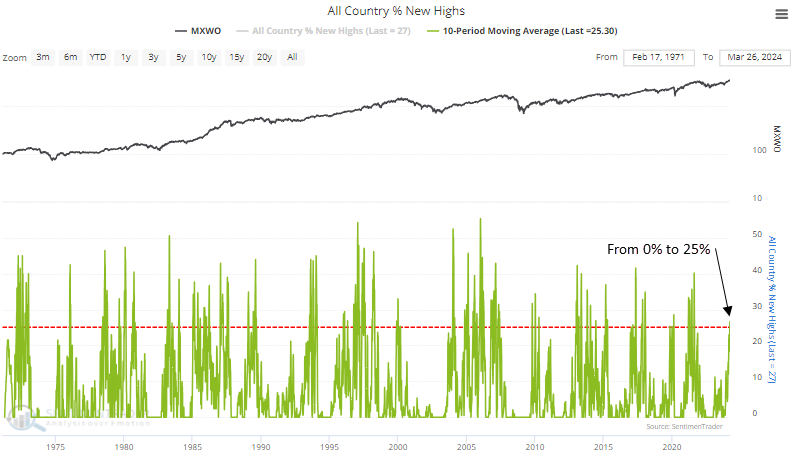
Similar expansions in 52-week highs for global indexes preceded excellent returns
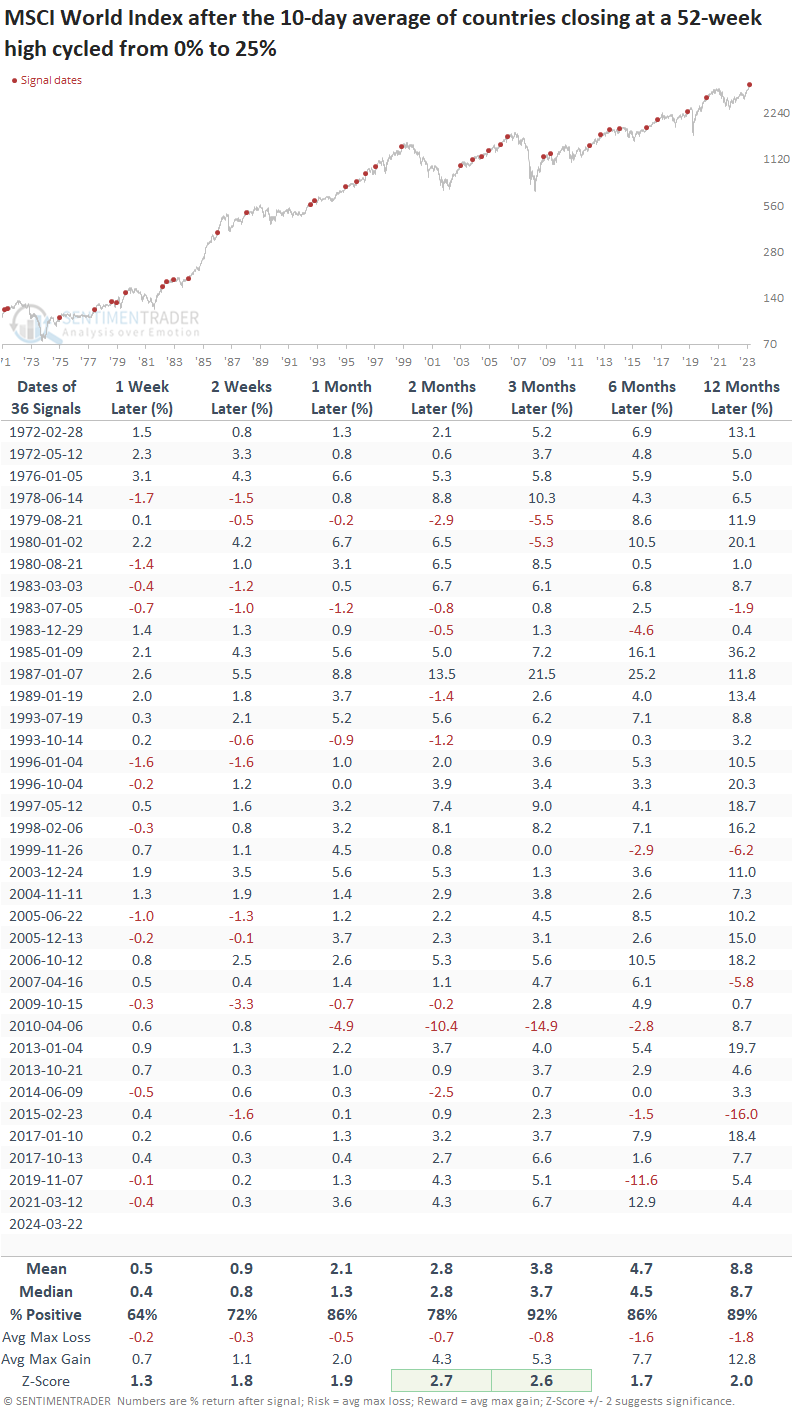
Whenever the 10-day moving average of global indexes closing at a 52-week high cycled from 0% to greater than 25%, the MSCI World Index exhibited outstanding returns and win rates, with several horizons showing significance relative to any random time.
The three-month horizon was particularly robust, showing a 92% win rate and 21 straight gains between 1980 and 2009.
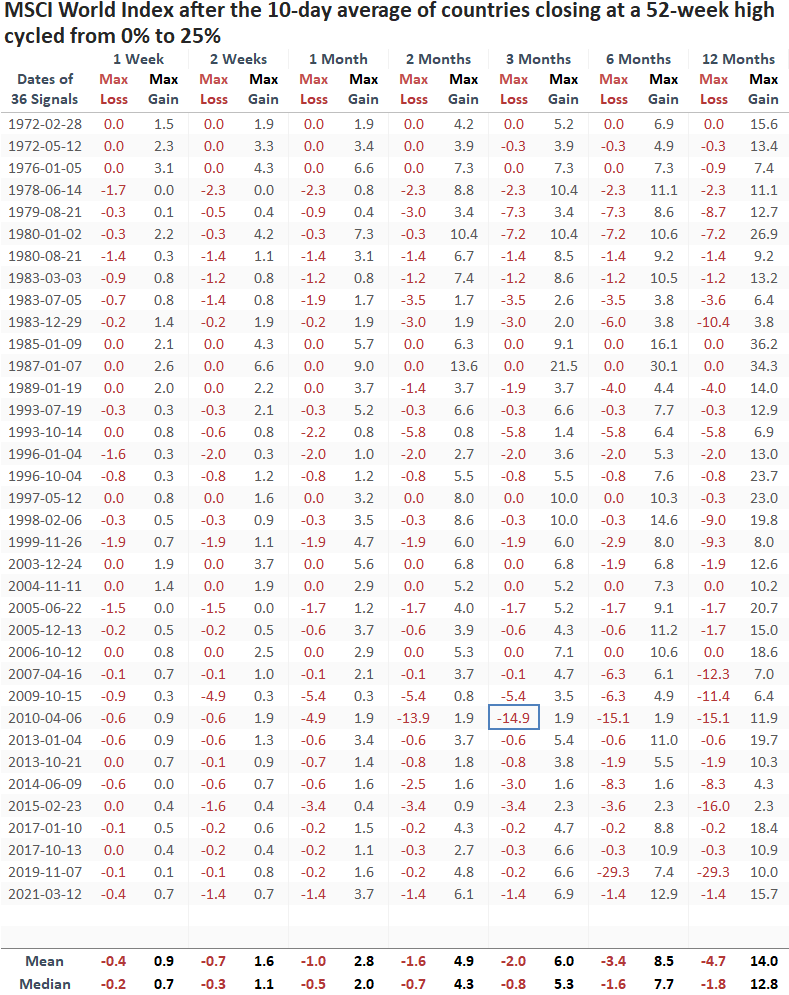
It was exceedingly rare to encounter a maximum loss exceeding -10% in the following three months, with only one instance surpassing this threshold, notably linked to the 2010 Flash Crash.
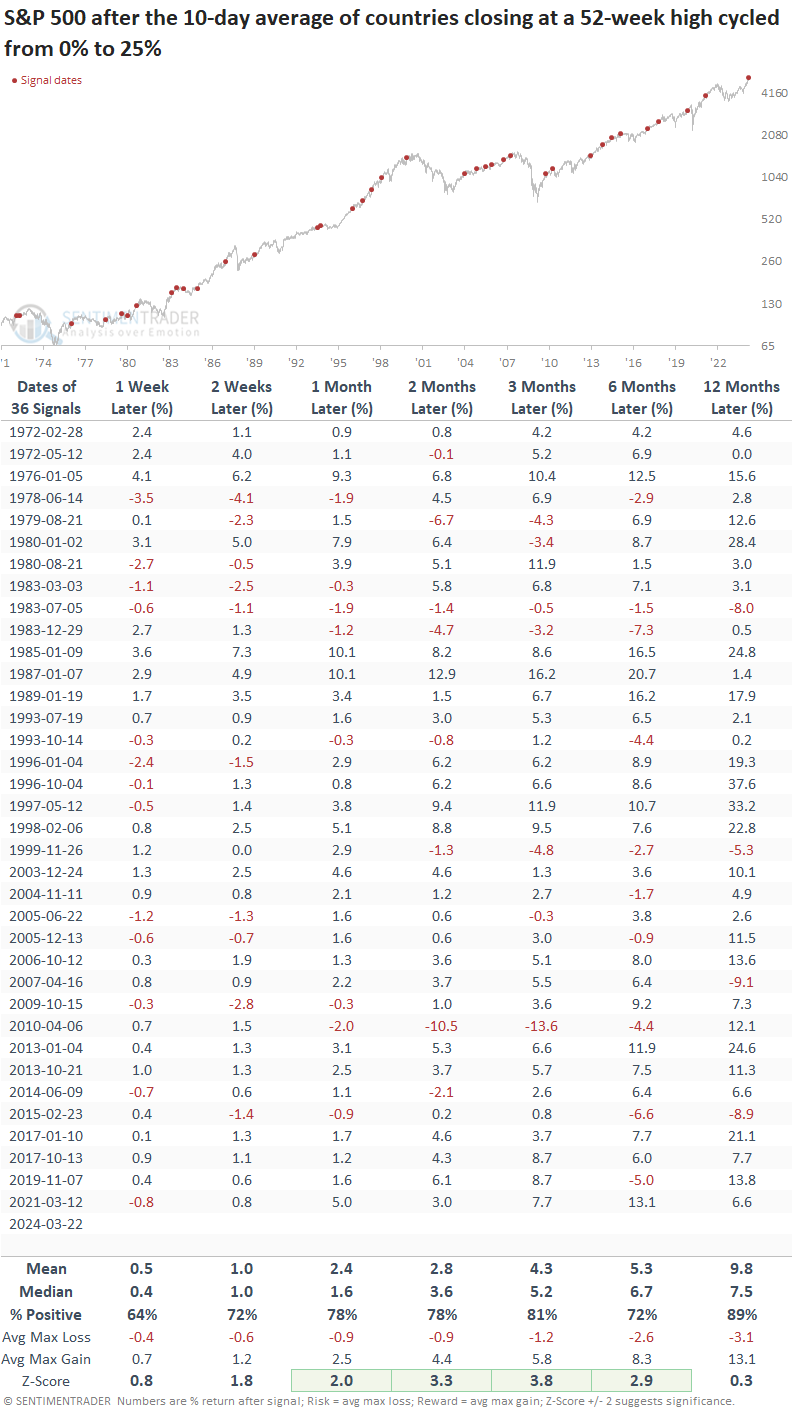
The S&P 500 responded exceptionally well to global breakouts, exhibiting outstanding performance and win rates. In 4 out of 7 horizons, returns showed significance relative to any random time.
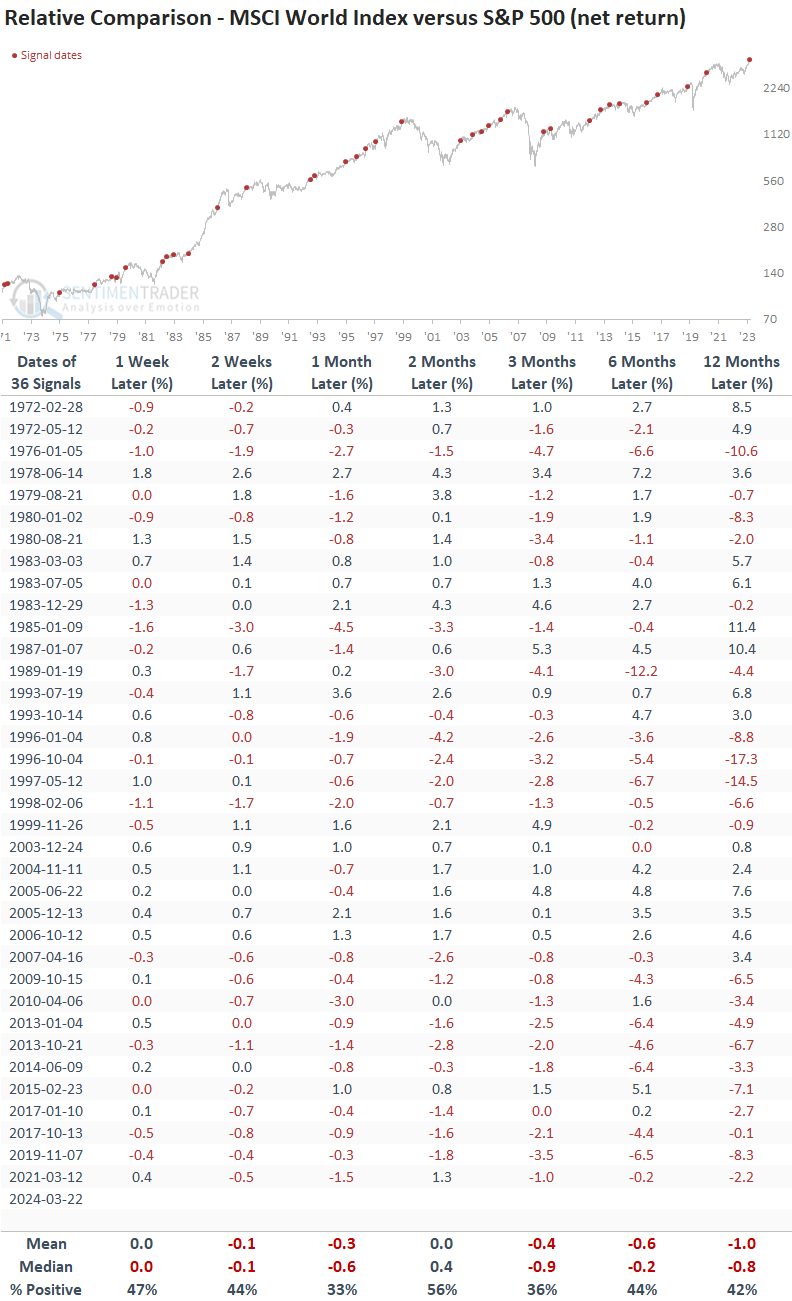
From a relative perspective, the world benchmark consistently underperformed the S&P 500, which is unsurprising given that the world's most benchmarked index has been heavily influenced by growth stocks for most of the last three decades, notwithstanding the 2003-07 value cycle.
Given the underperformance in the world index relative to the S&P 500, I would classify the global index breakout as a confirmation signal rather than a call to action to buy a world index ETF. i.e., add this one to the favorable side of the bullish ledger.
What the research tells us...
The ongoing presence of big-picture indicators confirming the sustainability of the uptrend suggests equity investors should maintain a positive outlook, even amidst customary corrections, which are part and parcel of stock ownership. The latest indicator to paint a favorable picture for stocks, a composite that measures the percentage of 52-week highs for global indexes, triggered a buy signal when its 10-day average cycled from 0% to greater than 25%. After similar alerts, the MSCI World Index and the S&P 500 exhibited excellent returns and win rates.