
Following trends in market relationships

Key Points
- There are no permanent relationships in the financial markets
- No security, sector, index, or commodity ever has a permanent edge on another (although it does seem that way at times)
- Alert investors often gain an advantage by monitoring key relationships and a) recognizing completed turning points and b) the current Trend
- In this piece, we look at the current status of a variety of crucial market relationships to help highlight areas of strength and weakness for further examination
Relative Strength Charts
All charts below are weekly relative strength charts courtesy of StockCharts.com. In other words, these charts do not show the actual price action of a single security. Instead, they compare the relative price performance of two different securities.
- The main solid line displays the weekly Trend of the relative performance.
- If the main solid line is black, it rose in the latest week, and if red, it means it fell in the latest week.
- A rising line means that the first security listed in the comparison is outperforming and vice versa.
- Each chart also displays a 52-week simple moving average. Suppose the black/red relative strength line is above the blue moving average line. I refer to that as an "uptrend" and another confirmation that the first security listed is outperforming - and vice versa.
- Likewise, if the 52-week moving average is rising, that is another indication that the first security listed is outperforming.
- Please note that I do not use these charts' actions to generate automatic buy or sell signals. I use them strictly as a "starting point" in finding securities exhibiting significant strength (or weakness).
- A red/black line making a new high above a rising 52-week moving average suggests further investigation for a buying opportunity in the first security listed.
- A red/black line making a new low below a falling 52-week moving average suggests further investigation for a buying opportunity in the second security listed.
- The primary goal is to find opportunities to trade with the trend in a more robust security.
Stocks vs. Bonds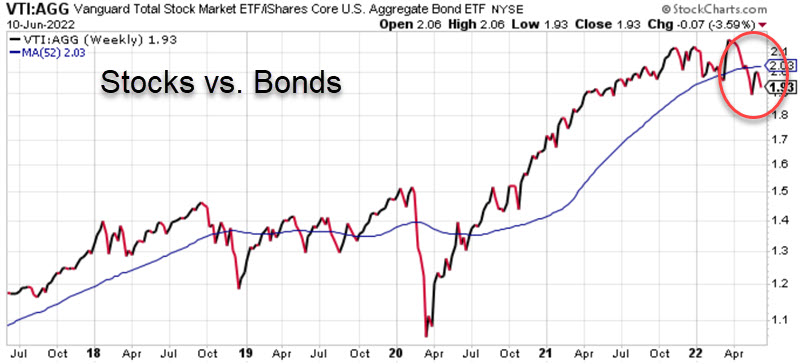 Comparing: VTI vs. AGG (Total U.S. Stock Market vs. Total U.S. Bond Market)
Recent Action: Although bonds have had their worse start to a year, stocks have been worse...
Current Trend: ...thus pushing the RS line below the 52-week MA (stocks underperforming bonds)
Stocks vs. Commodities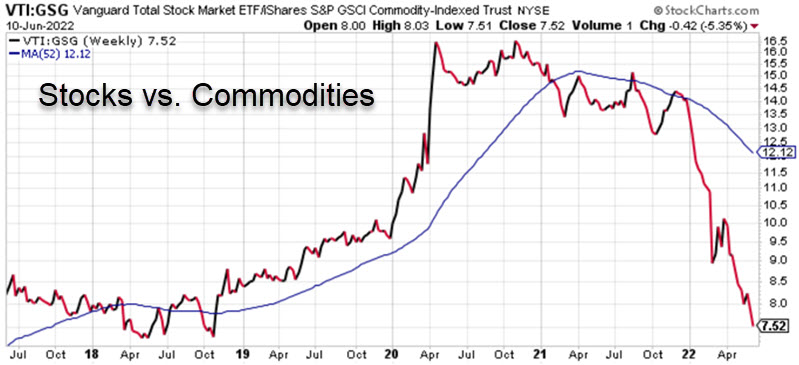 Comparing: VTI vs. GSG (Total U.S. Stock Market vs. Goldman Sachs Commodity Index)
Recent Action: Commodities have been significantly stronger than stocks since October 2021, with this relationship now back to 2018 levels.
Current Trend: RS line trending sharply lower below 52-week MA (commodities outperforming stocks). One word of caution - market relationships rarely move in a straight line indefinitely. Commodities may cool in the second half of 2022.
U.S. Stocks vs. International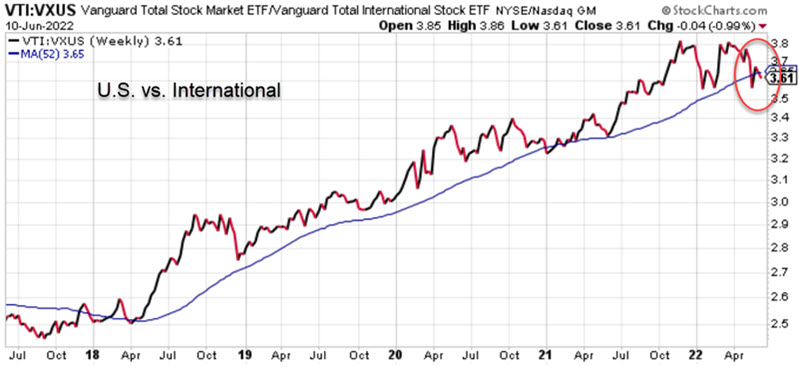 Comparing: VTI vs. VXUS (Total U.S. Stock Market vs. Total International Stock Market)
Recent Action: The RS line has recently weakened and dropped slightly below the 52-week MA
Current Trend: US stocks have outperformed international stocks for over ten years. That won't last forever. It is too soon to say that that Trend has reversed. But investors should keep a close high on the RS line for signs of an actual reversal (see the VTI vs. GSG chart above)
U.S. Stocks vs. Emerging Markets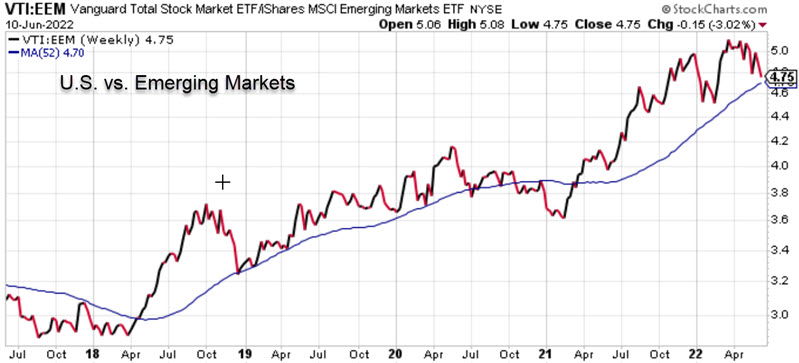 Comparing: VTI vs. EEM (Total U.S. Stock Market vs. Emerging Markets)
Recent Action: The RS line has weakened somewhat but remains above a rising 52-week MA
Current Trend: RS line above a rising 52-week MA means no reversal yet favoring emerging markets
Developed Markets vs. Emerging Markets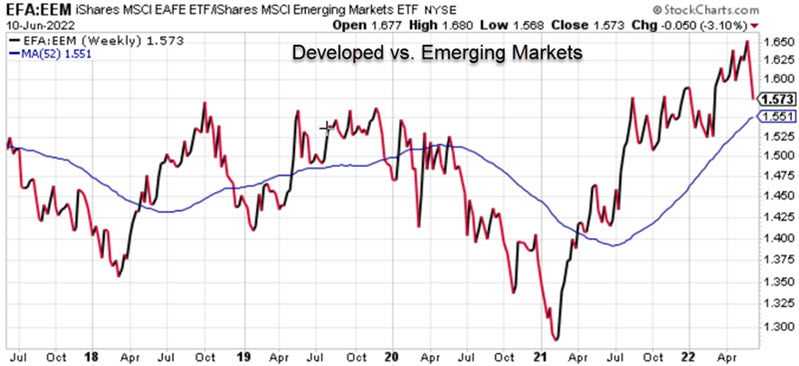 Comparing: EFA vs. EEM (Developed Market vs. Emerging Markets)
Recent Action: RS line declined sharply recently (i.e., developed underperforming emerging); however, RS line remains above a rising 52-week MA line
Current Trend: RS line above a rising 52-week MA means the Trend still favors developed markets over emerging markets
Large-cap vs. Small-cap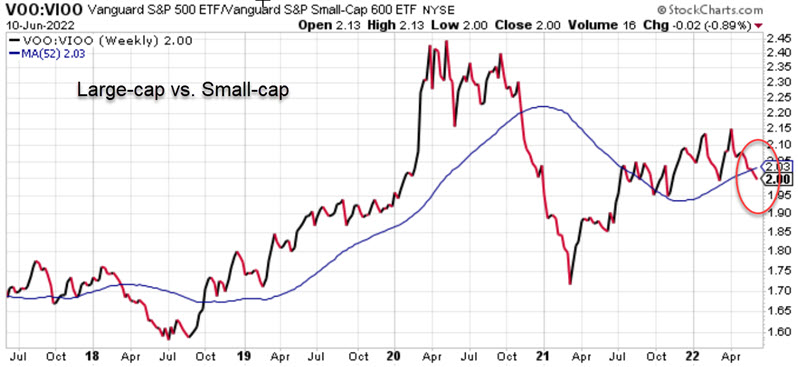 Comparing: VOO vs. VIOO (US Large-cap sector vs. US Small-cap sector)
Recent Action: Few investors know that Large-cap outperformance topped out in early 2020, then rebounded in early 2022. However, in the latest fortnight, the Trend appears to be reversing once again
Current Trend: RS line just dropped below 52-week MA (If RS line remains below 52-week MA, it will signal a shift favoring Small-caps)
Large-cap vs. Mid-cap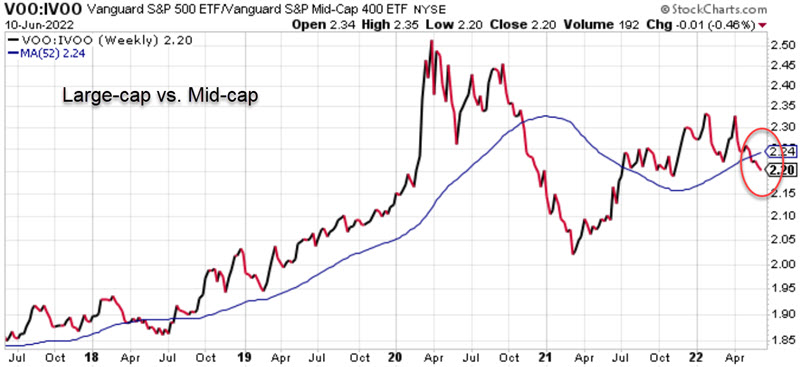 Comparing: VOO vs. IVOO (US Large-cap sector vs. U.S. Mid-cap sector)
Recent Action: Very similar to Large-cap vs. Small-cap, with RS line topping in 2020, reversing higher in 2021, and now moving back below 52-week MA
Current Trend: RS line just dropped below 52-week MA (If RS line remains below 52-week MA, it will signal a shift favoring Mid-caps over Large-caps)
Growth vs. Value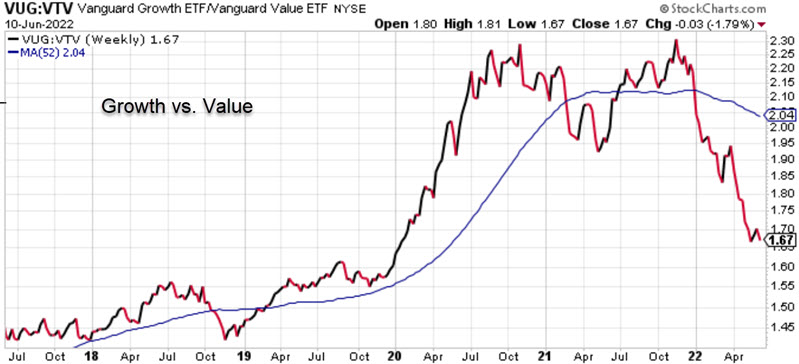 Comparing: VOO vs. IVOO (US Growth stock sector vs. US Value stock sector)
Recent Action: A classic case of the ying-versus-yang of stock market relationships. After many years of Growth outperformance, the RS line staged a double top and sharp reversal lower since November 2021
Current Trend: Value is clearly in favor over Growth at the moment. The RS line may be a bit overextended, but as long as it remains below 52-week MA, the Trend favors Value over Growth
Momentum vs. Low Volatility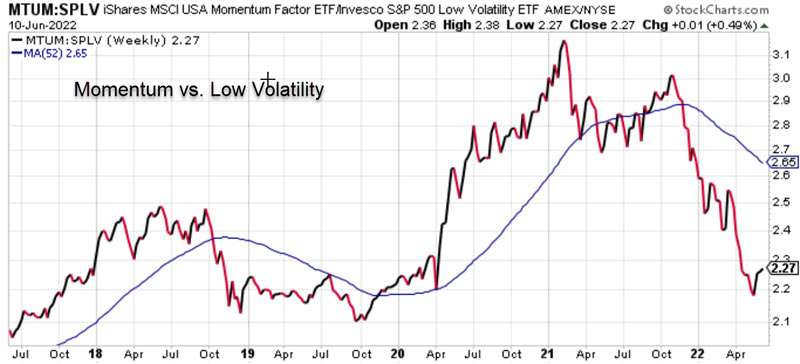 Comparing: MTUM vs. SPLV (US Momentum stocks vs. US Low Volatility stocks)
Recent Action: Low volatility has held up significantly better than the weak Momentum sector so far in 2022
Current Trend: RS line below a declining 52-week MA (Low volatility stocks outperforming Momentum stocks)
Technology vs. All Stocks
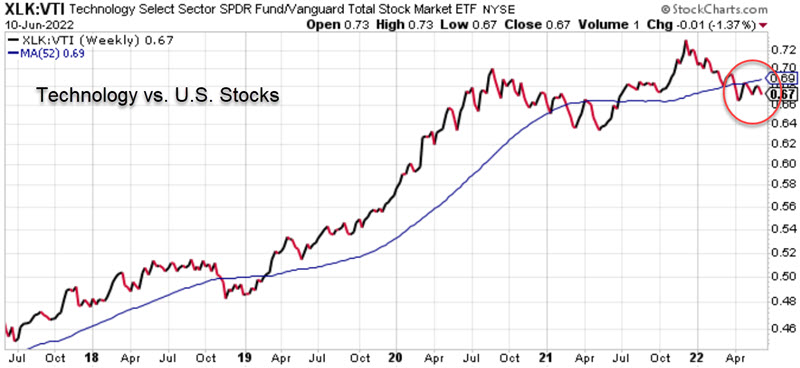
Comparing: XLK vs. VTI (Technology stock sector vs. Total U.S. Stock Market)
Recent Action: RS line has broken back below 52-week MA
Current Trend: Despite the "conventional wisdom" that technology was wildly overvalued and is in a 2000-2002 type decline, its relative performance is not nearly as bad as most would think. Nevertheless, with the RS line below 52-week MA, this sector is by no means showing a positive trend
Energy vs. All Stocks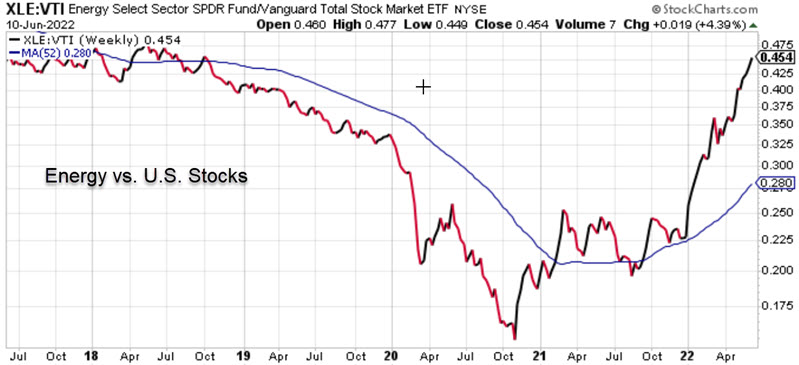 Comparing: XLE vs. VTI (Energy stock sector vs. Total U.S. Stock Market)
Recent Action: Energy has been a market leader since November 2020
Current Trend: RS line far above a rising 52-week MA. A powerful uptrend, but the gap between the RS line and 52-Week MA could suggest a cooling-off period as 2022 progresses
TIPs vs. Aggregate Bond Index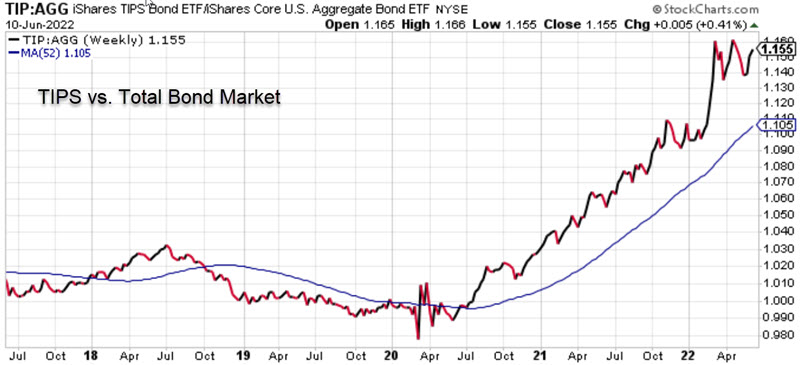 Comparing: TIP vs. AGG (Treasury inflation-protected bonds vs. Total U.S. Bond Market)
Recent Action: TIP has weakened as interest rates have risen. However, it has still outperformed most other types of bonds
Current Trend: RS line is above a rising 52-week MA, so TIP remains a leader in the bond market. As long as high inflation persists, TIP can continue to outperform straight bonds
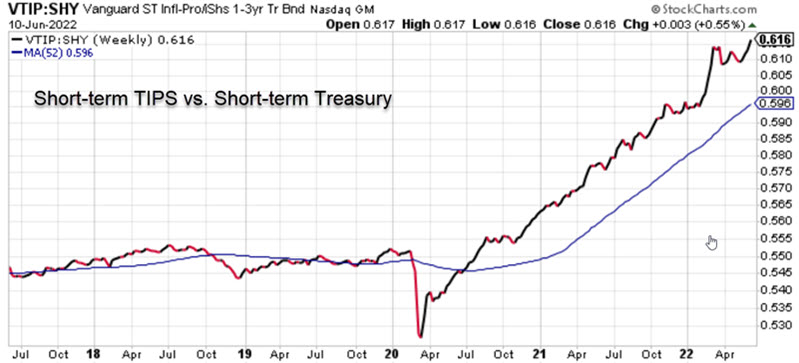
NOTE: Within the TIPs bonds category, short-term TIPs have held up best as interest rates have trended higher. The chart below displays VTIP (Short-Term Treasury inflation-protected bonds) versus SHY (1-3 year treasuries). This displays the outperformance of short-term TIPs versus straight short-term treasury bonds).
Short-term treasury vs. Long-term treasury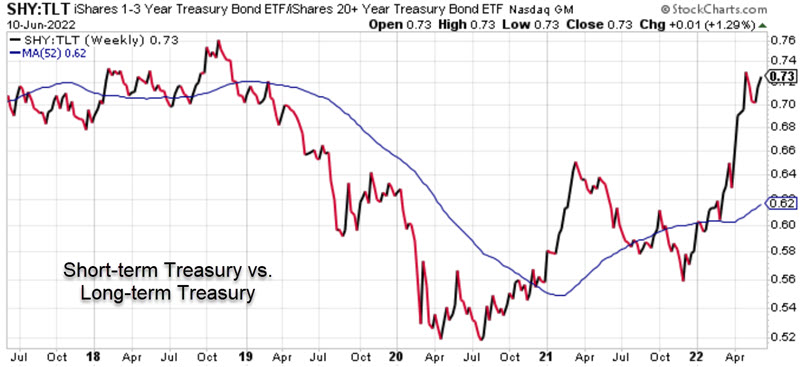 Comparing: SHY vs. TLT (1-3 year treasury securities versus 20+ year treasury bonds)
Recent Action: As expected in a rising interest rate environment, long-term bonds get hit the hardest (as they are most sensitive to changes in interest rate). SHY has performed poorly but has held up far better than TLT; thus, the RS line has trended higher since late 2021
Current Trend: RS line far a rising 52-week MA. The Trend favors SHY, but things may have gotten a bit overdone in the near term. A "bounce" in long-term bonds remains possible in the months directly ahead.
REITs vs. All Stocks
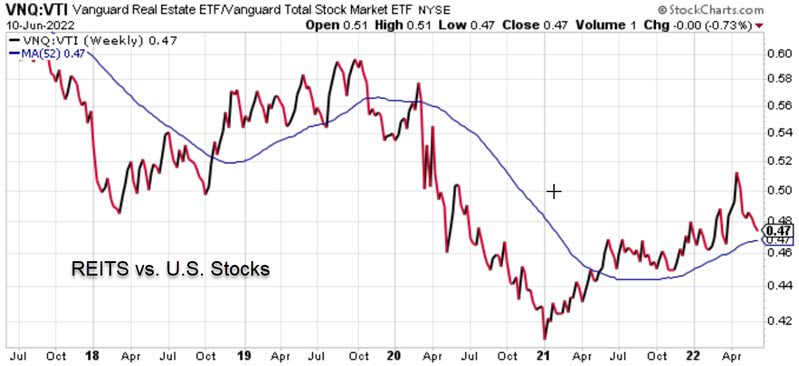
Comparing: VNQ vs. VTI (Real Estate Investment Trusts vs. US Total Stock Market)
Recent Action: A slowing economy and rising mortgage rates may weigh on the real estate market. Still, for now, this relationship continues to favor REITs, although the RS line dropped sharply in recent weeks.
Current Trend: RS line for now still above 52-week MA (REITs outperforming overall stock market in a somewhat grinding fashion)
Traditional Energy vs. New Energy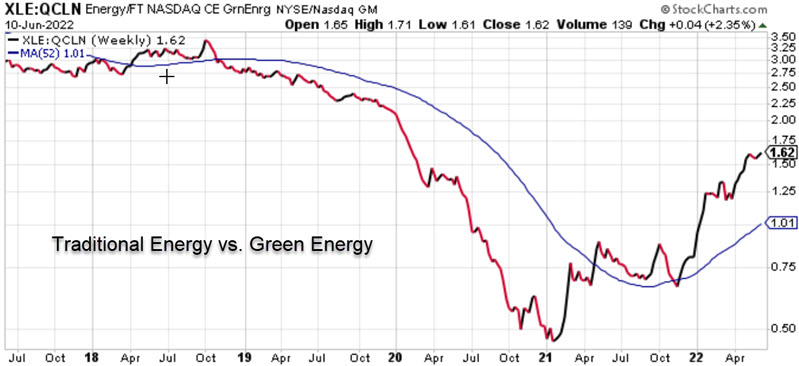 Comparing: XLE vs. QCLN (Traditional oil/gas-based energy sector vs. Clean energy sector)
Recent Action: One Trend that has confounded many in the last year and a half is the significant outperformance of traditional (oil & gas) energy versus "green energy." The RS line and 52-week MA's continue to work higher
Current Trend: RS line far above a rising 52-week MA (traditional energy sector outperforming clean energy sector)
Base Metals vs. Precious Metals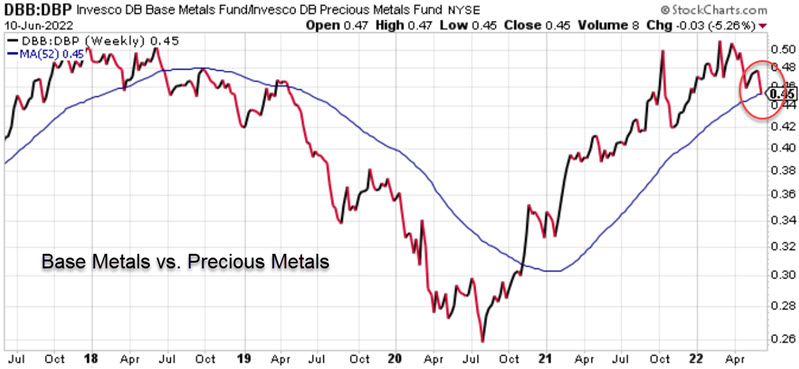 Comparing: DBB vs. DBP (Base Metals vs. Precious Metals)
Recent Action: Another trend that has confounded many is the underperformance of precious metals in the face of soaring inflation. This may be in the early stages of changing as the RS line has lost upside momentum and is threatening the 52-week MA
Current Trend: A drop by the RS line below the 52-week average may signal some significant changes: 1) Precious metals finally rising to the fore, 2) a weakening economy as demand for base metals wanes. However, the jury remains out on these possibilities
What the research tells us...
The process of trading can essentially be boiled down to two steps:
- Spotting opportunity
- Exploiting opportunity
The information above is intended to help traders focus on the most robust trends as part of Step #1 above. Focusing on owning the best-performing securities - and avoiding (or selling short) weaker-performing securities - is typically one of the keys to achieving long-term success.