
Financial corporate insiders pick a side in the financial crisis

Key points
- Talk of a "banking/financial crisis" has dominated the business news in recent weeks
- Fear of bank run "contagion" is a hot topic among pundits
- Meanwhile, financial corporate insiders have been voting with their wallets
Financial corporate insiders go on a buying spree
I don't use corporate insider transactions as specific buy or sell signals. I typically view them as a "perspective" tool. If insiders act bullish, this almost invariably argues for higher prices over the next three to three years. But the recent action of financial company corporate insiders is quite compelling.
Silicon Valley Bank failed a week ago and was seized by the government. A tidal wave of pundits announcing the onset of the next great "financial crisis" bellow daily from the airwaves. And in the end, they could be right. But the people who know the finance industry best acted in an entirely different way.
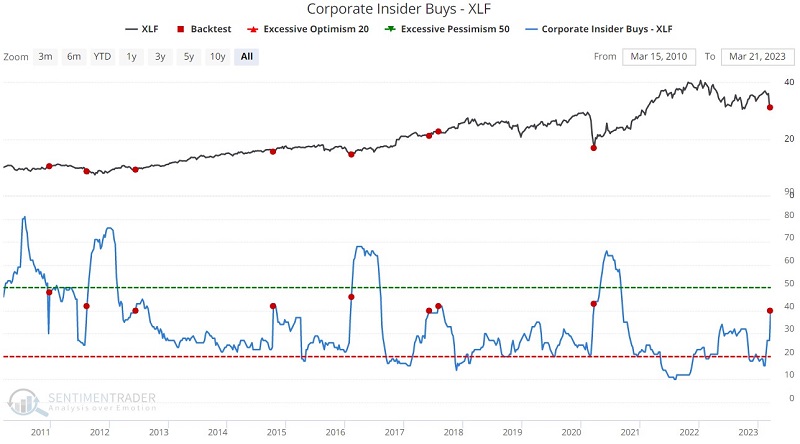
The chart below displays Corporate Insider Buys among component companies of the Financial Select Sector SPDR Fund ETF (XLF) and denotes those times when the indicator crossed above 39.9. Note the sharp uptick in buying over the past two weeks. The question that comes to mind is, "if these executives perceived that the banking system was about to collapse - why would they start buying their stocks aggressively?"
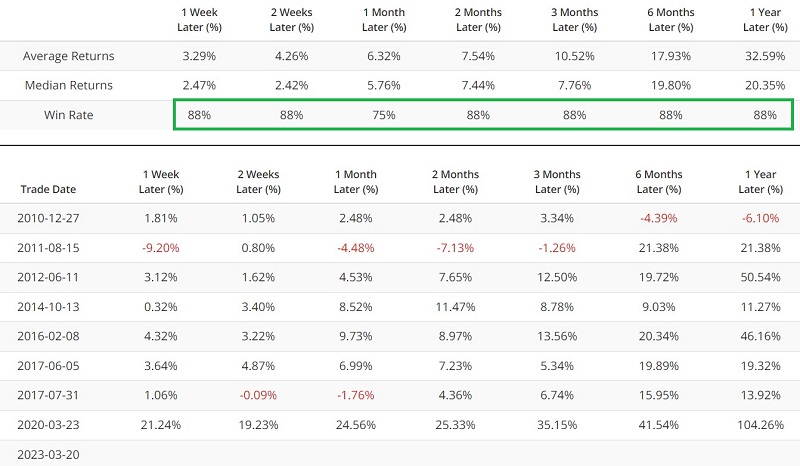
The table below displays XLF performance following the red dots in the chart above. The critical thing to note is the consistently high Win Rates across all time frames.
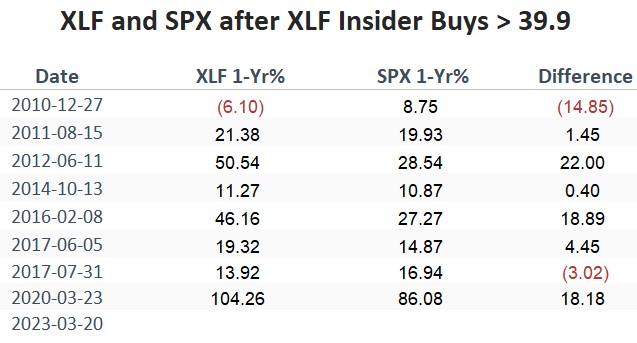
For comparison's sake, the table below displays the 1-year % return for XLF and the S&P 500 Index following a cross above 39.9 by the indicator.
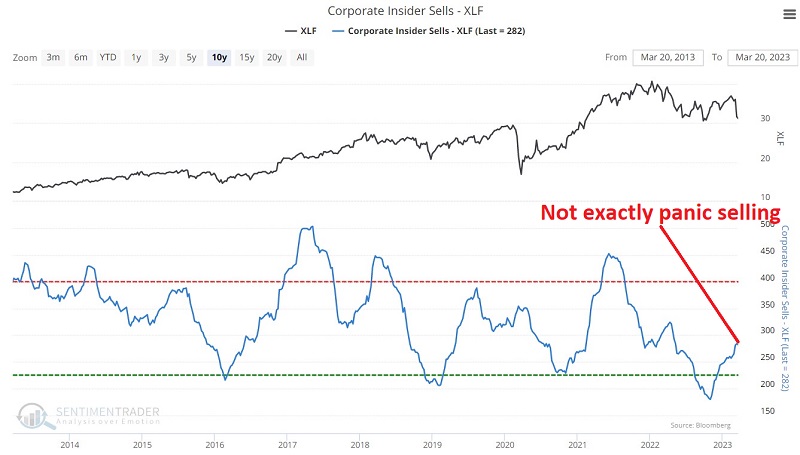
On the contrary, insiders would presumably be more inclined to sell shares if they anticipated a collapse in their sector. The chart below displays Corporate Insider Sells for XLF. Selling has picked up since the extremely low level of late 2022. However, so far, it does not reflect a stampede to the exits.
What does it all mean? The indicator below combines the two above into the Corporate Insider Buy/Sell Ratio - XLF indicator. The red dots note those times when the ratio has crossed above 0.139.
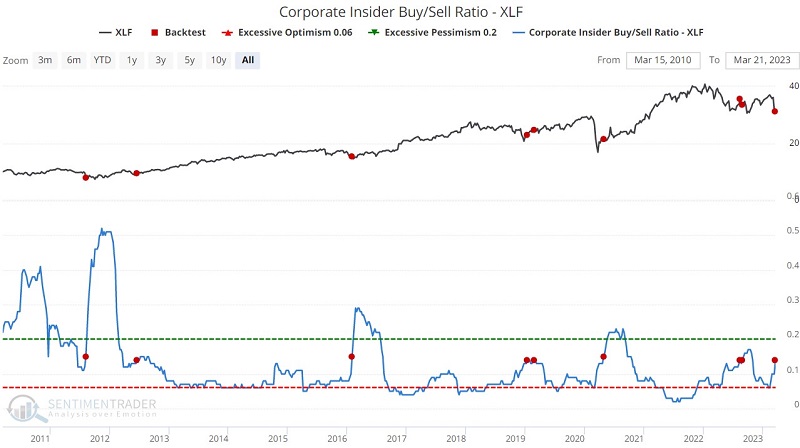
The table below displays XLF performance following the red dots in the chart above.
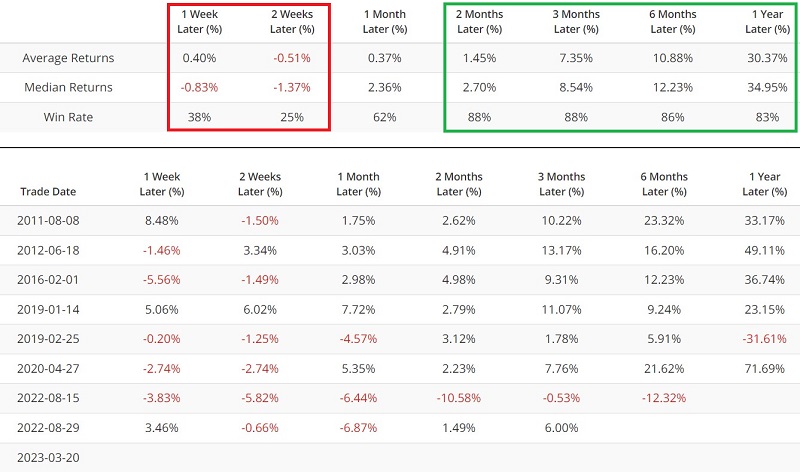
The good news is the high Win Rates for the two to 12 months timeframes and the exceptionally high Median return for 12 months (+34.95%). The bad news is the tendency for weakness during the first two weeks after a signal and the -31.91% decline after the 2019-02-25 signal. For the record, XLF was up almost 20% before the Covid collapse began during the second half of February 2020.
For comparison's sake, the table below displays the 1-year % return for XLF and the S&P 500 Index following a cross above 0.139 by the indicator.
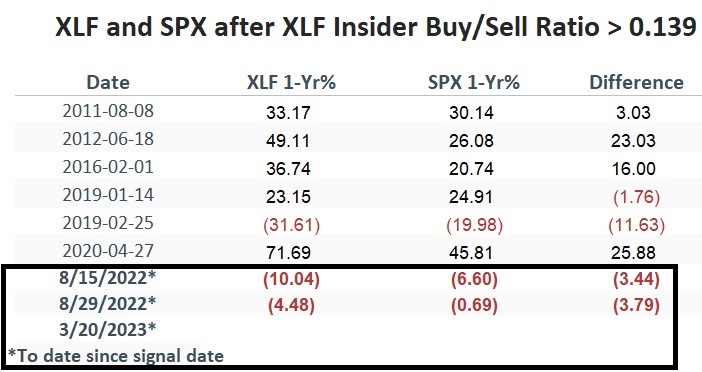
What the research tells us…
Anytime a significant bank runs into trouble, there is the risk of contagion and that more banks - and potentially the entire banking/finance system - will suffer. So, there is a potential risk in the market now. However, the actions of financial corporate insiders in light of recent events appear to fly in the face of the daily panic and gloom from market pundits. Instead of dumping massive amounts of stock holdings to insulate themselves from the "coming collapse," they instead went on something of a buying spree. The most reasonable interpretation is that the people who know financial company prospects the best are confident that the worst case will not unfold.