
Financial conditions ease further, bolstering the case for stocks

Key points:
- The Goldman Sachs Financial Conditions Index closed at a 6-month low but not a 1-year low
- After similar breakdowns in financial conditions, the S&P 500 was higher a year later 95% of the time
- Cyclical sectors, the Russell 2000 and Nasdaq Composite tend to outperform the S&P 500 over the next year
Financial conditions continue to ease, which is bullish for stocks
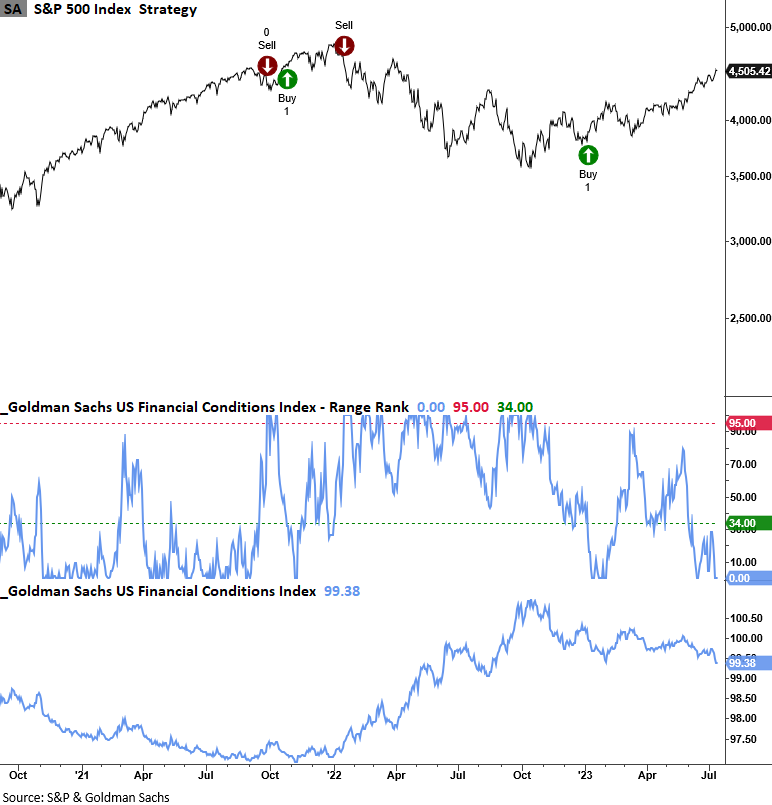
In a research note in January, I shared a system that buys or sells the S&P 500 based on the prevailing trend of the Goldman Sachs Financial Conditions Index. The system went long the S&P 500 as financial conditions reversed from a period of tightening to easing.
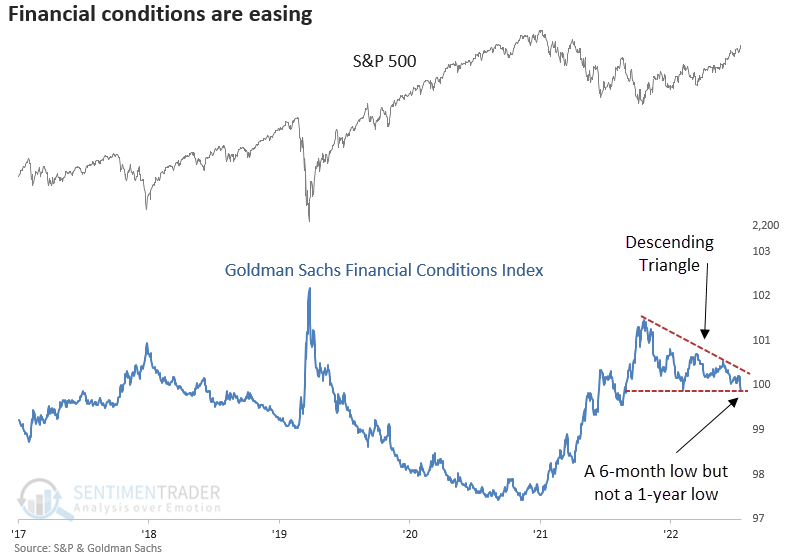
Since the trend change, the financial conditions index has consolidated in a bearish descending triangle pattern until now.
Last week the financial conditions index broke below a significant support level and registered a new 6-month low but not a 1-year low.
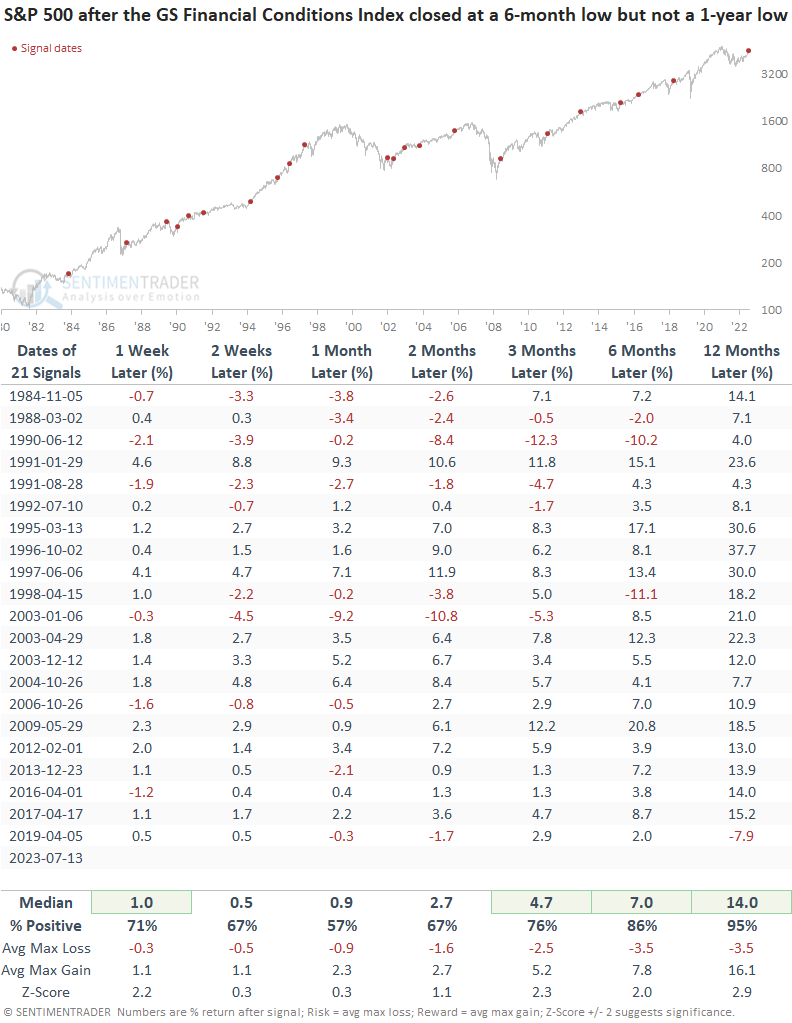
Similar breakdowns in financial conditions preceded excellent returns
When the Goldman Sachs Financial Conditions Index closed at a 6-month low but not a 1-year low, the S&P 500 was higher a year later in all but one precedent. The one outlier was derailed by a government-imposed economic shutdown, causing stocks to plummet.
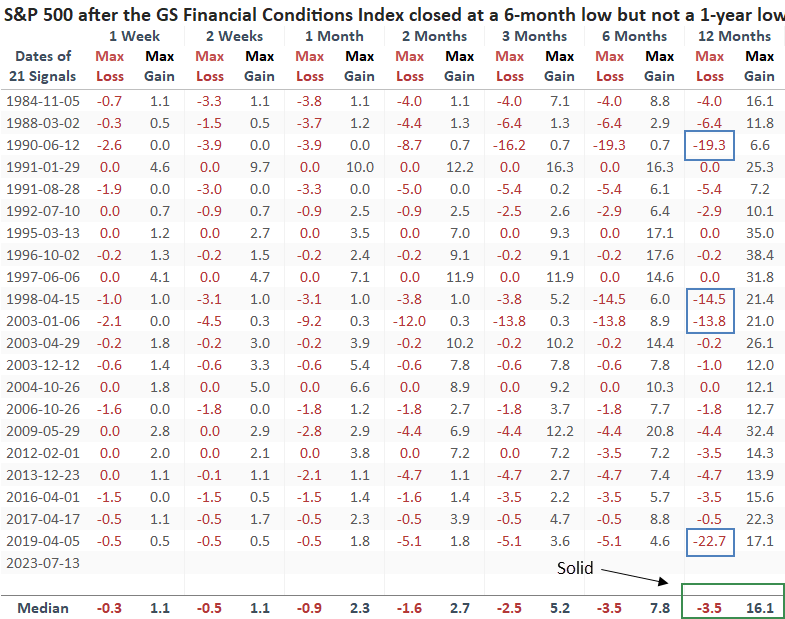
Over the next year, the max gain exceeded the max loss in 19 of 21 precedents. And only four instances showed a max loss of greater than -10% over that same time frame.
When financial conditions ease, Technology, Financials, and Consumer Discretionary tend to outperform the most over the next year.
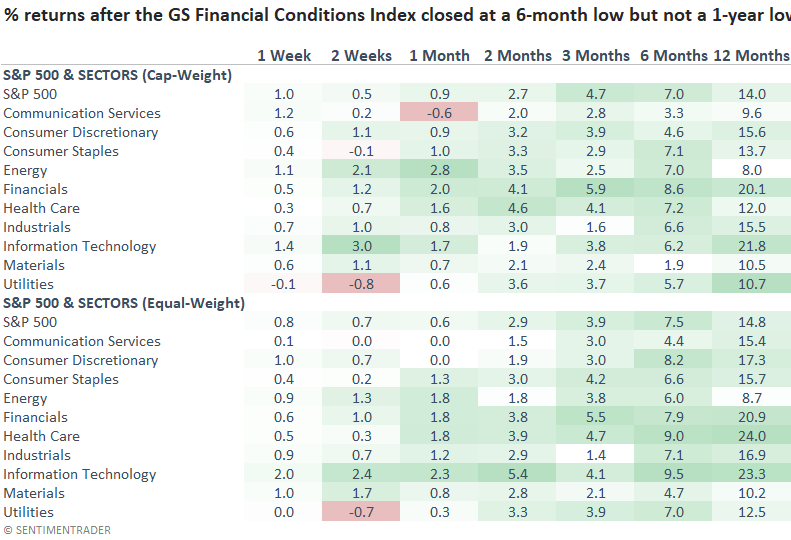
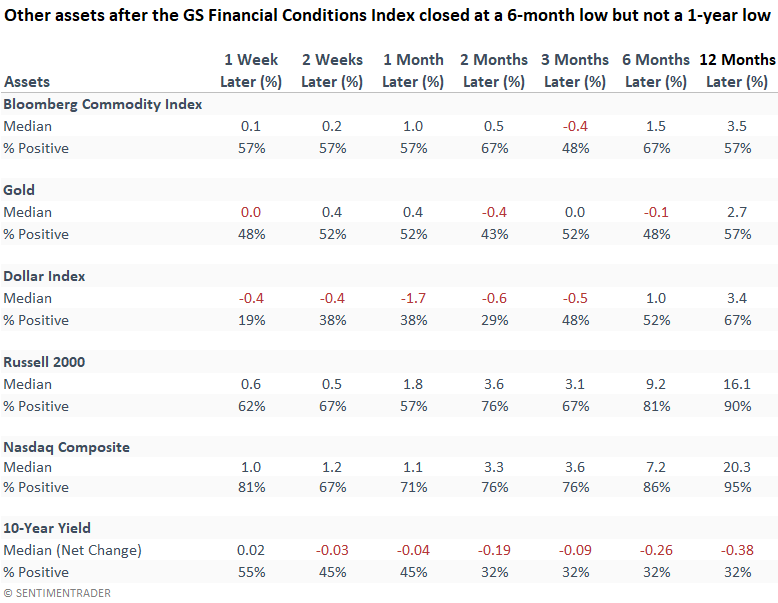
Indexes with a higher risk profile, like the Russell 2000 and the Nasdaq Composite, exhibit solid performance trends similar to the S&P 500. The current downtrend in the dollar index will likely persist, which could ease financial conditions further. Surprisingly, the devaluation of the dollar had a negligible impact on commodities, and it certainly didn't boost the value of gold.
A market timing system based on financial conditions
My financial conditions system performed remarkably well in 2022, successfully avoiding the majority of the drawdown. With the Goldman Sachs Financial Conditions Index near the lower boundary of its range, the likelihood of a sell signal from tightening financial conditions seems low, which is interesting considering all the doomsday talk on social media.
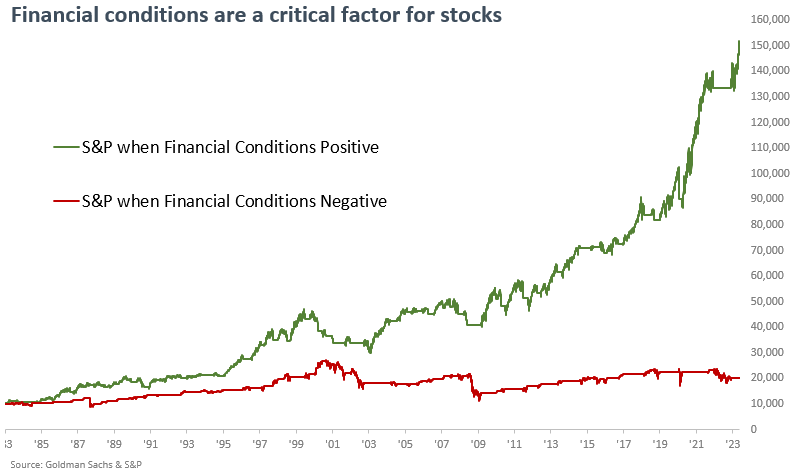
Under positive conditions, the system turns an initial capital outlay of $10,000 into a staggering $149,000. Conversely, during unfavorable financial conditions, that same $10,000 investment merely grows to a modest $20,000.
What the research tells us...
After rising for almost a year, The Goldman Sachs Financials Conditions Index completed a significant top formation when it broke down from a descending triangle and closed at a new 6-month low but not a 1-year low. Similar breakdowns led to a 95% win rate for the S&P 500 over the next year. When financial conditions ease, like now, investors are rewarded by owning riskier indexes like the Russell 2000, Nasdaq Composite, and cyclical sectors.