
Financial conditions ease, creating a bullish backdrop for stocks

Key points:
- The Goldman Sachs Financial Conditions Index reversed relative to its recent range
- Returns for the S&P 500 are more favorable when financial conditions ease rather than tighten
- The Technology sector tends to outperform after similar shifts in financial conditions
Financial conditions suggest a more supportive environment for stocks
In my previous financial conditions system update, I hinted that the model's shift to tighter conditions could produce a whipsaw alert, given the market's oversold status and the approaching bullish seasonality.
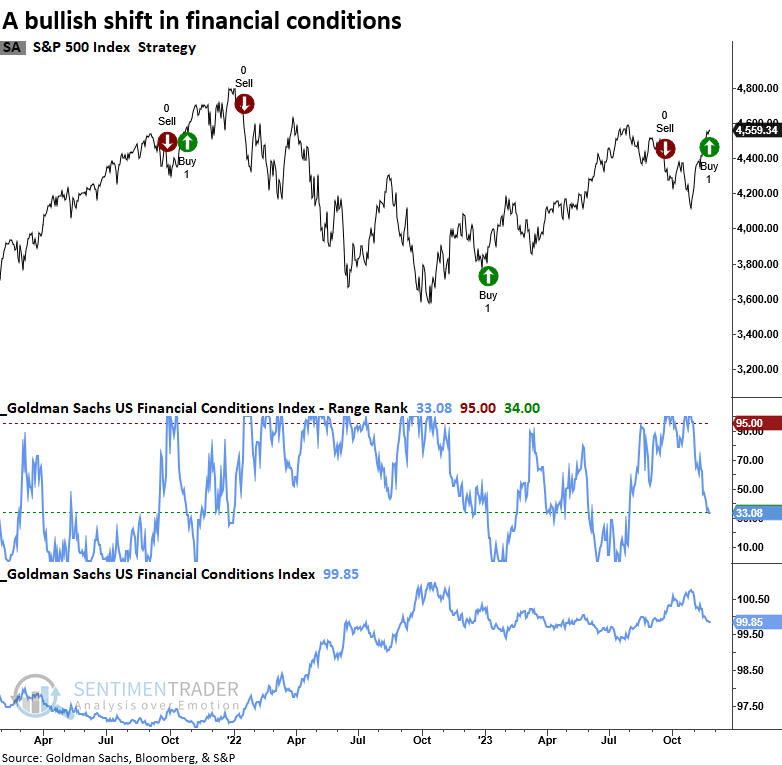
Despite the S&P 500's 4.91% decline from the sell signal date to the October 27th index low, the model could not adjust promptly to easier financial conditions. As stocks surged higher, the system triggered a new buy alert above the prior sell signal price, producing the dreaded whipsaw.
As the headwind from interest rates, the dollar, and credit spreads ease, the weight of the evidence favoring a bullish market outlook strengthens.
How the system works
The model applies an 84-day range rank to the Goldman Sachs Financial Conditions Index. When the range rank declines below the 34th percentile and price momentum for the S&P 500 is positive, the system goes long. Conversely, the model issues a sell signal when the range rank increases above the 95th percentile and the S&P 500 exhibits negative price momentum.
Similar reversals in financial conditions preceded positive returns
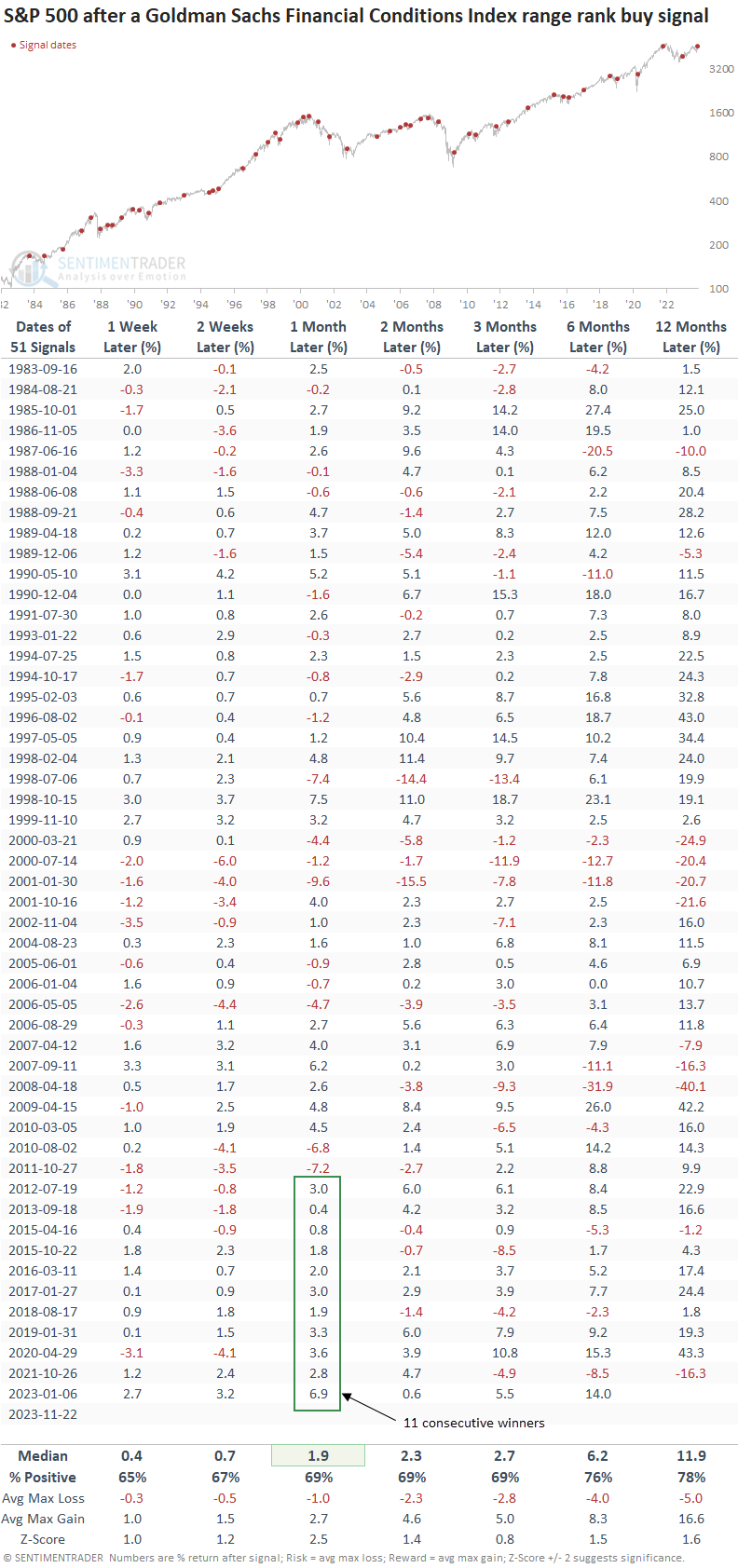
Whenever the Goldman Sachs Financial Conditions Index transitions from an unfavorable backdrop in conditions to a more advantageous one, the S&P 500 displayed solid returns, win rates, and z-scores.
Over the next month, the S&P 500 experienced gains 69% of the time, with a median increase of 1.9%.
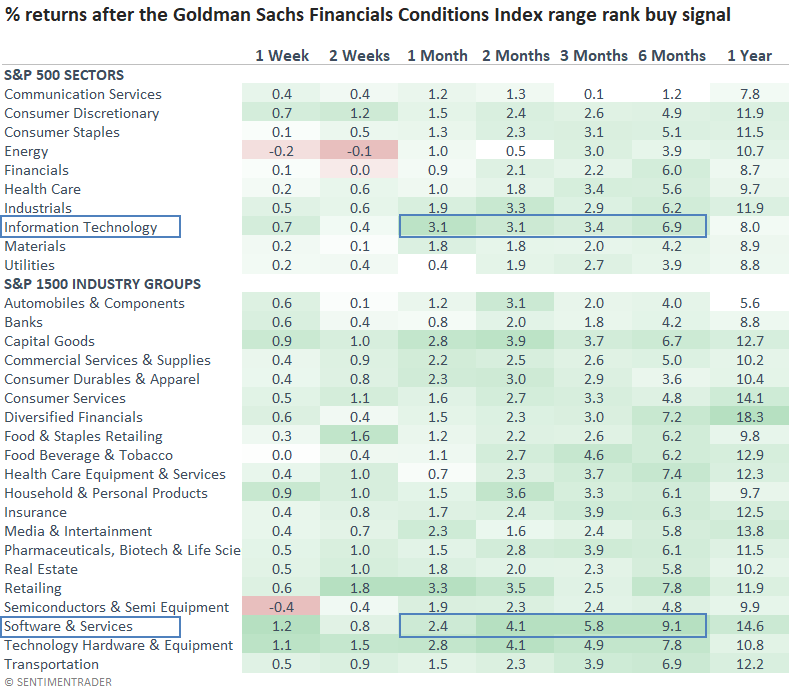
The ongoing dominance of the Technology sector could persist in an environment where financial conditions are less of a burden on stocks.
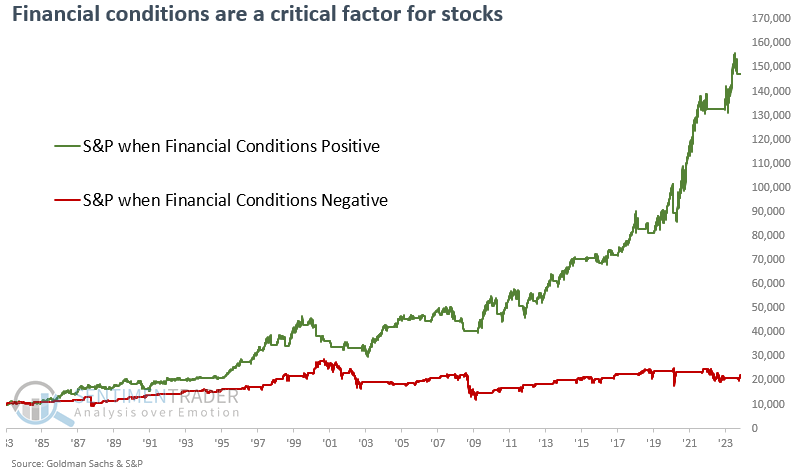
By and large, stocks usually do well when financial conditions are easing
When examining a binary all-in or all-out model, the most suitable way to gauge the strategy's validity is by assessing the performance of an initial capital outlay.
Utilizing the range rank rules, a $10,000 investment in the S&P 500 increases to $147,000 when financial conditions ease. Conversely, tightening conditions result in significantly smaller growth, with the initial investment reaching only $22,000.
What the research tells us...
A trading system that uses the Goldman Sachs Financial Conditions Index to assess whether financial conditions are easing or tightening relative to a recent range triggered a new buy signal for the S&P 500. Similar shifts in a composite that monitors interest rates, the dollar, and credit spreads tend to produce a bullish backdrop for the S&P 500. The Technology sector typically outperforms other groups over the subsequent six months when financial conditions are less restrictive.