
Favorable momentum indicators pile up - Part I

Key points
- Momentum is an important factor in the stock market
- The recent multi-month surge triggered two more momentum signals at the end of March 2024
- The S&P 500 closed March 2024 up 15+% over the last three months and +25+% over the last five months
S&P 500 up 25+% in 5 months
The S&P 500 Index closed the month of March with a five-month gain of +25.3%. An increase of this magnitude in such a short period is a rare feat. While admiring recent gains is fine, the real question is, "Does it mean anything going forward?" If history is a guide, the answer may be "Yes."
Let's apply a systematic approach to trading this event using the following rules:
- If the S&P 500 closes any month 25% or more above its monthly closing price five months ago, we buy and hold the index for twelve months
- If another signal occurs within the initial twelve months, we extend the holding period another twelve months
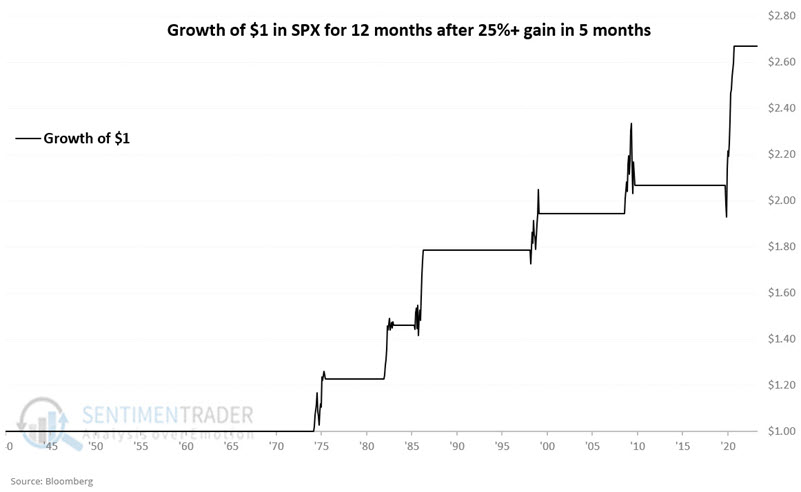
The chart below displays an equity curve showing the hypothetical growth of $1 invested in the S&P 500 using the rules above since 1941.
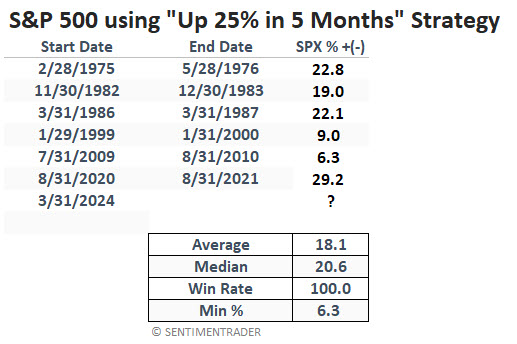
The table below summarizes the results using the rules above.
S&P 500 up 15+% in 3 months
The S&P 500 Index closed January 2024 with a 3-month gain of +15.5%. The table below displays the S&P 500 forward 12-month performance following those previous occasions when the S&P 500 gained 15+% in just three months.
Let's apply the same systematic rules for this signal as we used above:
- If the S&P 500 closes any month 15% or more above its monthly closing price three months ago, we buy and hold the index for twelve months
- If another new signal occurs within the initial twelve months, we extend the holding period another twelve months
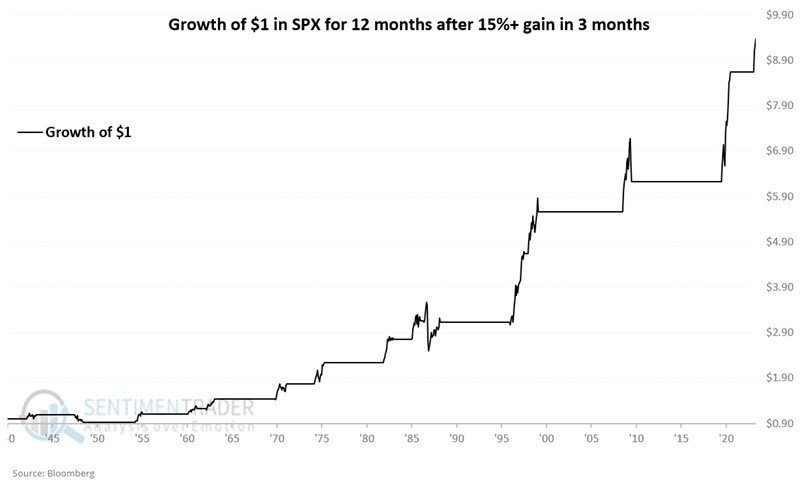
The chart below displays an equity curve showing the hypothetical growth of $1 invested in the S&P 500 using the rules above since 194.
The table below summarizes the results using the rules above.
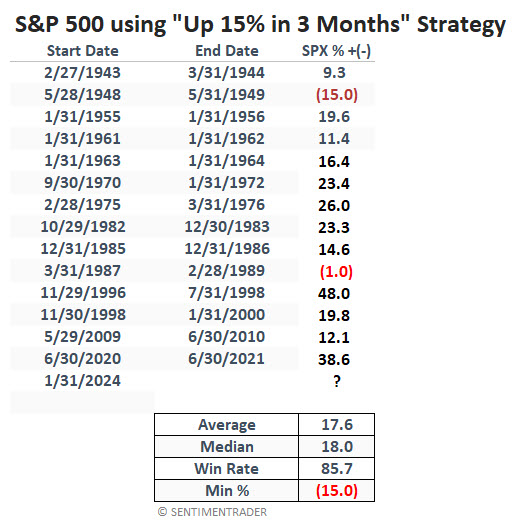
In the first two months since the 2024-01-31 signal, the S&P 500 has gained +8.4%. Longer-term, overall results are solid, but from a real-world investing point-of-view, it is fair to note the -15% decline during the 1948-49 period and the fact that the seemingly moderate -1.0% loss during 1987-89 included riding the Crash of '87 from peak-to-valley.
What the research tells us…
Momentum is an important factor for the stock market. The results above suggest that investors give the bullish case the benefit of the doubt when specific simple momentum indicators give favorable signals. The fact that both of the indicators highlighted are presently favorable offers a potentially powerful "weight of the evidence" clue that investors should continue to give the bullish case the benefit of the doubt. That said, momentum is only one factor that affects stock prices and should not be relied upon as one's sole gauge of market activity.