
Emerging markets feel the pressure first

Key points:
- U.S. market breadth has shown fresh deterioration.
- After previous signals, emerging markets fell within two sessions on 15 occasions, averaging a loss of about 1.9%. Their performance relative to the S&P 500 also stayed weak over subsequent weeks.
- Emerging markets sometimes recovered over the following months, but those rebounds were less consistent and carried substantially deeper interim losses than U.S. equities.
U.S. market breadth has clearly deteriorated
Earlier this week, we examined how persistent high-beta leadership tends to give way to quality stocks without necessarily ending the broader advance. What happens beneath the surface and where the index heads do not always agree.
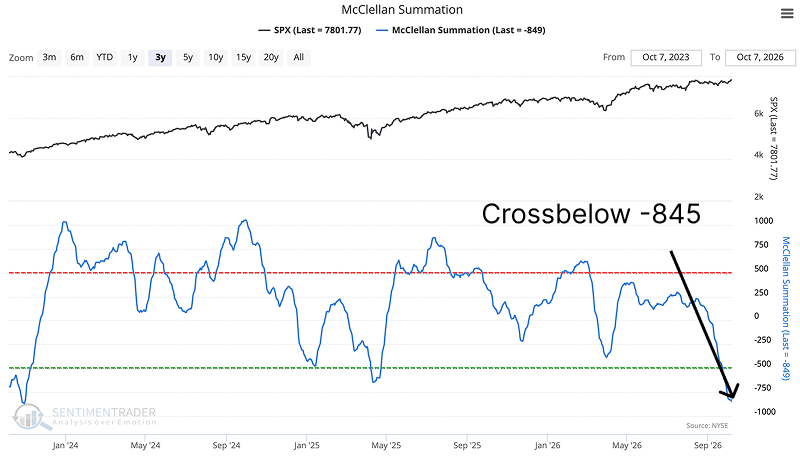
Now a different measure of internals is deteriorating as well. On October 7, the S&P 500 McClellan Summation Index, a running measure of breadth momentum, crossed below -845 and registered a new signal under the 21-session cooldown rule.
Historically, such readings have reflected deteriorating breadth. The S&P 500 has often recovered in the following months, though outcomes varied widely across environments.
But the implications may extend beyond U.S. equities. Emerging markets are parti