Products
SentimenTrader Trading Tools
‍
Backtest Engine
My Trading Toolkit
Correlation Analysis
Seasonality
Market Prediction
Indicators & Data API
‍
Proprietary Indicators & Charts
Market Data API
Strategies & Scanner
‍
50+ Trading Strategies
Smart Stock Scanner
Smart Option Scanner
Research Reports
‍
Research Solutions
Reports Library
Free Resources
Simple Backtest Calculator
Simple Seasonality Calculator
The Kelly Criterion Calculator
Sentiment Geo Map
Public Research Reports
Education
Sentiment Indicators
Technical Indicators
Pricing
Company
About
In the News
Testimonials
Client Success Stories
Contact
Log inLoginSign up
< BACK TO ALL REPORTS

Election Cycle This, Election Cycle That (Part II)

Jay Kaeppel
2021-03-05
In this piece - Part II - will compare the performance of several other indexes to that of the Dow Jones Industrial Average during two distinct periods within the 4-year election cycle.

In Part I we analyzed the performance generated by holding the Dow Jones Industrial Average ONLY during two distinct periods within the 4-year election cycle:

  • April-May of the Post-Election year
  • January through July of the Pre-Election year

There is good news and better news. The good news - as you can see in the chart below from Part I - is that when combined these two periods showed a net gain during every 4-year election cycle starting in 1941.
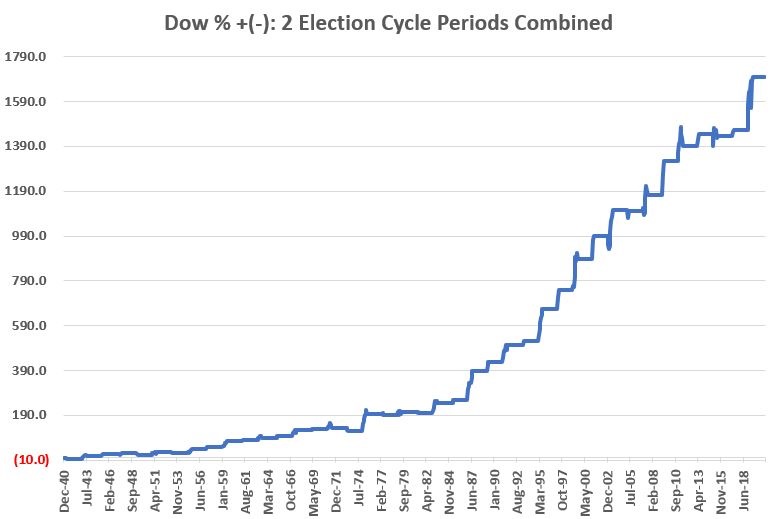
 The better news is that there may be a way to improve upon these results.

Using Other Indexes

Instead of using the Dow Jones Industrial Average, let's consider the S&P 400 MidCap Index and the Nasdaq 100 Index. 

Data Notes: 

In Part I we used price performance only data for the Dow. 

In Part II we will use monthly total return data as follows:

  • The first month of data for the S&P 400 MidCap Index is January 1981. So, we will start our test there.
  • The first month of monthly total return data I have for the Nasdaq 100 Index is April of 1996. So:
    • From January 1981 through March 1996, we will use Nasdaq Composite Index data
    • From April 1996 through December 2020, we will use Nasdaq 100 Index data

(Are we having fun yet?)

Election Cycle: Period 1

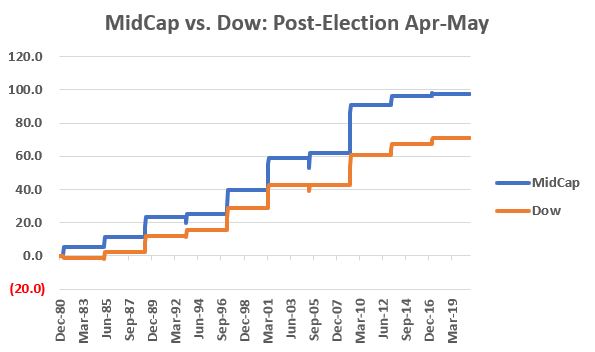
For Period 1 we will look at the performance of the S&P 400 MidCap Index versus the performance of the Dow ONLY during April and May of the Post-Election year starting in 1981.

The chart below displays the cumulative price gain for the MidCap Index and the Dow during this 2-month period every four years. 
The Table below displays the actual cycle-by-cycle results.
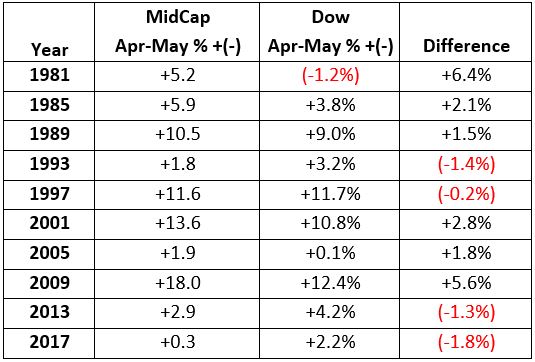
The S&P 400 MidCap Index showed a gain during all 10 cycles and outperformed the Dow 6 out of 10 times.

Election Cycle: Period 2

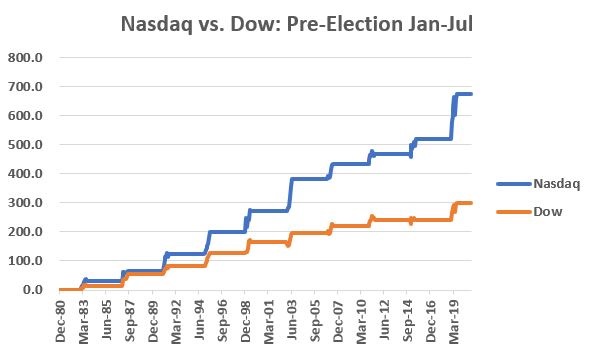
For Period 2 we will look at the price performance for the Nasdaq* versus the Dow during January through July of the Pre-Election year starting in 1983.

The chart below displays the cumulative price gain for the Nasdaq* and the Dow during this 7-month period every four years. 

*-Nasdaq Composite 1981-1996, Nasdaq 100 Index 1996-2020
The Table below displays the actual cycle-by-cycle results.
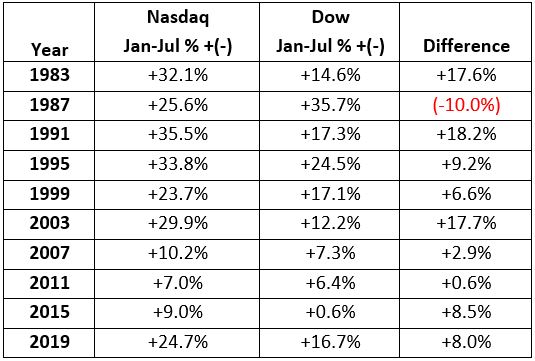
The Nasdaq showed a gain during all 10 cycles and outperformed the Dow 9 out of 10 times.

Two Periods Combined

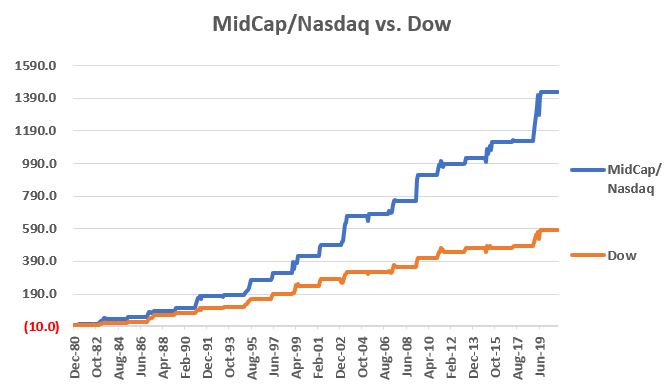
Just to complete the "experiment", let's compare holding the S&P 400 MidCap Index ONLY during April and May of each post-election year and holding the Nasdaq during January through July of every pre-election year starting in 1981 (a return of zero percent is assumed for all other months). And let's compare these results to holding the Dow Jones Industrial Average during these months instead. The hypothetical equity curves appear in the chart below.
The Table below displays the actual cycle-by-cycle results.
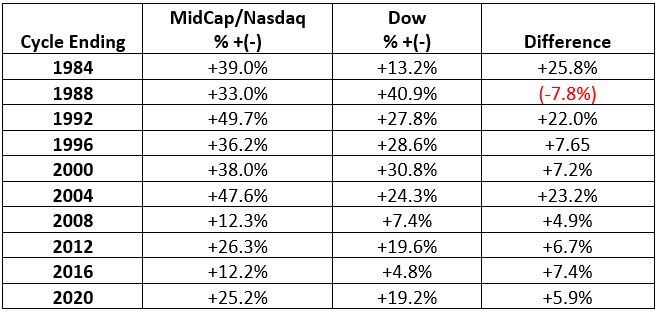
 

In sum:

  • MidCap/Nasdaq gained +1,430%
  • Dow gained +583%
  • MidCap/Nasdaq outperformed the Dow across 9 of 10 completed 4-year cycles
PRODUCTS
SentimenTrader
Trading Tools
Indicators & Data API
‍
Strategies & Scanner
‍
Research Reports
FREE
RESOUrCES
Simple Backtest
Calculator
Simple Seasonality
Calculator
The Kelly Criterion
Calculator
Sentiment Geo Map
‍
Public Research Reports
‍
Education
Sentiment Indicators
‍
Technical Indicators
‍
Pricing
Bundle pricing
‍
FAQ
‍
Announcements
‍
COMPANY
‍
About
‍
In the News
‍
Testimonials
‍
Client Success Stories
CONTACT
‍
General Inquiries
‍
Media Inquiries
‍
Financial Professionals Inquiries
‍
© 2026 Sundial Capital Research Inc. All rights reserved.
Setsail Marketing
TermsPrivacyAffiliate Program
Risk Disclosure: The information and tools provided are for research and analytical purposes only and are not intended as investment advice. Market analysis involves uncertainty, and outcomes may differ from expectations. Users should conduct their own due diligence and consider their individual circumstances before making any financial decisions. Past performance is not necessarily indicative of future results.

Hypothetical Performance Disclosure: Hypothetical performance results have many inherent limitations, some of which are described below. No representation is being made that any account will or is likely to achieve profits or losses similar to those shown; in fact, there are frequently sharp differences between hypothetical performance results and the actual results subsequently achieved by any particular trading program. One of the limitations of hypothetical performance results is that they are generally prepared with the benefit of hindsight. In addition, hypothetical trading does not involve financial risk, and no hypothetical trading record can completely account for the impact of financial risk of actual trading. for example, the ability to withstand losses or to adhere to a particular trading program in spite of trading losses are material points which can also adversely affect actual trading results. There are numerous other factors related to the markets in general or to the implementation of any specific trading program which cannot be fully accounted for in the preparation of hypothetical performance results and all which can adversely affect trading results.

Testimonial Disclosure: Testimonials appearing on this website may not be representative of other clients or customers and is not a guarantee of future performance or success.