Products
SentimenTrader Trading Tools
‍
Backtest Engine
My Trading Toolkit
Correlation Analysis
Seasonality
Market Prediction
Indicators & Data API
‍
Proprietary Indicators & Charts
Market Data API
Strategies & Scanner
‍
50+ Trading Strategies
Smart Stock Scanner
Smart Option Scanner
Research Reports
‍
Research Solutions
Reports Library
Free Resources
Simple Backtest Calculator
Simple Seasonality Calculator
The Kelly Criterion Calculator
Sentiment Geo Map
Public Research Reports
Education
Sentiment Indicators
Technical Indicators
Pricing
Company
About
In the News
Testimonials
Client Success Stories
Contact
Log inLoginSign up
< BACK TO ALL REPORTS

Economic surprises in the U.S. far outpace the eurozone

Jason Goepfert
2023-06-07
Economic surprises in the U.S. have been coming in much better than expected, while those in the eurozone are lagging. As a result, the spread in economic surprises in the U.S. versus the eurozone is among the widest in 20 years. After similar economic performance, the S&P 500 and the dollar were the places to be.

Key points:

  • In recent months, U.S. economic reports have far outpaced the eurozone in positive surprises
  • The spread between the two economic forces is now among the widest in 20 years
  • After similar spreads, the S&P 500 tended to beat the Euro Stoxx 50, and the dollar beat the euro

The U.S. economy has been much more surprising than the eurozone

After a wretched 2022, stocks in the eurozone enjoyed a ripping rally off the fall lows, which continued into April of this year. It has only been in recent weeks that the U.S.-based S&P 500 has retaken its leadership position.

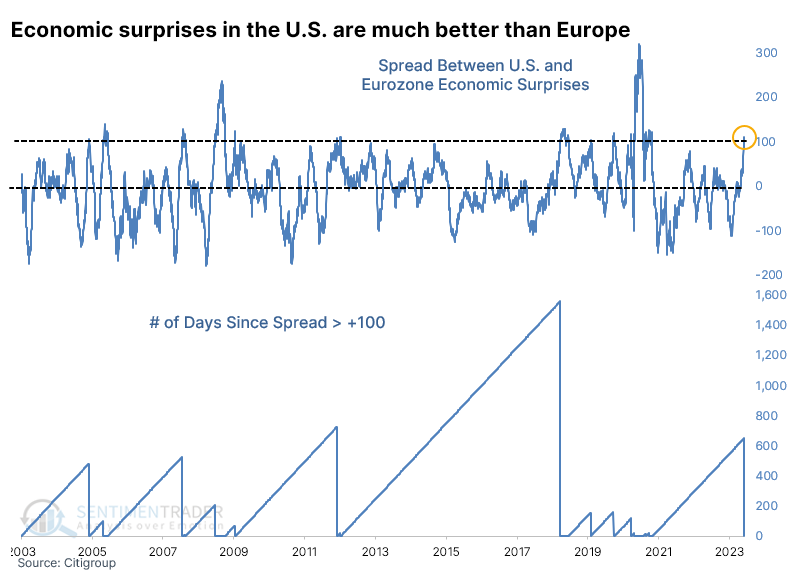
We wouldn't know this by studying the flurries of economic reports. Based on those, the U.S. has massively outperformed the eurozone for months, and the spread is getting wider.

Recently, the Citi Economic Suprise Index for the U.S. was more than 100 points higher than the same index for the eurozone. That's the widest spread favoring U.S. economic conditions in nearly three years. The past few days' readings have ranked in the top 5% of all readings over the past twenty years.
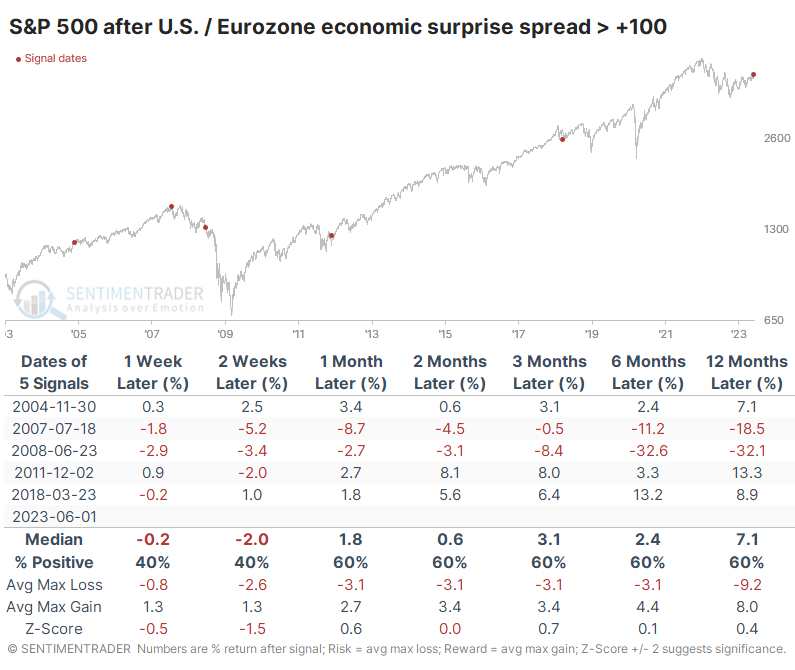
That's all fine and good, but it doesn't really help investors. The table below shows returns in the S&P 500 after the spread between U.S. and eurozone economic surprises surpassed +100. The limited data and extreme nature of the current environment mean that we necessarily have a tiny sample size and all the caveats that go along with that.

For the S&P, there isn't much to say. It preceded medium-term rallies a few times and significant declines a couple of times, thanks to the 2008 financial crisis.
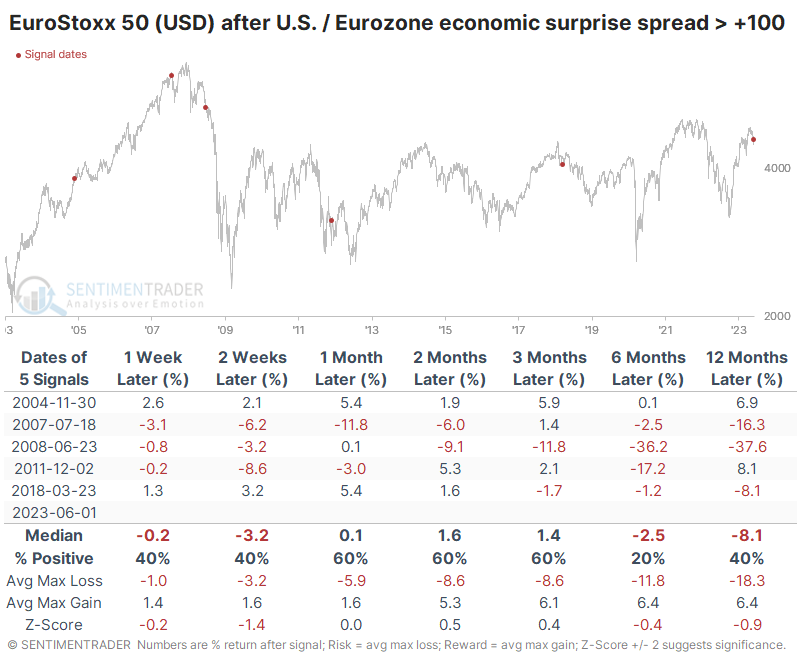
The Euro Stoxx 50 (priced in U.S. dollars) showed poor returns over the next six months. Only a single signal sported a positive return, and that was just barely. The risk/reward in those stocks was lopsided toward the risk side.
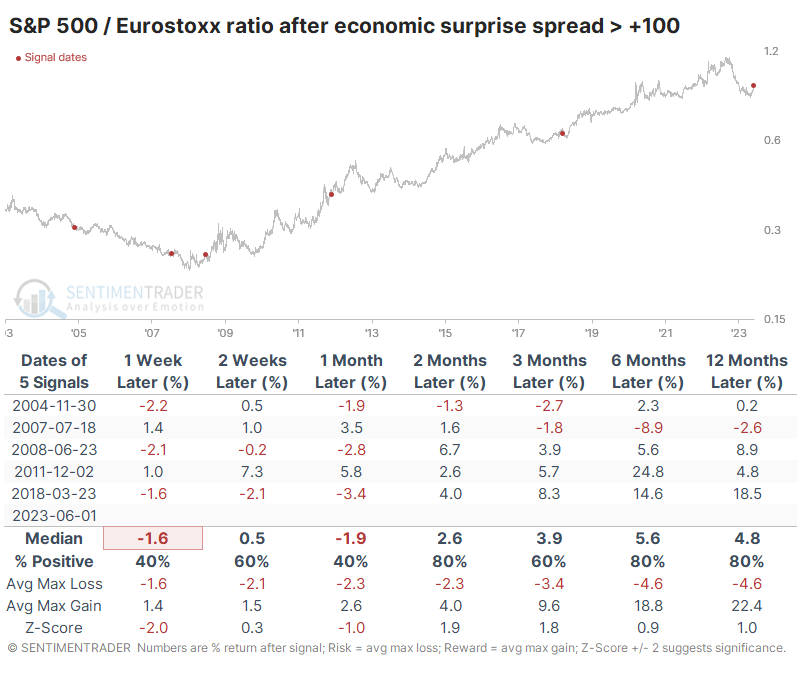
When we look at the ratio of the S&P 500 to Euro Stoxx 50 (in dollars), then we can see that - as much as we can conclude from a sample size of five - similar spreads in economic performance also favored gains in the S&P relative to the Euro Stoxx. Over the next two to twelve months, the S&P consistently gave investors better returns.
Currencies showed the same pattern

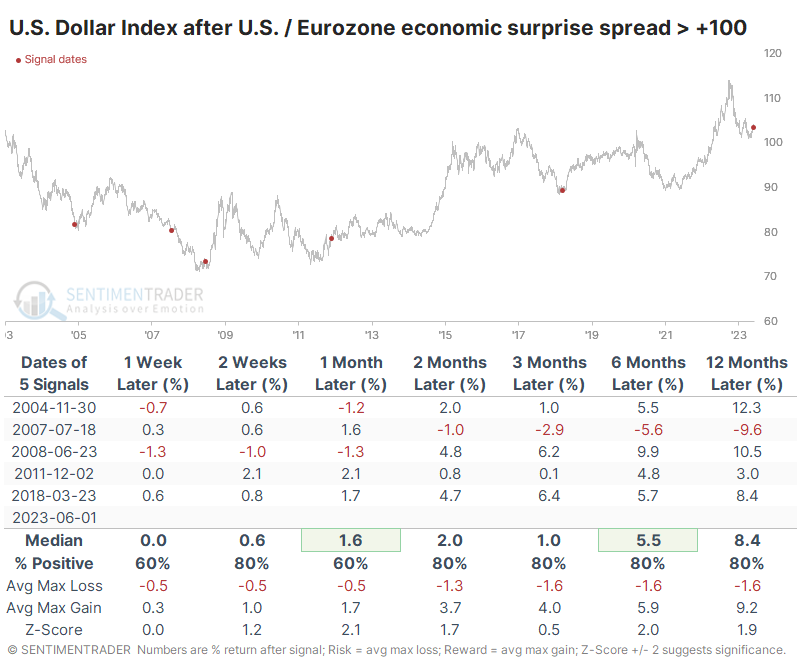
An outperformance of U.S. assets over eurozone assets was also evident with the currencies. The U.S. Dollar Index rallied after four of the five instances.
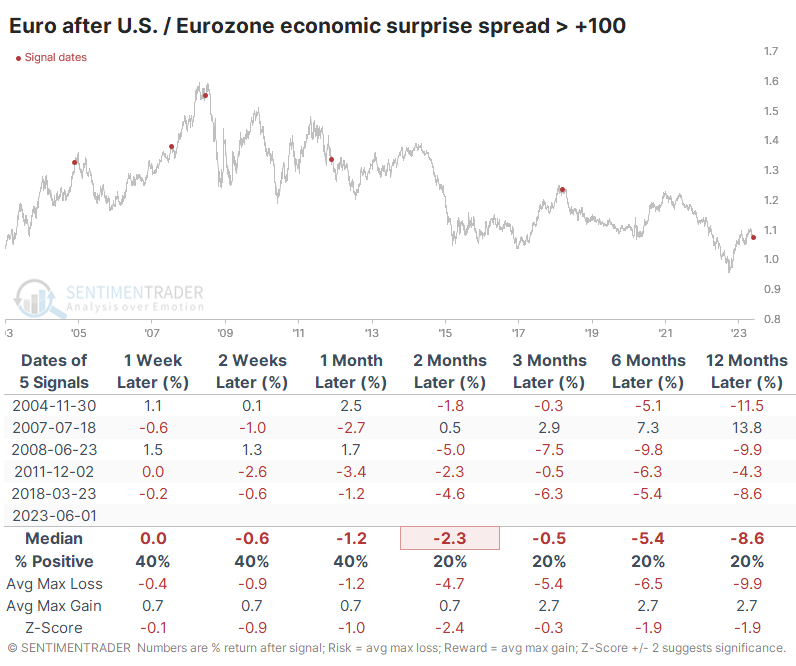
The euro, however, suffered the opposite fate. That's not surprising, given its heavy weight in the Dollar Index, but still.
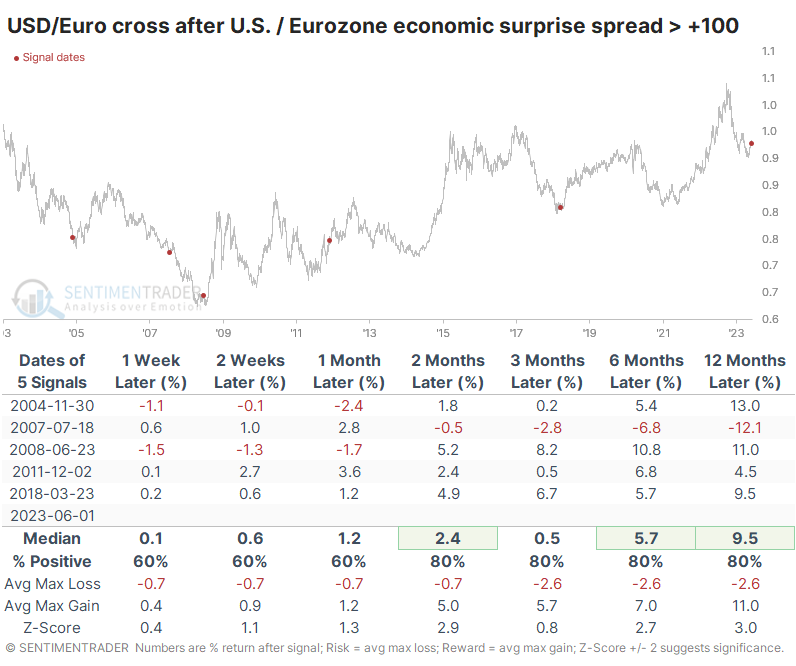
If we look specifically at the U.S. dollar/euro cross, it pretty much matches the U.S. Dollar Index but was a bit better depending on which metric one prefers.
What the research tells us...

We've learned time and again over the years that the economy is not the market, no matter which market we're talking about but usually stocks. Often, stocks (and other markets) move one way when the economy suggests it should do the opposite. This is one of the relatively rare examples when there is a more linear relationship between economics and markets. While it's hard to rely too much on a tiny sample size, when economic surprises in the U.S. far outpaced those in the eurozone, it showed a consistent tendency to lead to better returns in U.S. stocks and the dollar than eurozone stocks and the euro.

PRODUCTS
SentimenTrader
Trading Tools
Indicators & Data API
‍
Strategies & Scanner
‍
Research Reports
FREE
RESOUrCES
Simple Backtest
Calculator
Simple Seasonality
Calculator
The Kelly Criterion
Calculator
Sentiment Geo Map
‍
Public Research Reports
‍
Education
Sentiment Indicators
‍
Technical Indicators
‍
Pricing
Bundle pricing
‍
FAQ
‍
Announcements
‍
COMPANY
‍
About
‍
In the News
‍
Testimonials
‍
Client Success Stories
CONTACT
‍
General Inquiries
‍
Media Inquiries
‍
Financial Professionals Inquiries
‍
© 2026 Sundial Capital Research Inc. All rights reserved.
Setsail Marketing
TermsPrivacyAffiliate Program
Risk Disclosure: The information and tools provided are for research and analytical purposes only and are not intended as investment advice. Market analysis involves uncertainty, and outcomes may differ from expectations. Users should conduct their own due diligence and consider their individual circumstances before making any financial decisions. Past performance is not necessarily indicative of future results.

Hypothetical Performance Disclosure: Hypothetical performance results have many inherent limitations, some of which are described below. No representation is being made that any account will or is likely to achieve profits or losses similar to those shown; in fact, there are frequently sharp differences between hypothetical performance results and the actual results subsequently achieved by any particular trading program. One of the limitations of hypothetical performance results is that they are generally prepared with the benefit of hindsight. In addition, hypothetical trading does not involve financial risk, and no hypothetical trading record can completely account for the impact of financial risk of actual trading. for example, the ability to withstand losses or to adhere to a particular trading program in spite of trading losses are material points which can also adversely affect actual trading results. There are numerous other factors related to the markets in general or to the implementation of any specific trading program which cannot be fully accounted for in the preparation of hypothetical performance results and all which can adversely affect trading results.

Testimonial Disclosure: Testimonials appearing on this website may not be representative of other clients or customers and is not a guarantee of future performance or success.