Products
SentimenTrader Trading Tools
‍
Backtest Engine
My Trading Toolkit
Correlation Analysis
Seasonality
Market Prediction
Indicators & Data API
‍
Proprietary Indicators & Charts
Market Data API
Strategies & Scanner
‍
50+ Trading Strategies
Smart Stock Scanner
Smart Option Scanner
Research Reports
‍
Research Solutions
Reports Library
Free Resources
Simple Backtest Calculator
Simple Seasonality Calculator
The Kelly Criterion Calculator
Sentiment Geo Map
Public Research Reports
Education
Sentiment Indicators
Technical Indicators
Pricing
Company
About
In the News
Testimonials
Client Success Stories
Contact
Log inLoginSign up
< BACK TO ALL REPORTS

Earnings are recovering and investors don't care

Jason Goepfert
2023-10-31
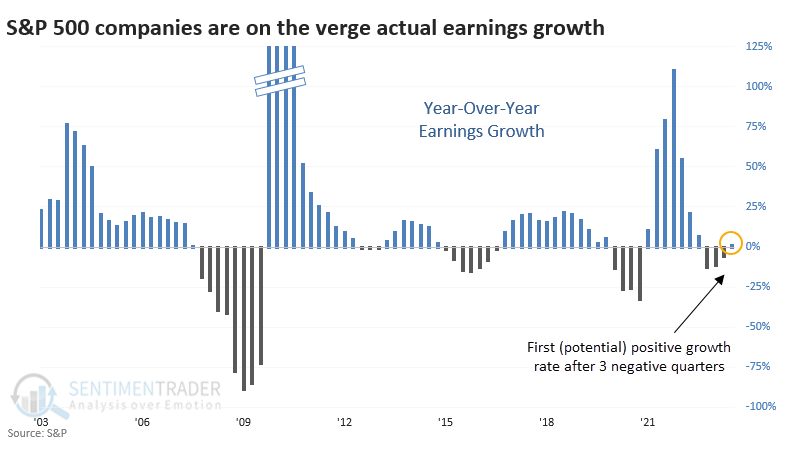
Earnings among S&P 500 companies are on track to show year-over-year growth for the first time in three quarters. After other earnings recoveries, stocks tended to rise, but it wasn't as consistent as investors may think. When there was a negative return in the first month after a recovery, the S&P showed a strong tendency to rise over the next 9 months.

Key points:

  • S&P 500 companies are on track to show year-over-year earnings growth for the 1st time in 3 quarters
  • Earnings recoveries mostly preceded higher prices, especially during the past 50 years
  • When stocks declined in the first month after a recovery, returns nine months later were good

After three negative quarters, earnings are on track to recover

It might not seem like it, given how the average stock has performed over the past few months, but their underlying fundamentals are improving. For the first time in several quarters, earnings among S&P 500 companies are on track to show growth.

Per The Wall Street Journal:

The corporate earnings downturn is poised to end, but you wouldn't know it looking at the stock market carnage.

With the third-quarter earnings season nearly halfway over, companies in the S&P 500 are on track to post a 2.7% year-over-year increase in profits, according to a FactSet blend of reported results and consensus analyst estimates. That would mark the first earnings growth in four quarters.

According to S&P Global Data, as-reported 12-month earnings per share for S&P 500 companies are estimated to total $189.20 for the quarter ending September 30. That's a little more than 1% higher than Q3 2022 - not much, but hey, it's something. And it would mark the first actual earnings growth after three consecutive declines.
Earnings recoveries preceded mostly rising prices

There is a dubious relationship between stock prices and fundamentals, or the economy. The table below shows that while investors might reasonably expect an earnings recovery to precede a rising stock market, it did not consistently do so. Investors anticipate rather than react (mostly). 

That's not to say forward S&P returns were poor; they were just...fine. Cycles over the past 50 years have led to excellent returns, except for that little interruption called Black Monday in October 1987.
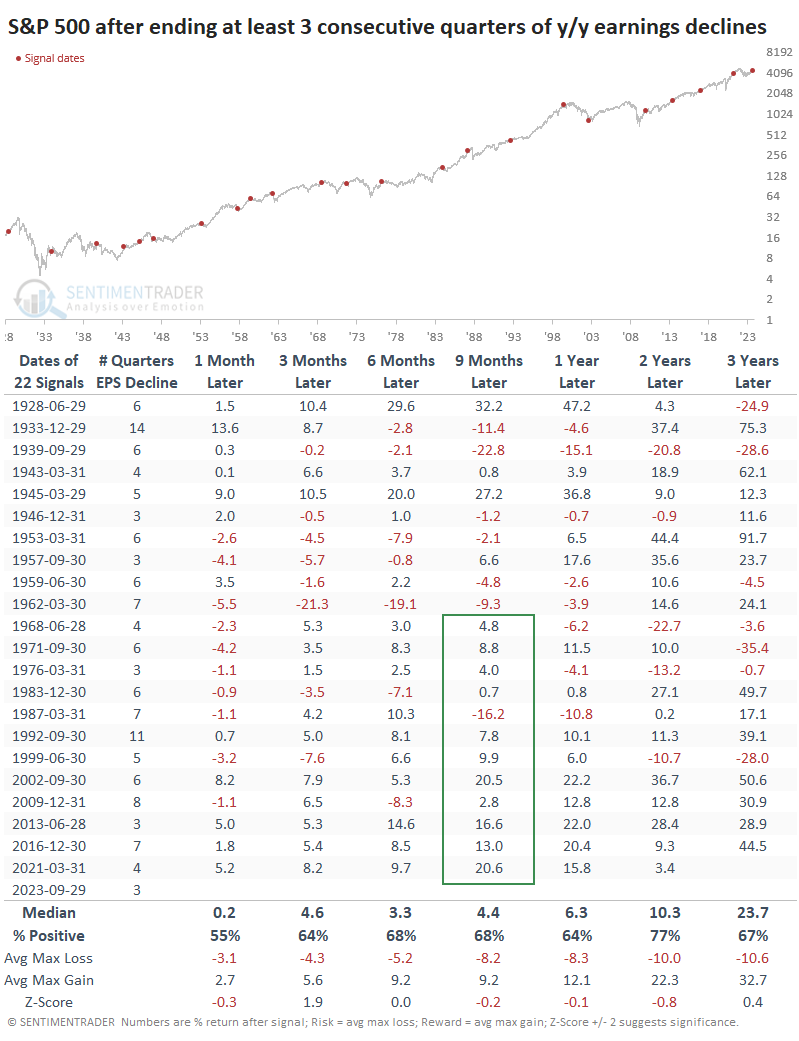
One interesting wrinkle is that since the quarter ended, the S&P has continued to decline, and we're almost guaranteed to have an adverse reaction in the first month after quarter-end. There were ten other times when earnings returned to growth, but stocks declined in the first month after that quarter ended. That dampened returns across most time frames going forward.
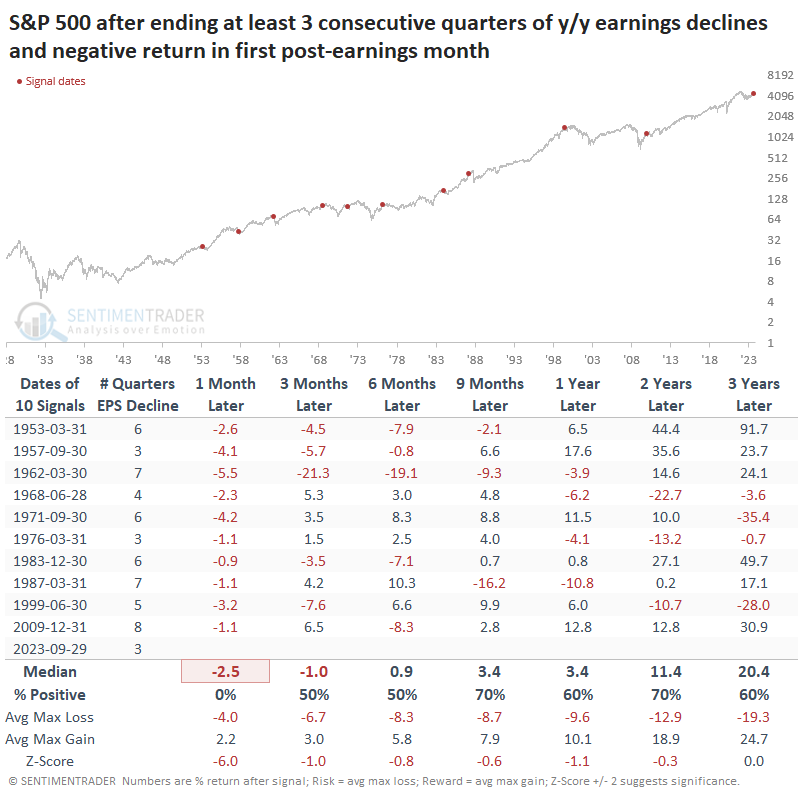
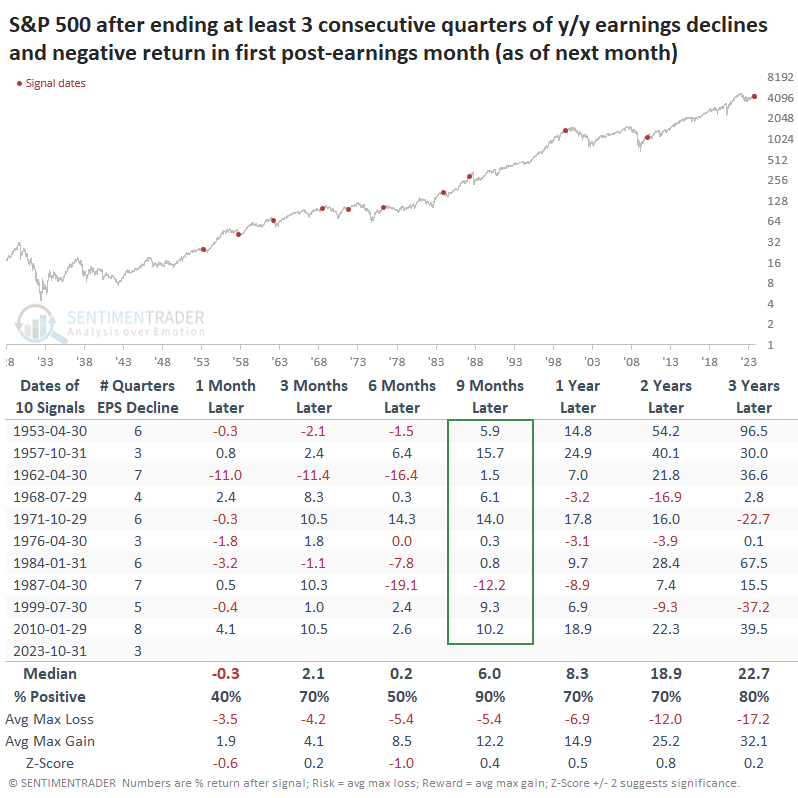
The returns in the table above, however, are influenced negatively by that first month, through which we have already suffered. The table below corrects that and represents what investors would experience going forward in real-time. That helped quite a bit for expectations during the next 9-12 months. Nine months later, there was only one negative return (that pesky '87 crash).
What the research tells us...

According to Standard & Poors, there is a high likelihood that stocks in the S&P 500 will show an aggregate increase in earnings from the same quarter a year ago, ending a several-quarter streak of declines. A return to growth has always translated into rising stock prices since sometimes investors had already anticipated that earnings would recover and bid up prices ahead of time.

When there has been a negative reaction in the month after earnings recover, as has happened this time, future returns were above average, especially during the next nine months. This appears to be a modest positive for the current recovery.

PRODUCTS
SentimenTrader
Trading Tools
Indicators & Data API
‍
Strategies & Scanner
‍
Research Reports
FREE
RESOUrCES
Simple Backtest
Calculator
Simple Seasonality
Calculator
The Kelly Criterion
Calculator
Sentiment Geo Map
‍
Public Research Reports
‍
Education
Sentiment Indicators
‍
Technical Indicators
‍
Pricing
Bundle pricing
‍
FAQ
‍
Announcements
‍
COMPANY
‍
About
‍
In the News
‍
Testimonials
‍
Client Success Stories
CONTACT
‍
General Inquiries
‍
Media Inquiries
‍
Financial Professionals Inquiries
‍
© 2026 Sundial Capital Research Inc. All rights reserved.
Setsail Marketing
TermsPrivacyAffiliate Program
Risk Disclosure: The information and tools provided are for research and analytical purposes only and are not intended as investment advice. Market analysis involves uncertainty, and outcomes may differ from expectations. Users should conduct their own due diligence and consider their individual circumstances before making any financial decisions. Past performance is not necessarily indicative of future results.

Hypothetical Performance Disclosure: Hypothetical performance results have many inherent limitations, some of which are described below. No representation is being made that any account will or is likely to achieve profits or losses similar to those shown; in fact, there are frequently sharp differences between hypothetical performance results and the actual results subsequently achieved by any particular trading program. One of the limitations of hypothetical performance results is that they are generally prepared with the benefit of hindsight. In addition, hypothetical trading does not involve financial risk, and no hypothetical trading record can completely account for the impact of financial risk of actual trading. for example, the ability to withstand losses or to adhere to a particular trading program in spite of trading losses are material points which can also adversely affect actual trading results. There are numerous other factors related to the markets in general or to the implementation of any specific trading program which cannot be fully accounted for in the preparation of hypothetical performance results and all which can adversely affect trading results.

Testimonial Disclosure: Testimonials appearing on this website may not be representative of other clients or customers and is not a guarantee of future performance or success.