
Don't be taken by surprise by QQQ strength

Key points
- The Nasdaq 100 is off to a quick start in early 2023 on the heels of a massive -33% decline in 2022
- Investors should not be taken by surprise
- The Nasdaq 100 has a strong history during the first seven months of pre-election years
The Nasdaq 100 Index versus the calendar
I wrote about the tendency for strength in the early to middle part of a pre-election year in this article and this article. Here let's focus on the Nasdaq 100 Index ($NDX). For trading purposes, an investor can focus on the Invesco QQQ Trust (ticker QQQ), an ETF that tracks the Nasdaq 100 Index.
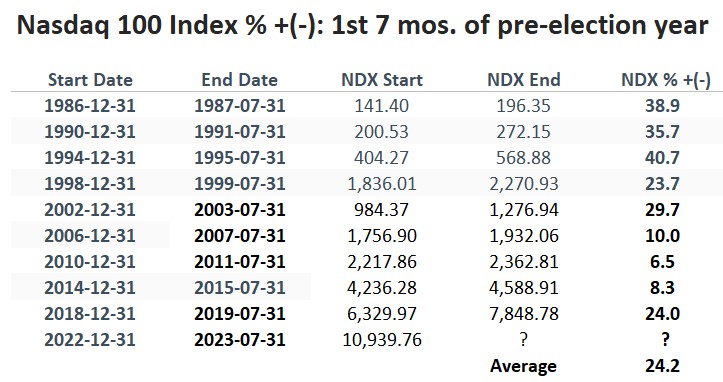
NDX was first calculated in 1985. Since then, nine pre-election years have been completed, plus the first few trading days of 2023. The table below displays the return for NDX during the first seven months of each pre-election year, starting in 1987.
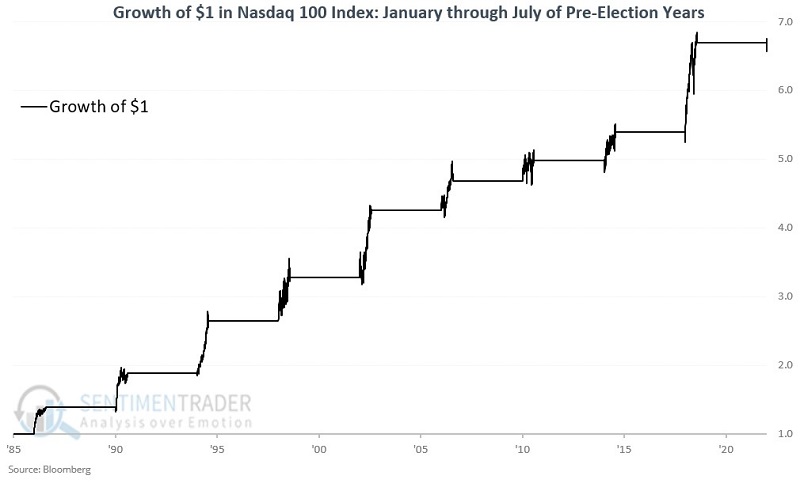
The chart below displays the cumulative growth of $1 invested in NDX only during January 1st through July 31st of each pre-election year - including the first few days of January 2023.
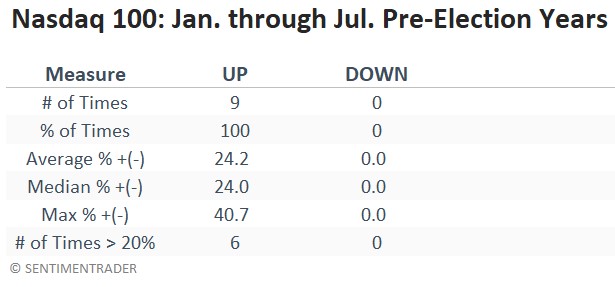
The table below displays a summary of NDX's performance during these times.
What the research tells us…
It is difficult to quibble with the historical performance of the Nasdaq 100 Index during the first seven months of a pre-election year. Some might raise the issue of a relatively small sample size - but remember that the S&P 500 Index has exhibited the same tendency to advance strongly during a pre-election year since the 1930s.
On the one hand, NDX lost a staggering -33% in 2022, so many investors are hesitant to jump into the weakest of the major indexes. On the other hand, the indexes' historical performance during this current phase in the four-year election cycle is quite compelling. While not guaranteed, a strong bounce coming off the deeply oversold extremes of 2022 should not come as a surprise.