
Do rising interest rates matter for stocks?

Key points:
- Interest rates are in a rising trend
- Stocks can advance during rising rate periods and decline during falling rate periods
- However, DJIA performance has been vastly better when interest rates are falling than when rising
Measuring interest rates and stock prices
Interest rates are stuck in a solid uptrend, and that has meant headwinds for stocks.
To create the most extended test possible, we will use the monthly closing price for the Dow Jones Industrials Average (DJIA) and month-end yield data for the 10-year treasury note beginning in 1901.
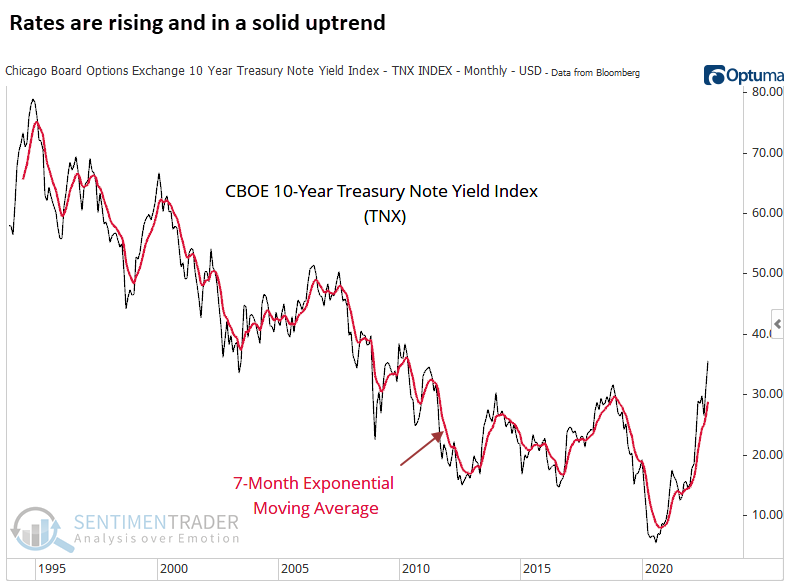
To designate the current trend for interest rates, we will track a 7-month exponential moving average of month-end 10-year treasury yields.
- If the current 10-year yield is below the 7-month EMA, the interest rate trend is falling
- If the current 10-year yield is above the 7-month EMA, the interest rate trend is rising
The chart below shows a monthly chart for the CBOE 10-Year US Treasury Index (TNX) along with its 7-month EMA (red line).
Dow performance during falling rates versus rising rates
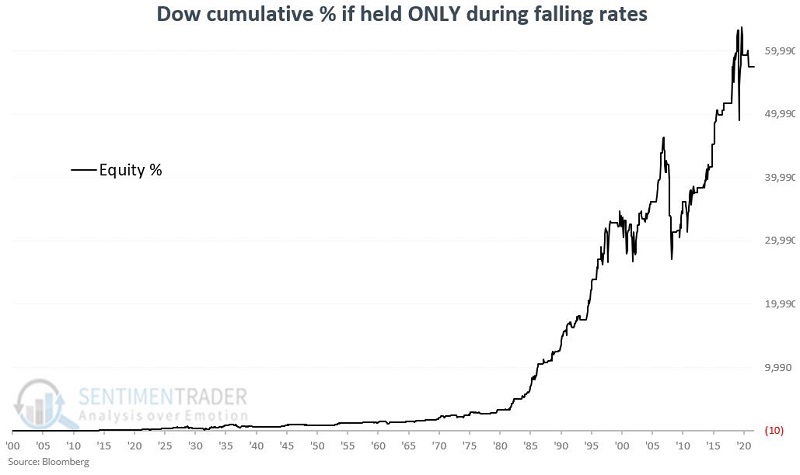
The chart below displays the cumulative price performance for the DJIA if held only when the 10-year yield was below its 7-month EMA at the end of the previous month. The cumulative return since 1900 is +57,582%.
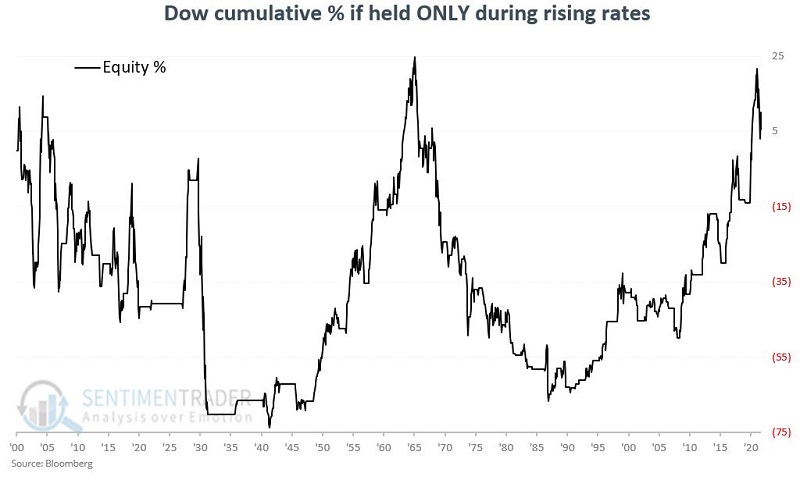
To put this performance into perspective, the chart below displays the cumulative price performance if held only when the 10-year yield was above its 7-month EMA at the end of the previous month. The cumulative return since 1900 is only +5.6% - barely breakeven.
The table below summarizes monthly performance data for the Dow based on whether interest rates were falling or rising at the end of the previous month.
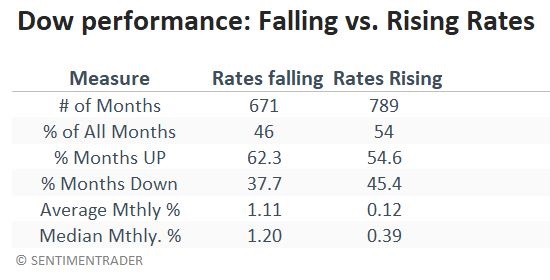
Rates were falling only 46% of the time but the percentage return in the DJIA during those months accounted for nearly all of the gains over the whole study period. The percentage of months that showed a gain was significantly higher when rates were falling, and the average monthly return was considerably higher as well.
What the research tells us…
The good news is that we can state with certainty that falling interest rates are much more favorable for stocks in the long run than rising interest rates. The caveat is that this information should likely not be used as a standalone model.
The charts above showed several instances when stocks declined sharply even while interest rates were falling. Likewise, the Dow staged significant multi-year rallies during the 1950s, 1990, and post-Great Financial Crisis, even when rates were rising. Nevertheless, as a weight-of-the-evidence indicator, the current rising rate environment falls squarely on the unfavorable side of the ledger.