
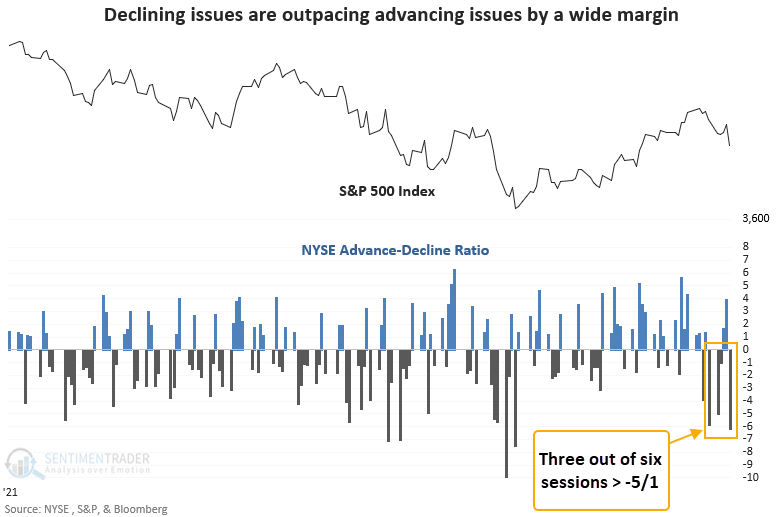
Declining issues on the NYSE are overwhelming advancing issues

Key points:
- Declining issues on the NYSE have overwhelmed advancing issues by a ratio of 5/1
- The lopsided breadth ratio has occurred in three of the last six sessions
- Similar market breadth conditions have preceded mixed returns on a short to medium-term basis
A lopsided advance-decline ratio
In the last few weeks, we've shared several notes that suggested we could see a pause in the rally. Until now, the studies primarily focused on external price indicators like the 200-day moving average and the MACD indicator.
In the last six sessions, NYSE market breadth has turned considerably unfavorable, with three sessions showing an advance-decline ratio of -5/1. Let's assess the outlook for the S&P 500 after similar setups. I will also include a condition requiring the 200-day moving average for the S&P 500 to decline for 80 consecutive days or more, which is the case now.
Similar signals preceded mixed returns
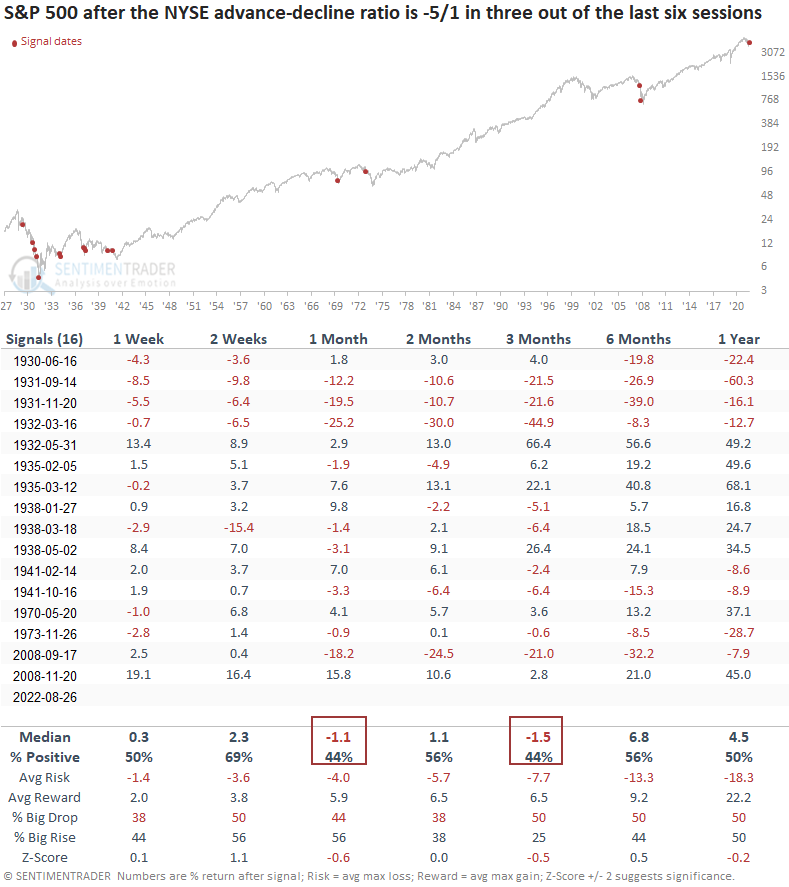
The lopsided breadth ratio in a downtrend is rare, especially since 1942. Our study identified 15 other instances in the last 93 years. While the one and three-month time frames show a negative return, the other short to medium-term windows were positive. So, the negative breadth in the last six sessions doesn't provide us with an overwhelming edge one way or the other.
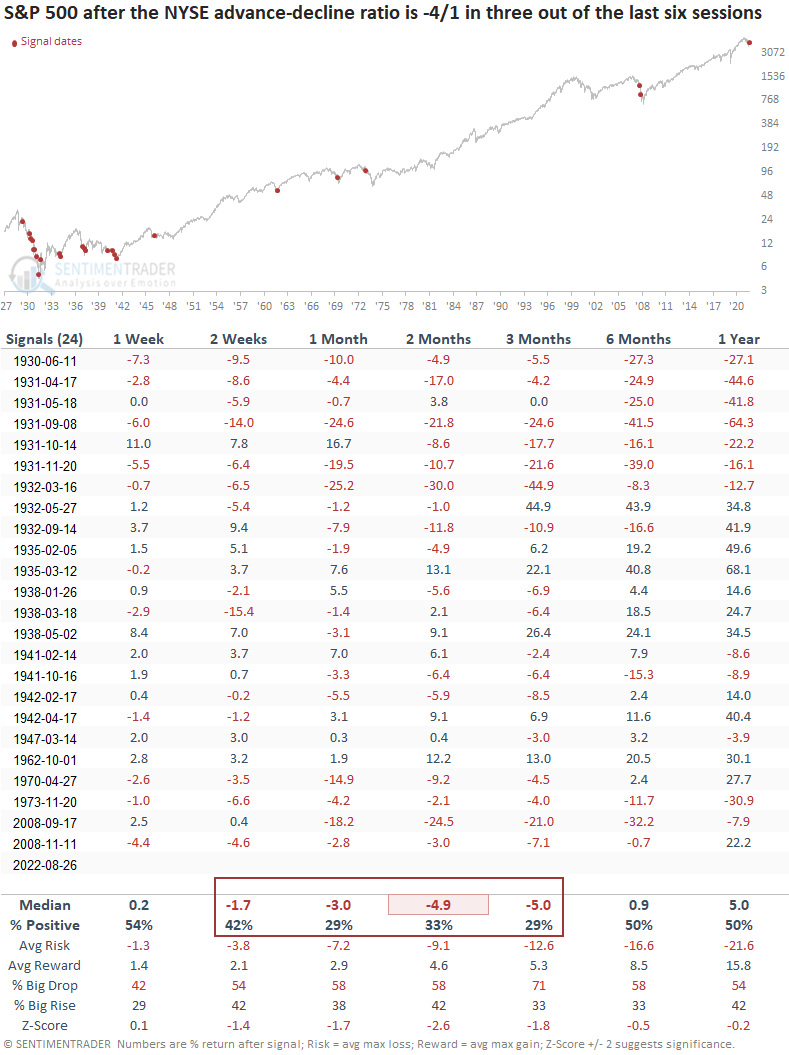
Suppose I lower the threshold for the ratio to -4/1. In that case, the study identifies an additional eight signals. Returns, win rates, and z-scores look considerably worse. As with the -5/1 signals, the 1929-42 period contains most of the instances.
What the research tells us...
Market breadth has turned considerably negative in the short-term, with the NYSE advance-decline ratio exceeding -5/1 in three of the last six sessions. The overwhelming adverse breadth condition is rare and, unfortunately, provides us with a somewhat inconclusive outlook. The study shows a more pessimistic view when I lower the threshold for the ratio to -4/1. While the long-term outlook suggests we trust the thrust, the near-term picture could be volatile.