
Corn is hoping for a seasonal tailwind

Key Points
- Corn has exhibited strong seasonal tendencies over many decades
- Corn is presently in one of the more consistently favorable seasonal periods
- While corn futures offer the greatest leverage, there is an ETF alternative
A favorable seasonal period for corn
The chart below displays the annual seasonal trend for corn futures. In the red box, you can see the tendency for corn to show strength between late January and at least late March (and often longer).
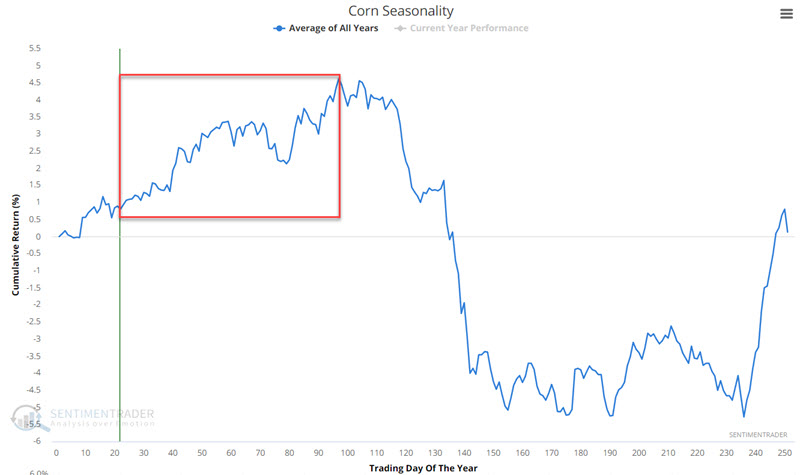
We will focus on the period highlighted in the red box in the chart above (Trading Day of Year #22 through Trading Day of Year #97. For 2022 this period extends from February 2nd through May 20th.
The chart below displays the hypothetical year by year $ +(-) achieved by holding long a corn futures contract ONLY during this seasonally favorable period.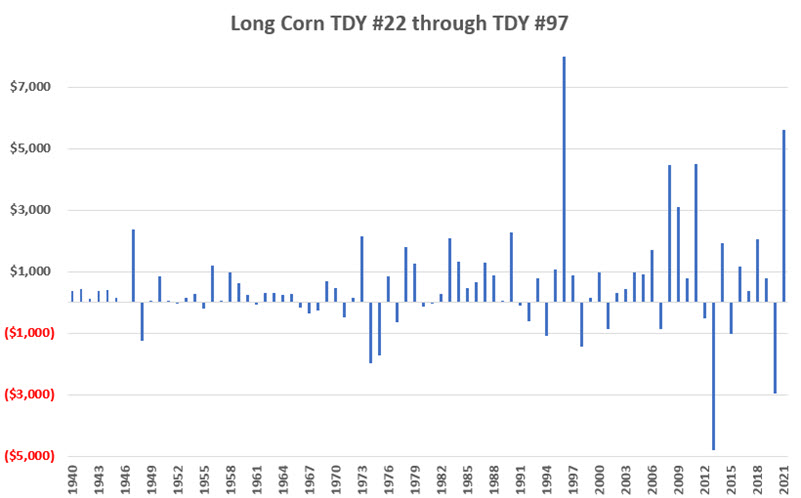
The chart below displays the hypothetical cumulative $ +(-) achieved by holding long a corn futures contract ONLY during this seasonally favorable period. In the charts above and below, we see the tendency for strength is by no means a "certainty" on a year-by-year basis.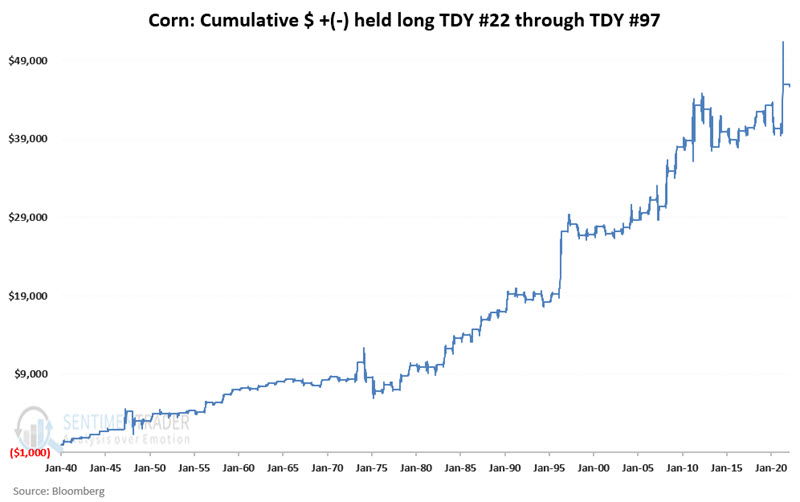
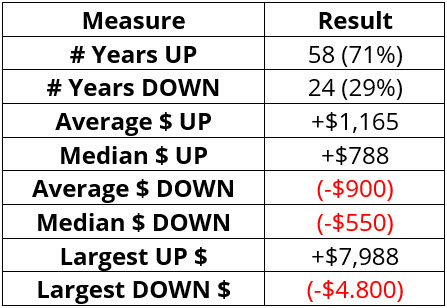
The table below displays a summary of annual results.
An ETF alternative
Traders who do not wish to trade futures contracts can participate in price movements of corn using shares of CORN (Teucrium Corn Fund). CORN is an ETF designed to track the price movements of corn futures but can be bought and sold like shares of stock. In the chart for CORN below, we see potential resistance at $23 share. In theory, a breakout above that level within the presently favorable seasonal timeframe would be a very positive development.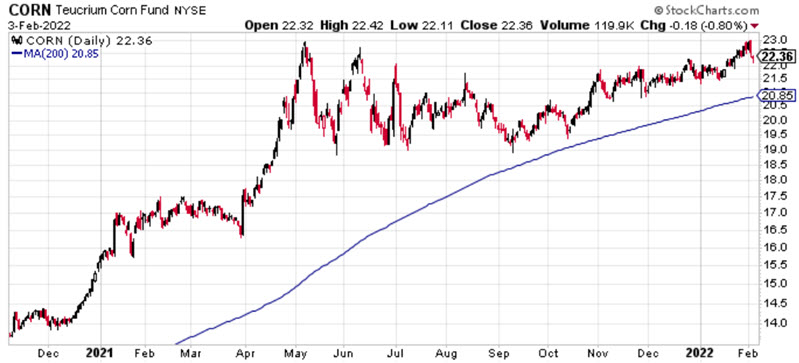
What the research tells us...
The CORN ETF has essentially traded sideways for almost nine months. Many factors can influence the price of corn, and seasonality is only one of them. Suppose corn does begin to exhibit strength and breaks out above recent resistance in the days and weeks ahead. In that case, the positive seasonal influence suggests a greater possibility of some meaningful follow-through.
From a real-world trading perspective, the proper approach would be a) to give the bullish case the benefit of the doubt, b) to carefully consider whether to enter a long position now or after an upside breakout and c) to assume an appropriate and acceptable amount of risk, in case 2022 is one of those years when seasonality does not work out as hoped.