
Commodities reflect a brighter economic backdrop

Key points:
- Following a significant decline, the Bloomberg Spot Commodity Index surged over the past six weeks
- Similar reversals preceded favorable returns for the commodity index over the subsequent year
- A resurgence in commodities tended to benefit cyclical sectors, with most outperforming the S&P 500
A resurgence in a commodity index bodes well for commodities and stocks
Similar to stocks, commodities are subject to business cycle fluctuations. When economic growth stagnates or contracts, their prices typically dip. However, when the outlook brightens and growth prospects improve, commodities experience a resurgence driven by heightened demand.
A trading model that seeks to identify a reversal in commodity prices hinting at improved economic prospects triggered an alert at the close of trading on Friday.
The system generates a signal when the Bloomberg Spot Commodity Index's 6-week rate of change increases above 7%, following a 52-week rate of change reset below -15 %.
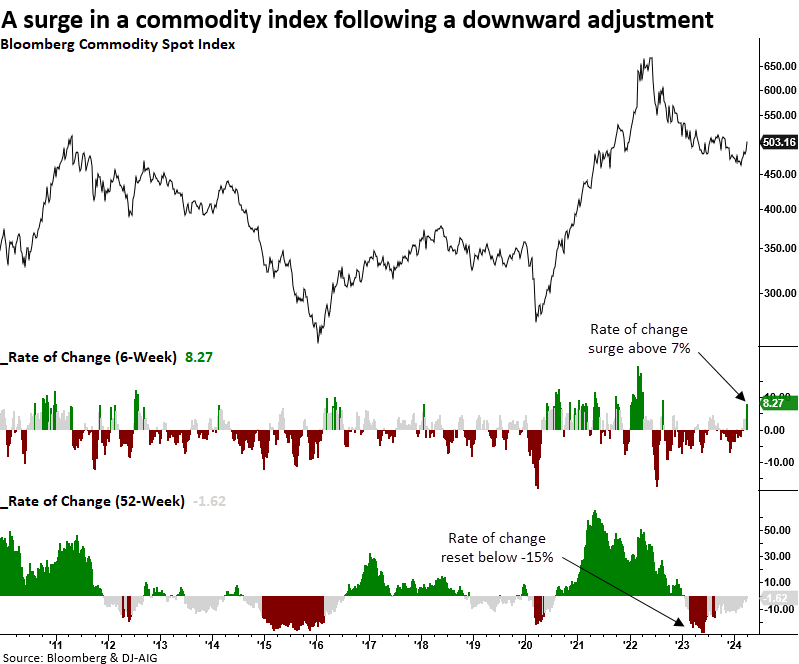
Similar price momentum reversals suggest a broad commodity index rallies further
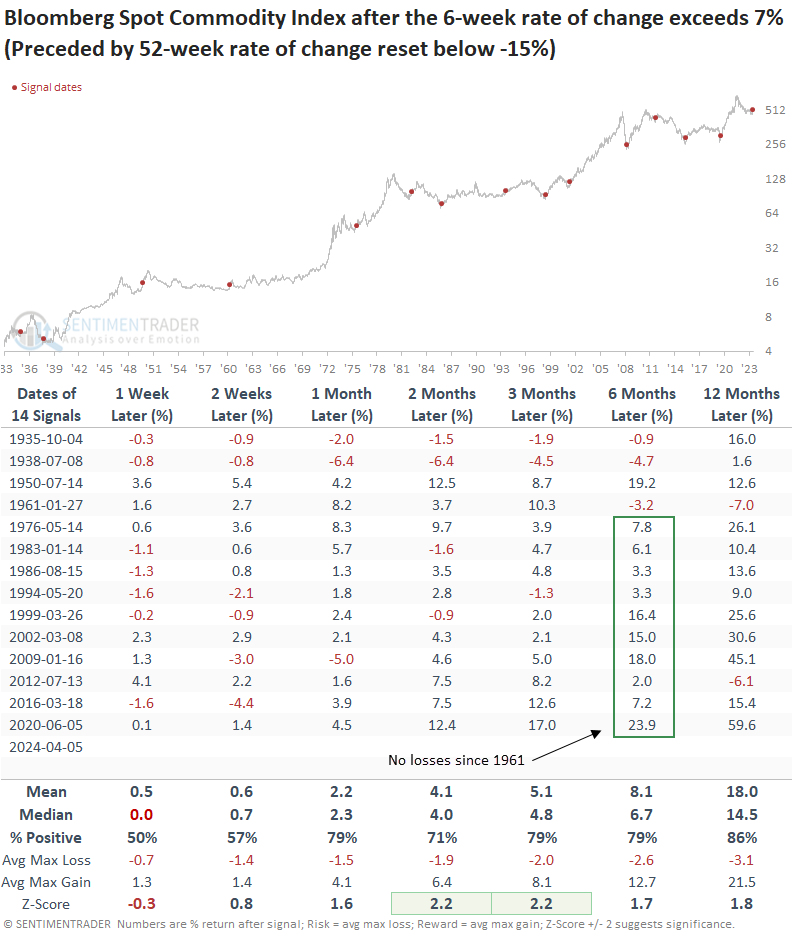
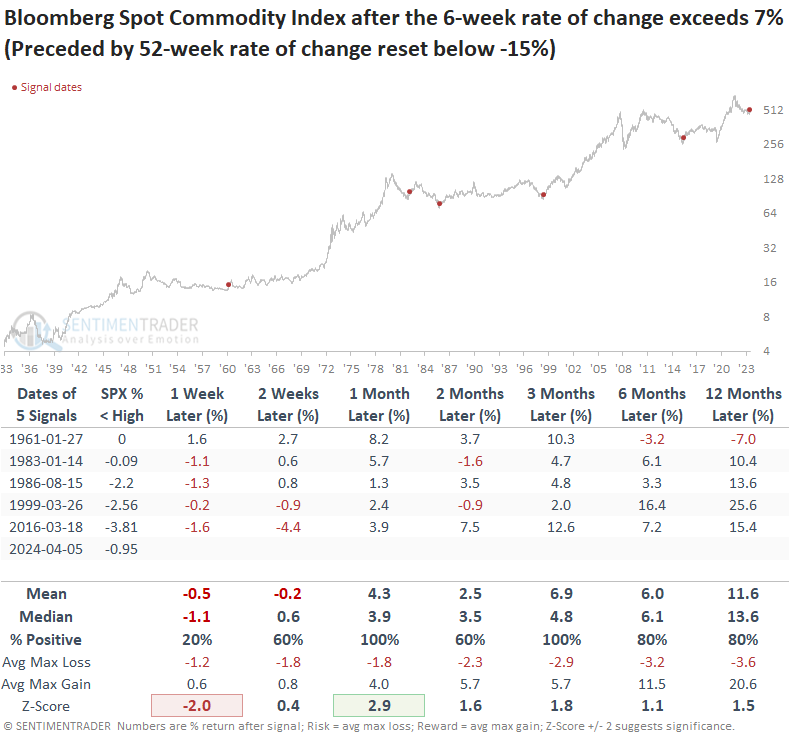
Whenever the Bloomberg Spot Commodity Index surged by 7% or more over a six-week period following a 52-week rate of change reset of -15%, the broad basket of commodities showed a consistent upward bias, with only two negative returns a year later.
In both cases, 1961 and 2012, the index rallied 10% and 8%, respectively, over the next three months before peaking.
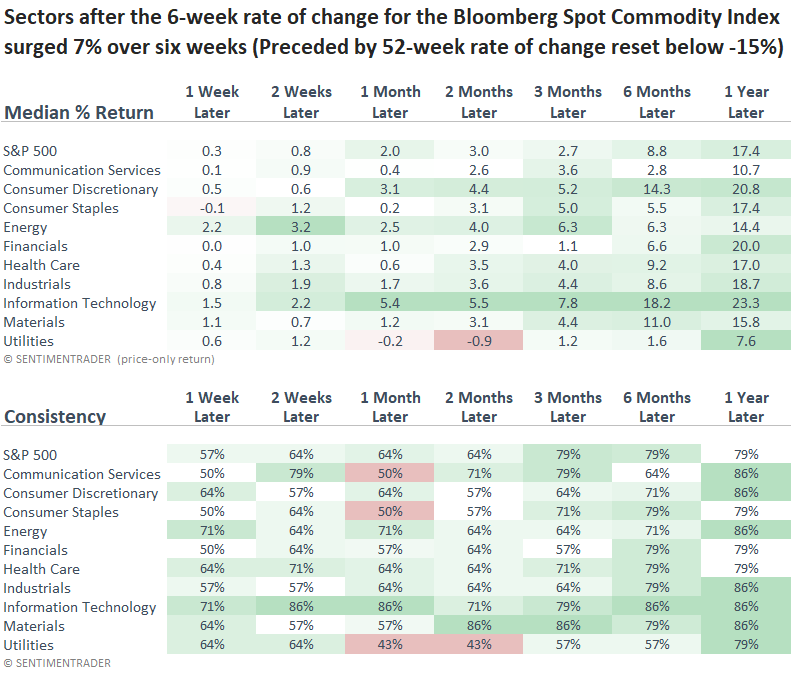
A resurgence in commodity prices after a signficant decline tended to benefit economically sensitive sectors, with Consumer Discretionary, Financials, Industrials, and Technology outperforming the S&P 500. Interestingly, the two commodity-based groups, Energy and Materials, underperformed the world's most benchmarked index.
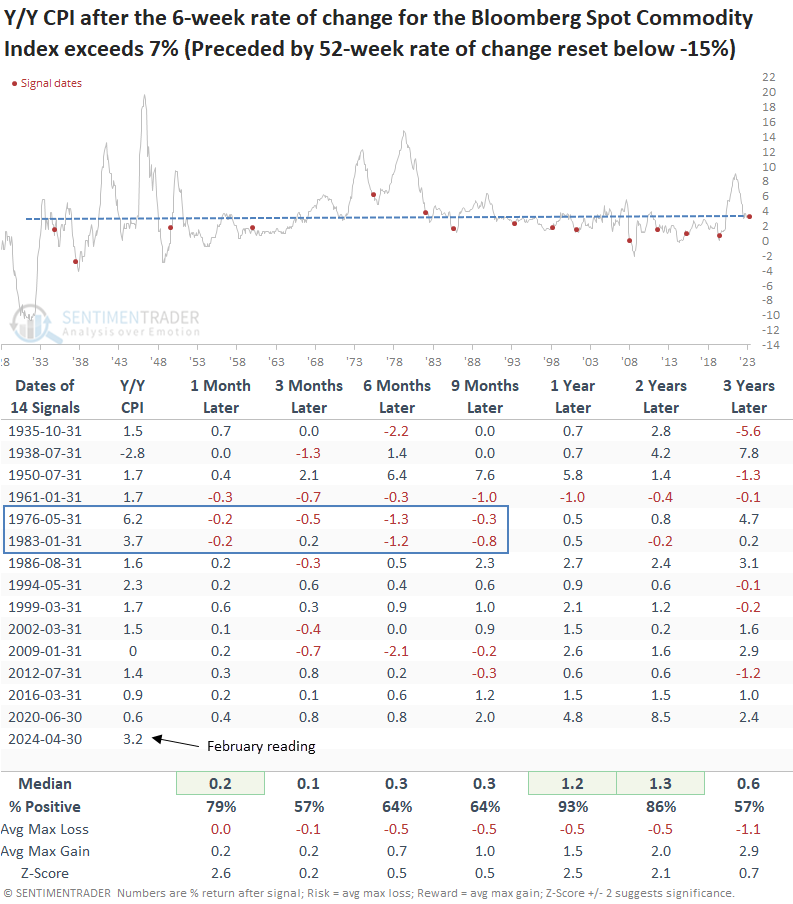
It's not uncommon for year-over-year CPI to rise following a commodity reset and surge signal like now. In the two prior instances, 1976 and 1983, where CPI was higher than the current February reading of 3.2%, CPI fell over the following nine months.
So, despite rising inflation, stocks did just fine. It's also important to recognize that CPI components and weightings have changed over history.
Additional context
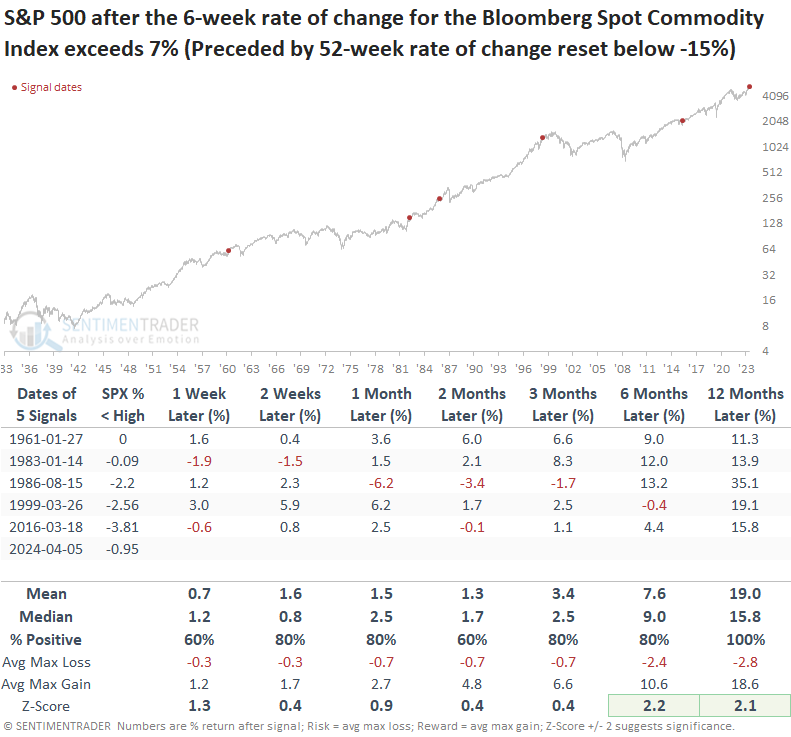
While the Bloomberg Spot Commodity Index remains well below its all-time high, that's not true for the S&P 500, which hovers just below that milestone. While the sample size is small, the following outlook table contains the commodity reversal signals triggered when the S&P 500 was less than 5% below an all-time high.
Similar precedents suggest a favorable outlook for the spot commodity index over medium and long-term horizons.
The outlook for the S&P 500 was equally impressive, with the world's most benchmarked index rising every time a year later. So, even if you think the business cycle is long in the tooth, like 1999, one should not dismiss the possibility of additional gains in the stock market.
What the research tells us...
Over the past six weeks, a commodity index has seen a notable uptick following an extended period of bearish market conditions. This shift in price momentum bodes well for commodities and stocks. Historically, when commodities hinted at an improving economic backdrop, investors were rewarded by owning more economically sensitive sectors, which aligns with current relative trends.