
Beware of "Ugly Months"

Key Points
- An analysis of stock market history on a monthly basis across twenty-year cycles revealed 17 out of 120 months that exhibited consistently poor results
- Two of those 17 months during the current cycle (2020-2039) are June 2022 and September 2022
A quick review of the Ugly 17
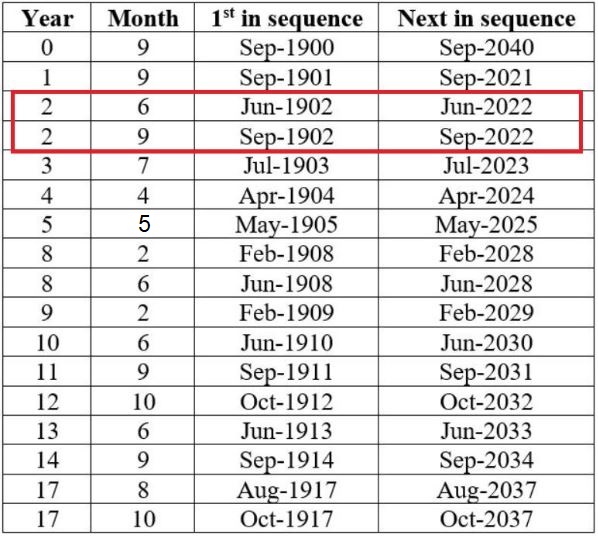
I wrote about the Ugly 17 months in 2021 in this article. The months in question occur on a 20-year cycle starting in 1900 (no, seriously) and are shown below. Note that the next two months in the sequence are June 2022 and September 2022.
The chart below displays the cumulative % performance for the Dow Jones Industrial Average if held long ONLY during this same sequence of 17 months every 20 years.
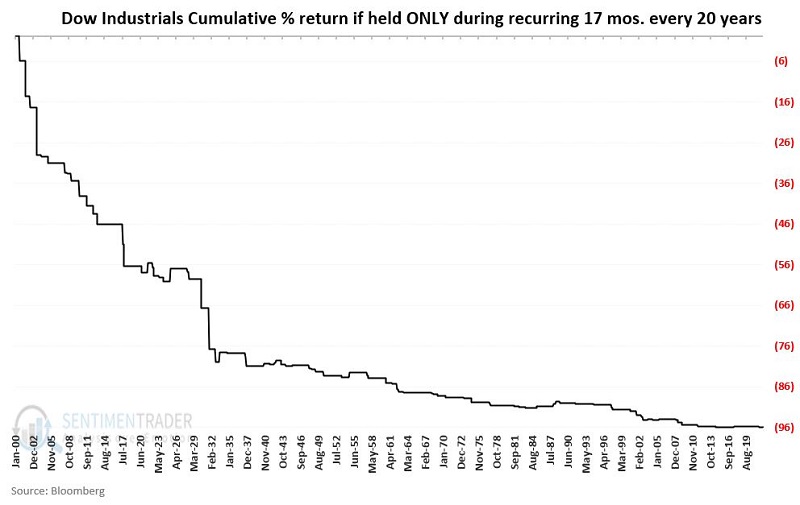
The net result is this - held only during the same 17 months within every 20-year cycle starting in 1901, the Dow Jones Industrials Average has lost -96.3% of its value, which is pretty hard to believe (yet mathematically correct). Which makes this an opportune time to issue the all-important "past performance is no guarantee of future results" caveat.
Looking ahead
Given the chart above, just how concerned should investors be that "Year 2, Month 6" and "Year 2, Month 9" (June and September 2022) are the next two Ugly 17 months on the list? Unfortunately, each investor must answer that question for themselves.
Last week I highlighted a pretty wide array of seemingly bullish market signals (here and here). The market kindly responded by popping higher into a holiday weekend. So, should all of that purported bullishness be pushed aside? And should we prepare for some more rough months? Again, I report, you decide.
But to get a clearer picture of history, let's take a closer look at these two months historically.
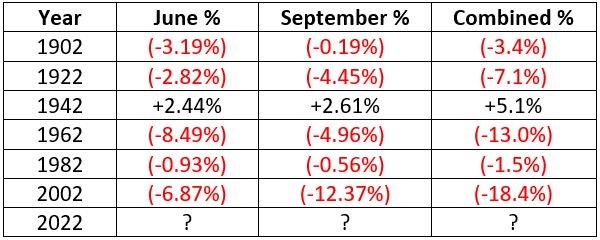
The table below displays the performance of Year2, Month 6. Year 2, Month 9, and the combined results.
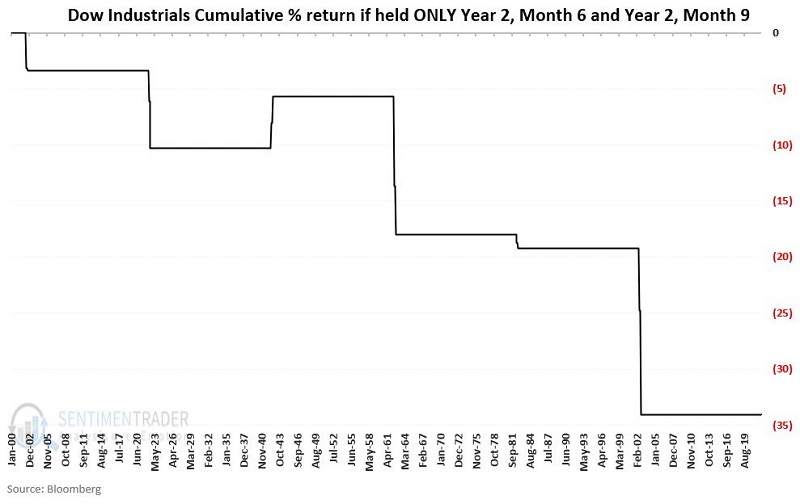
The chart below displays the cumulative % performance for the Dow Jones Industrial Average if held ONLY during these two months every 20 years.
What the research tells us…
So, are investors really to invest - or not - based on some "mystical" forces that purportedly cause the market to move in a particular direction every 20 months? Well, that is the question. At the moment, there are no easy answers as investors can find countless reasons to justify a bullish or bearish opinion. The information above should not be considered a "trading signal" but more as the "weight of the evidence." Investors inclined to be bullish should keep a wary eye open during June and September - or maybe even hedge their bets a bit if they are so inclined. Investors are the bearish side of the ledger should be prepared to push their bets during these two months in anticipation of the potential for significant weakness.