
Products
SentimenTrader Trading Tools
‍
Backtest Engine
My Trading Toolkit
Correlation Analysis
Seasonality
Market Prediction
Indicators & Data API
‍
Proprietary Indicators & Charts
Market Data API
Strategies & Scanner
‍
50+ Trading Strategies
Smart Stock Scanner
Smart Option Scanner
Research Reports
‍
Research Solutions
Reports Library
Free Resources
Simple Backtest Calculator
Simple Seasonality Calculator
The Kelly Criterion Calculator
Sentiment Geo Map
Public Research Reports
Education
Sentiment Indicators
Technical Indicators
Pricing
Company
About
In the News
Testimonials
Client Success Stories
Contact
Log inLoginSign up
< BACK TO ALL REPORTS

Beware beans

Jay Kaeppel
2024-09-10
The approach of harvest season means there is little mystery regarding the nature of the current year's soybean crop. This situation typically leads to a lot of risk premium leaving the market as hedges are unwound. This can create a solid opportunity for speculators willing to play the short side.

Key Points

  • Soybean seasonality in the middle of a period of historically consistent price weakness
  • 2024 could certainly be an exception to the bearish rule, but a trader needs a solid reason to risk holding a long position in beans during the upcoming seasonally weak period
  • Aggressive traders should continue to look for opportunities to press the short side

Why soybean seasonality tends to persist

Each year, as soybean harvesting season begins in the U.S. Midwest, little doubt remains about the state of the crop harvest. It is either good, bad, or somewhere in between, but the critical point is that the state of the crop harvest is a known quantity. As a result, whatever risk premium has been built in typically is shed during this September/early October period.

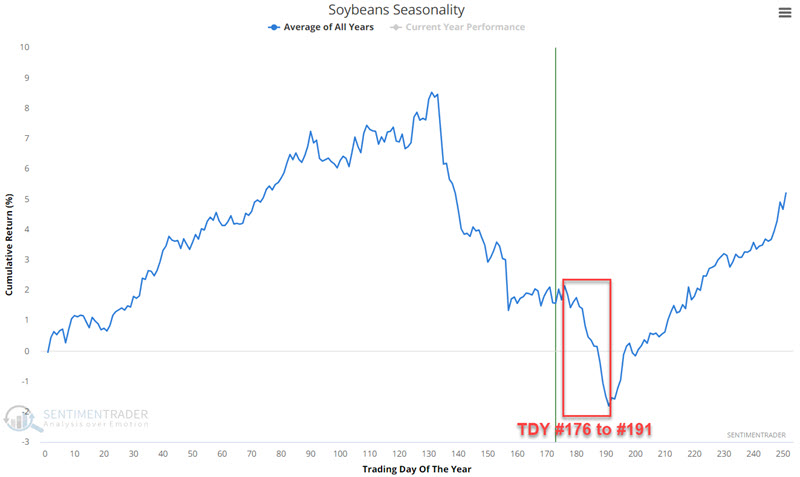
To understand this hedge unwinding, the chart below displays the annual seasonal trend for soybean futures. As you can see, beans are about to enter another period of typical price weakness that extends from the close on Trading Day of the Year (TDY) #176 through TDY #191. For 2024, this period extends from the close of 2022-09-12 through 2022-10-03.
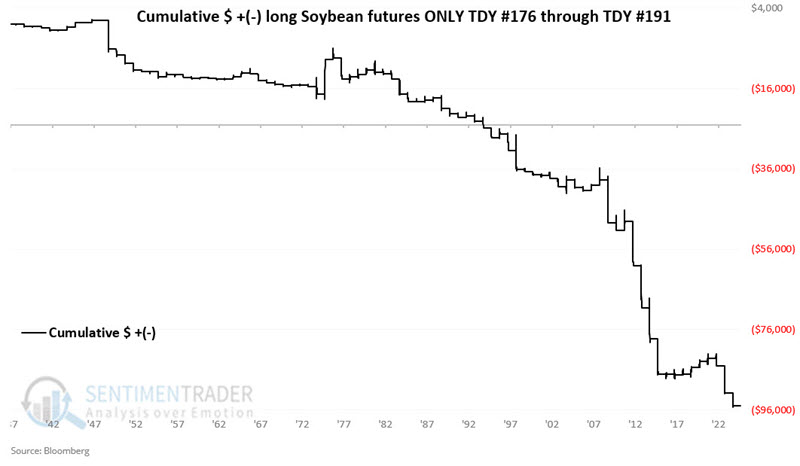
The chart below displays the cumulative $ +(-) for soybean futures held long only during Trading Day of Year #176 through TDY # 191. 
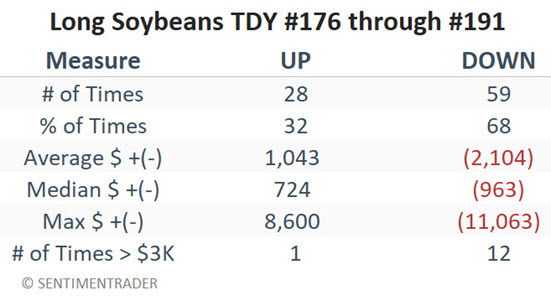
The table below displays a summary of performance starting in 1937.
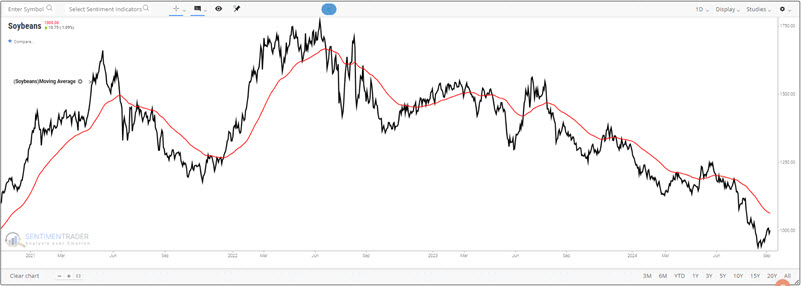
Seasonality tends to be most meaningful when price trends and seasonal trends align. In other words, if the price is in a downtrend when seasonality says it "should" be in a downtrend, that typically tends to be a good time for traders to press their advantage. The chart below shows that soybeans have been in a significant downtrend for some time. The one concern might be that they are so oversold that there may not be much downside potential left.
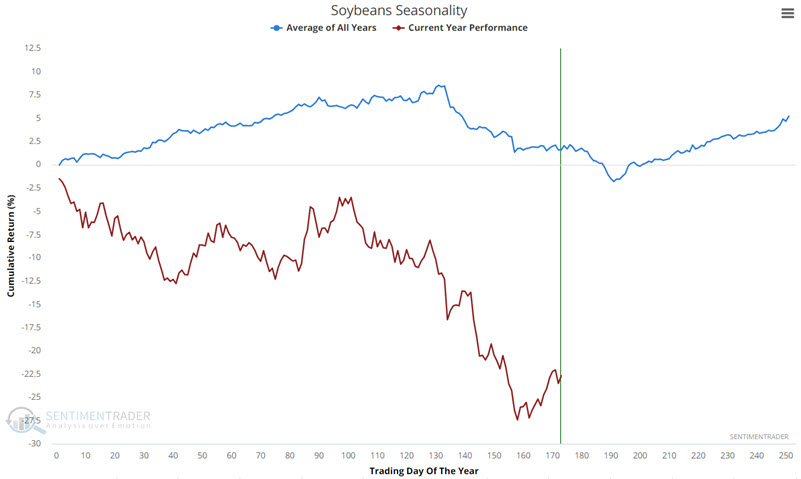
The chart below compares soybean's annual seasonal trend to actual price action so far this year. Even the typically favorable early part of the year failed to show any strength. 
What the research tells us…

The standard seasonality caveat applies: In any given year, anything can happen. Still, over the past eighty-seven years, in roughly three out of every ten years soybeans decline in price as the fall harvest season approaches. In addition, the losing years tend to be significantly greater than the winning years in terms of $ price movements. A trader must have a solid reason to consider holding a long position during this period. Likewise, speculators willing to play the short appear to have a substantial historical "edge" in their favor.

PRODUCTS
SentimenTrader
Trading Tools
Indicators & Data API
‍
Strategies & Scanner
‍
Research Reports
FREE
RESOUrCES
Simple Backtest
Calculator
Simple Seasonality
Calculator
The Kelly Criterion
Calculator
Sentiment Geo Map
‍
Public Research Reports
‍
Education
Sentiment Indicators
‍
Technical Indicators
‍
Pricing
Bundle pricing
‍
FAQ
‍
Announcements
‍
COMPANY
‍
About
‍
In the News
‍
Testimonials
‍
Client Success Stories
CONTACT
‍
General Inquiries
‍
Media Inquiries
‍
Financial Professionals Inquiries
‍
© 2026 Sundial Capital Research Inc. All rights reserved.
Setsail Marketing
TermsPrivacyAffiliate Program
Risk Disclosure: The information and tools provided are for research and analytical purposes only and are not intended as investment advice. Market analysis involves uncertainty, and outcomes may differ from expectations. Users should conduct their own due diligence and consider their individual circumstances before making any financial decisions. Past performance is not necessarily indicative of future results.

Hypothetical Performance Disclosure: Hypothetical performance results have many inherent limitations, some of which are described below. No representation is being made that any account will or is likely to achieve profits or losses similar to those shown; in fact, there are frequently sharp differences between hypothetical performance results and the actual results subsequently achieved by any particular trading program. One of the limitations of hypothetical performance results is that they are generally prepared with the benefit of hindsight. In addition, hypothetical trading does not involve financial risk, and no hypothetical trading record can completely account for the impact of financial risk of actual trading. for example, the ability to withstand losses or to adhere to a particular trading program in spite of trading losses are material points which can also adversely affect actual trading results. There are numerous other factors related to the markets in general or to the implementation of any specific trading program which cannot be fully accounted for in the preparation of hypothetical performance results and all which can adversely affect trading results.

Testimonial Disclosure: Testimonials appearing on this website may not be representative of other clients or customers and is not a guarantee of future performance or success.