
An options alternative in high-yield bonds

Key Points
- High yield bonds have been hit hard in recent months
- A lot of evidence is lining up on the bullish side of the ledger…
- …however, price action remains vulnerable looking
- A simple, low-cost option trade may offer an alternative to committing a much larger sum to buy high-yield ETF shares
High Yield Bonds
I wrote about high-yield bonds in this article. Jason wrote about his latest perspective here. Rising yields continue to roil the bond market - including the high-yield sector. Nevertheless, the case can firmly be made (or, more accurately, was made in the two linked articles) that the high-yield bond sector is reaching an inflection point. Will they rally from here? Or will they break down to new lows?
The reality is that either is a possibility. But since both linked articles generally argue the bullish point of view, the next - and possibly more important - question is "how to take advantage of a potential bounce in high-yield bonds without incurring a great deal of risk?"
The most straightforward approach
The simplest approach would be to buy 100 shares of HYG (name). As this is written, HYG is trading at $80.79 a share, so 100 shares would require a capital commitment of $8,079. Each $1 increase in the price of HYG will generate $100 of profit and vice versa. The straightforward nature of this approach is clear in the screenshots below.
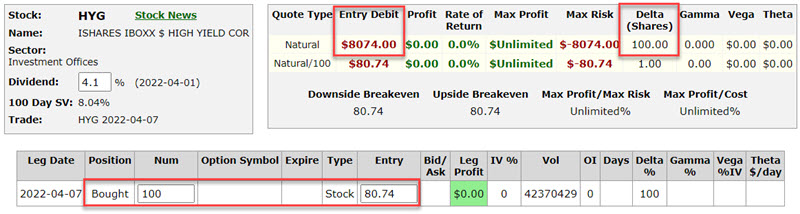
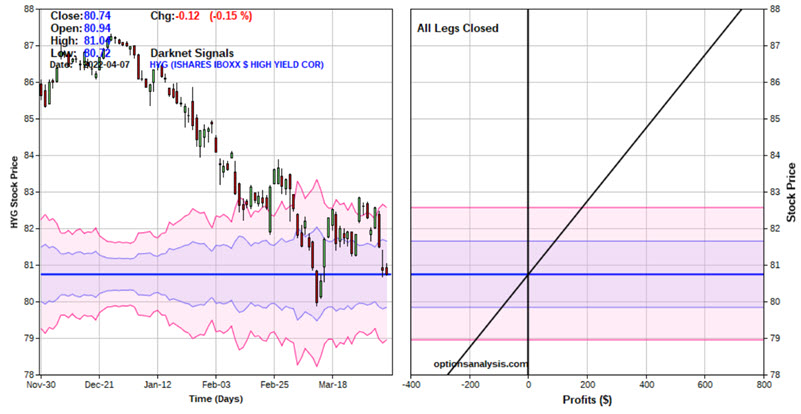
There is nothing wrong with this approach, assuming $8,079 is not too large a part of your overall portfolio and assuming you decide on where you would cut a loss and actually follow through.
But there are alternatives.
Long call option
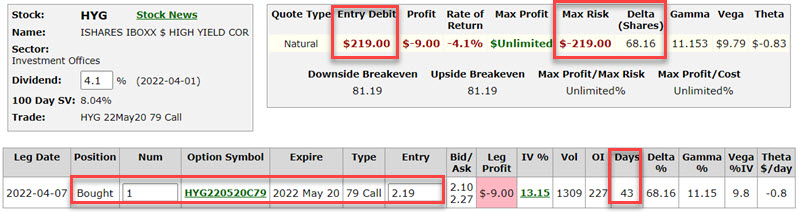
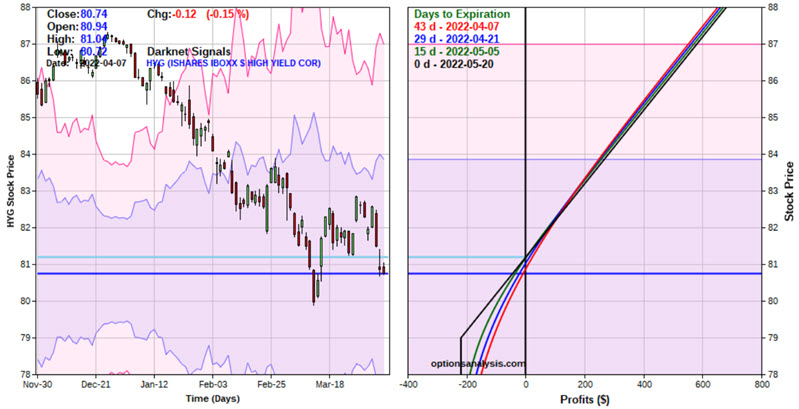
Let's consider an alternative - buying one HYG May20 2022 call option for $219. The particulars appear in the screenshot below and the risk curves in the one below that.
Things to note:
- There are 43 days left until the May option expiration
- The trade costs $219 to enter, which also represents the maximum risk
- The breakeven price equals (strike price + option price) or 79+2.19 = $81.19
- The trade has a "delta" of 68 (which means it is essentially an equivalent position to holding 68 shares of HYG
Comparing the two positions
The chart below overlays the risk curves for the two trades.
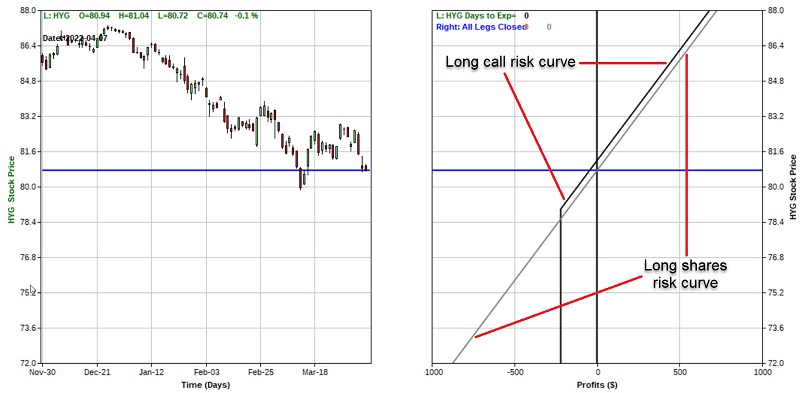
As you can see in the chart above, the two most important factors regarding the option trade are these:
- IF HYG rallies, the option position will gain point-for-point with the stock shares once HYG rises above the breakeven price of $81.19
- IF HYG collapses, the worst possible loss is for the option position is -$219, whereas the stock position continues to lose another -$100 for each point HYG shares decline
For example, let's assume HYG rallies modestly to $84 a share.

Formulating a plan
One of the keys to option trading success is to formulate a plan of action (or inaction, as the case may be) depending on what happens after entering a trade. The problem is that there is no definitive "right" or "wrong" way to manage an options trade. There are only decisions to be made and a need for discipline to follow the plan. What follows is merely an example of one way to manage this trade.
- Because this is essentially pure bottom-picking, we will treat it as a speculative trade and trade a very small size. If we assume a $25,000 account size and a willingness to risk 1% of our capital, that means we can commit a maximum of $250. So in this case, we will trade a 1-lot.
- Next, in entering the trade with a bid price of $2.10 and an ask price of $2.27, we will place a limit order at the midpoint of $2.19. If not filled near the close of the first day, we will decide whether to use a market order or develop a new limit price for the next day.
- In this case, we will not play for the "home run." HYG has some overhead resistance near $84 a share. So if HYG approaches $84 a share, we will sell the call and take our profit. One alternative would be to "let it ride" in hopes of additional gains if we anticipate that HYG will breakout above $84 and continue to run. Another possibility would be to sell the May call and roll out to another month to give HYG more time to move higher. One would want to carefully consider the width of the bid/ask spreads before acting.
- On the downside, HYG has an obvious support level at the recent low of $79.88. If HYG drops below the (arbitrary, subjective) price of $79.75, we will sell our call and salvage whatever premium we can. We will, however, also keep an eye open for an opportunity to re-enter if things improve - based primarily on the belief that the positive factors highlighted in the two articles linked above will eventually trigger a meaningful rally. Given that we are risking only 1% of our trading capital, a reasonable alternative would be to let it ride and assume the full $219 risk.
What the research tells us…
The call option position in this example appears to have several attractive advantages. However, there are no free lunches in trading. The key thing to remember is that in 43 days, the call option will expire and cease to exist. So, unless HYG moves higher in fairly short order, this option could expire worthless. A trader would have to make another decision - i.e., buy another call option and pay another premium or throw in the towel. Meanwhile, the trader holding 100 shares of HYG can hold on indefinitely.
Nevertheless, from a reward/risk standpoint, this example illustrates the potential for trading a low-cost option position versus buying shares.