
An off-the-beaten-path opportunity
Key points
- Live Cattle futures are not a market most traders consider
- However, like a lot of markets, at times, it is rife with opportunity
- This market has just entered its most unfavorable seasonal period of the year
Live Cattle is highly cyclical
A cursory glance at the weekly chart for Live Cattle futures shown below reveals the extremely choppy nature of price movements.
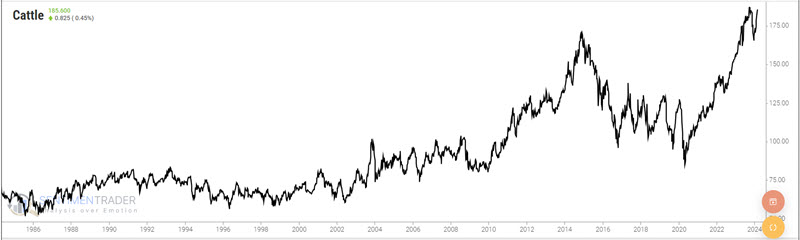
Interestingly, while there appears to be little rhyme or reason for the movements in the price chart above, several tendencies are abundantly clear when we break down price action intra-year.
The chart below displays the annual seasonal trend for Live Cattle futures.
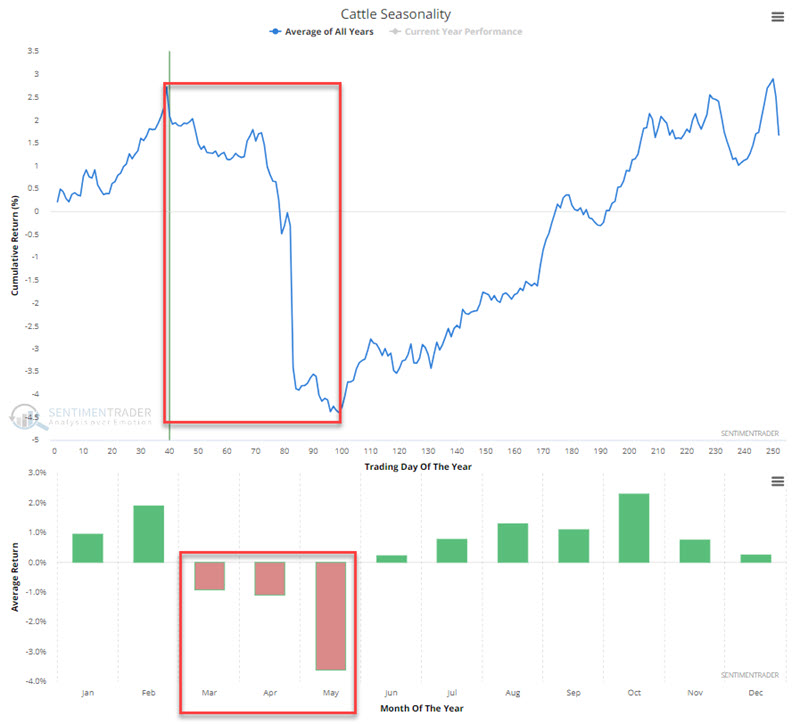
The critical period to note is the one highlighted in the red boxes. This period extends from the close of Trading Day of the Year (TDY) #39 through TDY #99 and encompasses most of March, April, and May.
For 2024, this period extends from the close on 2024-02-27 through the close on 2024-05-22
Using our new "Growth of $1" feature in our seasonality charts, we see the hypothetical Growth of $1 invested in Live Cattle only during this seasonal period each year starting in 1985. The results speak for themselves.
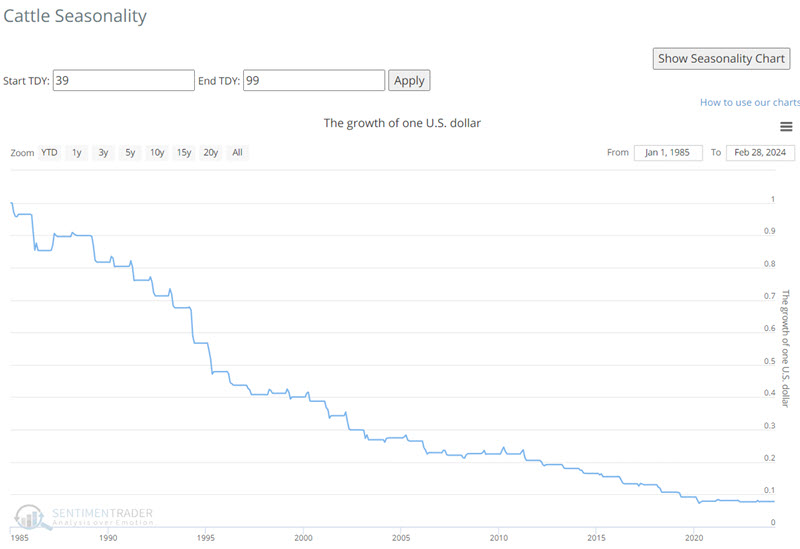
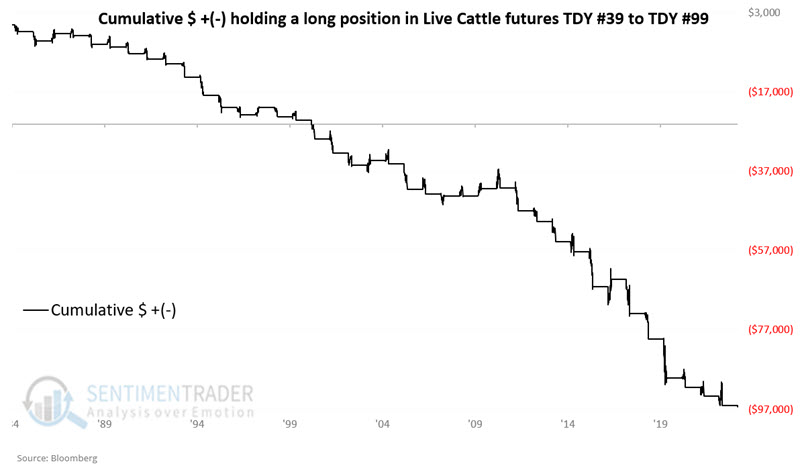
Note that for the sake of perspective and treating all markets and ETFs similarly, the Growth of $1 feature is based on percentage price changes. For futures markets, the actual dollar value gained or lost from holding a long (or short) position depends upon the contract size and the dollar value per point. The "Contract Size" for Live Cattle is 40,000 pounds of live cattle, and the dollar value is $400 per point.
So, if a Live Cattle futures contract were to advance from a price of 170 to 180, this 10-point change in the contract price would result in a $4,000 change in the value of the contract. In this example, a trader holding a long position would gain +$4,000, and a trader holding a short position would lose -$4,000.
The chart below displays the cumulative hypothetical $ +(-) achieved by holding a long position in Live Cattle futures only from TDY #39 through TDY #99 each year starting in 1985. An astute trader would consider taking a short position instead.
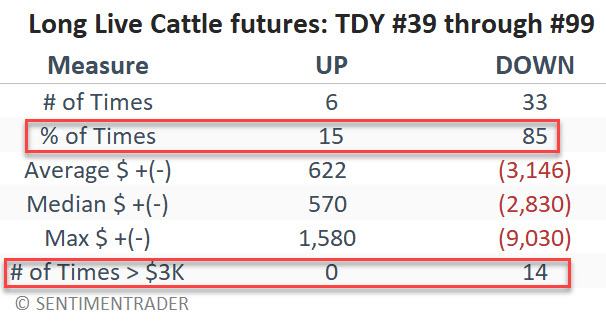
The table below summarizes Live Cattle futures performance from TDY #39 through TDY #99 each year starting in 1985.
What the research tells us…
Live Cattle is a highly cyclical market and has demonstrated a strong tendency for weakness from late February through late May. As always, a trader considering a short position in any futures market must carefully consider the risks involved - including essentially unlimited risk and the fact that Live Cattle futures can move "lock limit" on a given day (meaning you might not be able to exit a short position until the market stops making lock limit moves). A trader with the emotional and financial wherewithal to trade Live Cattle futures may be looking at an opportunity.