Products
SentimenTrader Trading Tools
‍
Backtest Engine
My Trading Toolkit
Correlation Analysis
Seasonality
Indicators & Data API
‍
Proprietary Indicators & Charts
Market Data API
Strategies & Scanner
‍
50+ Trading Strategies
Smart Stock Scanner
Research Reports
‍
Research Solutions
Reports Library
Free Resources
Simple Backtest Calculator
Simple Seasonality Calculator
The Kelly Criterion Calculator
Sentiment Geo Map
Public Research Reports
Education
Sentiment Indicators
Technical Indicators
Pricing
Company
About
In the News
Testimonials
Client Success Stories
Contact
Log inLoginSign up
< BACK TO ALL REPORTS

An extremely rare sector signal

Dean Christians
2023-05-12
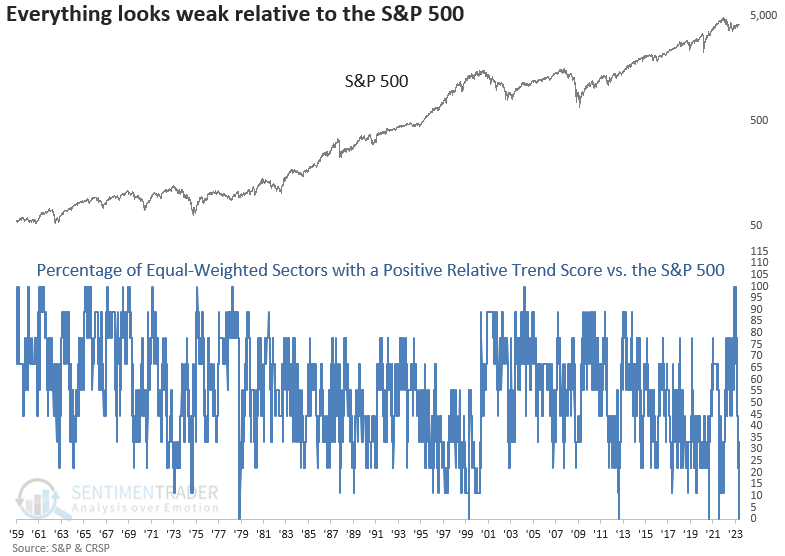
The percentage of equal-weighted S&P 500 sectors with a positive relative trend score versus the S&P 500 declined to 0% for only the 6th time since 1959. After similar periods of narrow market leadership, the S&P 500 showed an upward bias in price. From a portfolio allocation perspective, one would be better off rotating from the cap-weighted S&P 500 to the equal-weighted version.

Key points:

  • Not a single S&P 500 equal-weighted sector maintains a positive relative trend score versus the S&P 500 
  • After similar relative trend profiles, the S&P 500 showed an upward bias, with the EW Index outperforming
  • When I adjust the study conditions, an expanded sample size provides a similar message 

Does a narrowing in market leadership suggest an unhealthy market

Fewer and fewer stocks and sectors are outperforming the S&P 500. However, narrowing market leadership doesn't always spell doom and gloom for the world's most benchmarked index. Sometimes, investors crowd into the relative safety of meg-cap names or rotate amongst sectors in times of uncertainty.

While reviewing sector trend scores last night, I noticed that not a single S&P 500 equal-weighted sector maintained a positive relative trend score versus the S&P 500 Index.

Let's assess the outlook for the S&P 500 under similar narrow leadership conditions.
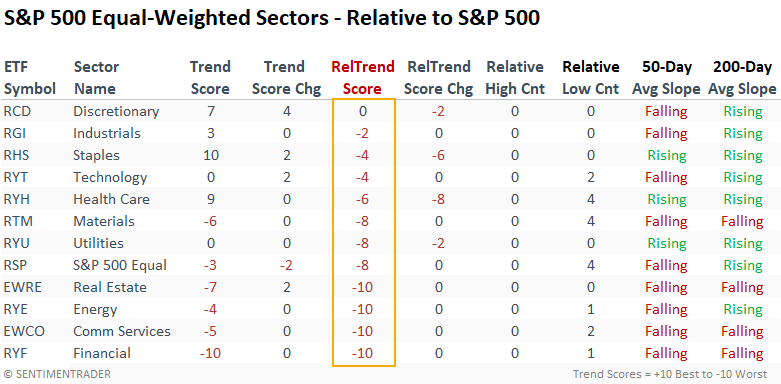
The equal-weighted Consumer Discretionary sector relative trend score dropped two points on Thursday. In doing so, not a single group maintains a positive relative trend score versus the S&P 500.
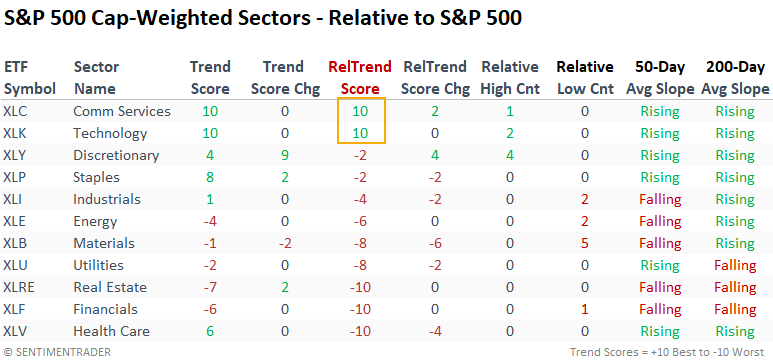
Even the market capitalization weighting methodology for sectors shows a narrowing in leadership, with only two positive groups versus the S&P 500. Interestingly, the Communications Services sector maintains a perfect score of 10. In contrast, the equal-weighted version displays a score of -10.
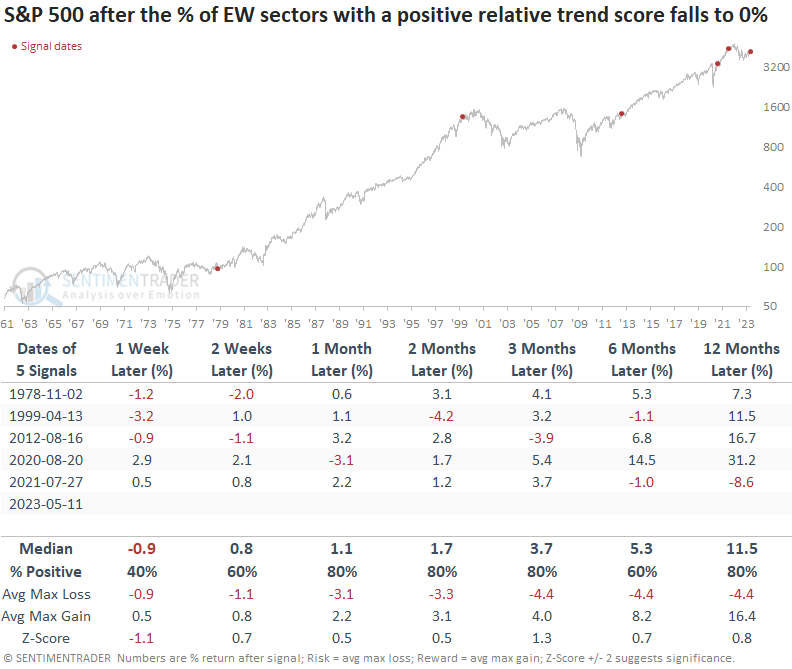
Similar periods of narrow market leadership preceded positive gains

When the percentage of equal-weighted sectors with a positive relative trend score versus the S&P 500 falls to 0%, the S&P 500 had a positive return at some point over the next six months in every case. And the max loss over that same period was -6%. 
When I apply the signals to the equal-weighted S&P 500 Index, returns and win rates are excellent across all time frames. And, once again, drawdowns were minimal.
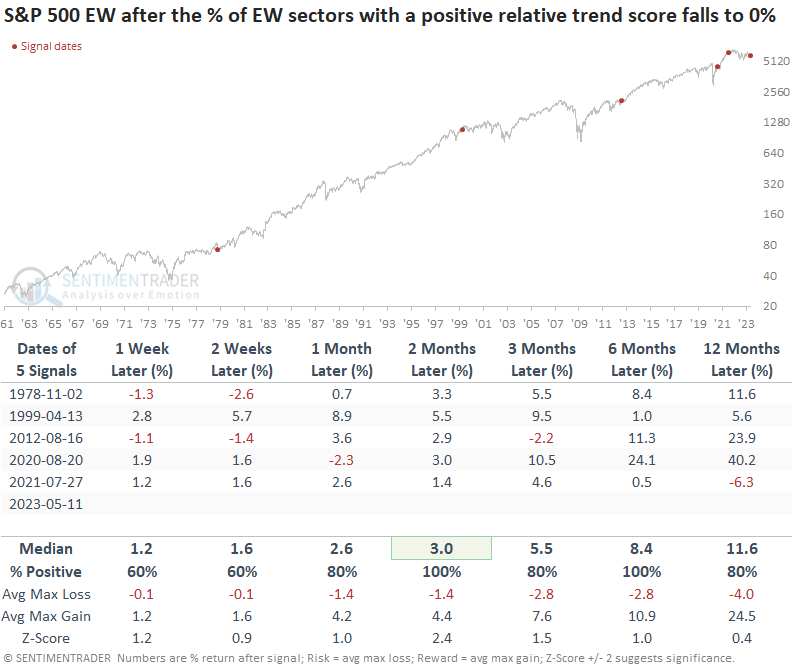
Based on the difference between the two index weighting methodologies, one could make a solid case for owning the equal-weighted S&P 500 ETF (RSP) instead of the cap-weighted ETF (SPY).
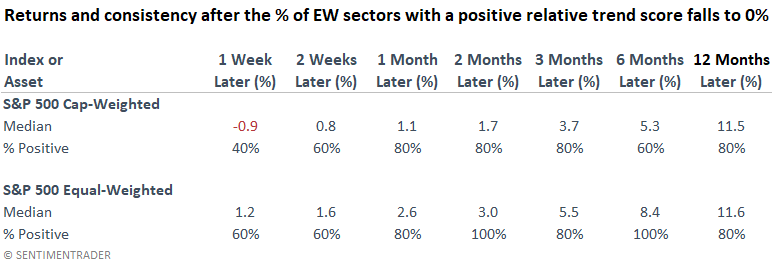
An adjustment to the threshold level

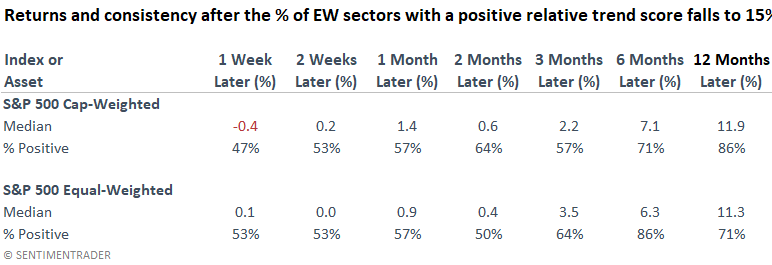
If I raise the threshold from 0% to 15% to capture a larger sample size, the study still shows a bullish upward bias. However, it picks up a few untimely precedents, like 1973, 1974, 1998, and 2018. So, in those cases, the narrowing in market leadership foreshadowed a drawdown phase.
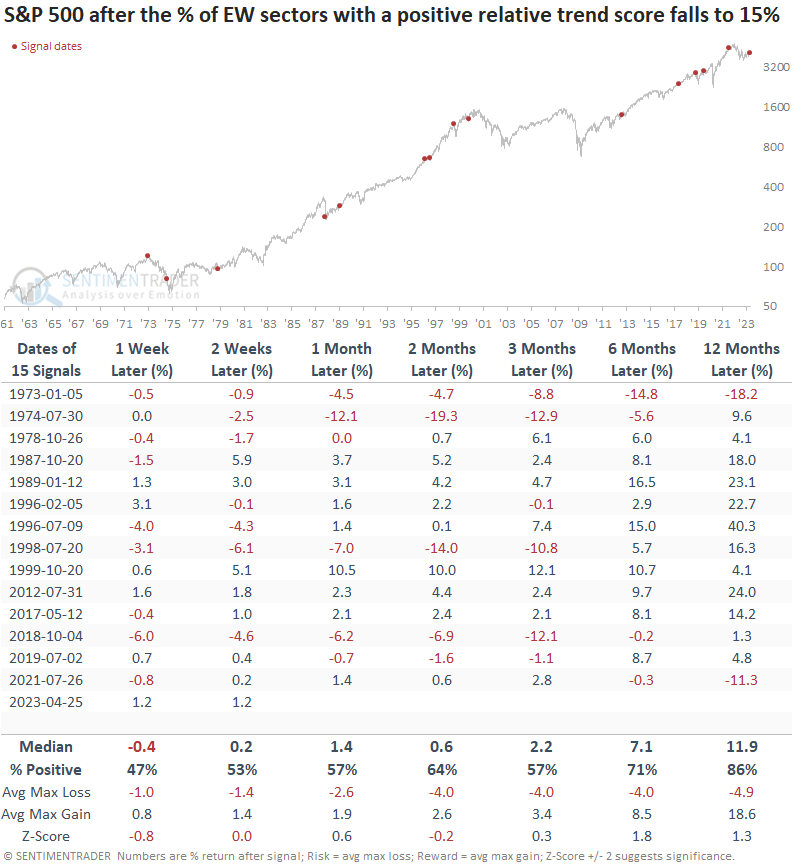
Returns and win rates for the equal-weighted S&P 500 outlook table look similar to the cap-weighted one. 
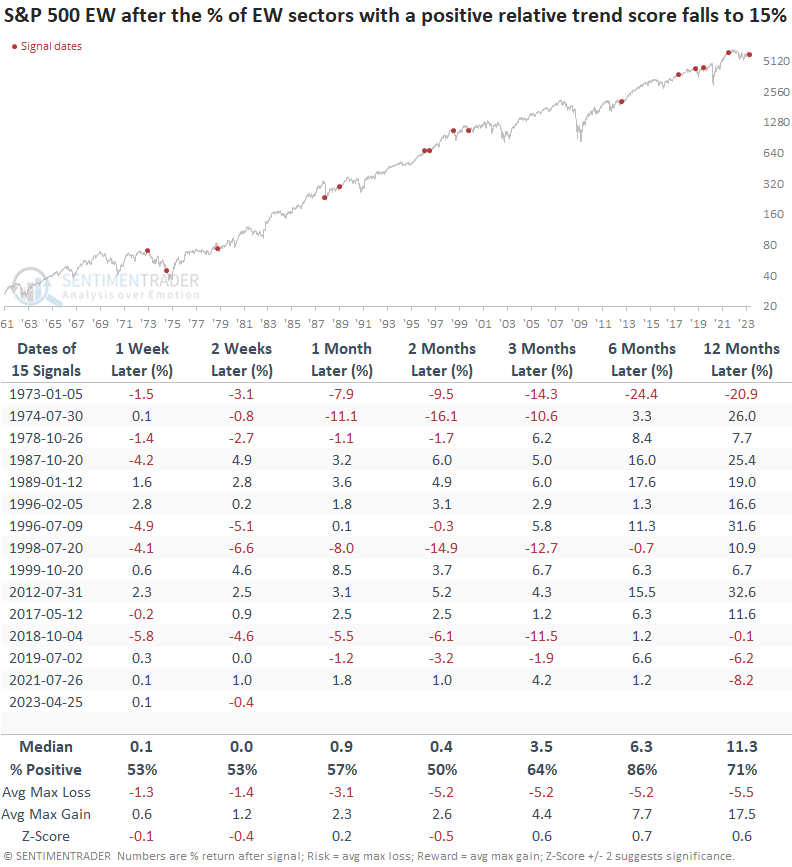
The cap-weighted version shows a slight advantage when I compare the two index methodologies, which is unsurprising as it tends to outperform in drawdown phases.
What the research tells us...

There is no denying that market leadership has narrowed to a handful of issues as uncertainty about the economy and the ongoing banking crisis remains a concern. Despite the uneasiness, other periods with a similar narrowing in market leadership have not produced a doom-and-gloom scenario for the S&P 500. More often than not, the divergence between sectors and the S&P 500 tended to resolve itself with an upward bias in price. 

Sorry, you don't have access to this report

Upgrade your subscription plan to get access
Go to Dasboard
PRODUCTS
SentimenTrader
Trading Tools
Indicators & Data API
‍
Strategies & Scanner
‍
Research Reports
FREE
RESOUrCES
Simple Backtest
Calculator
Simple Seasonality
Calculator
The Kelly Criterion
Calculator
Sentiment Geo Map
‍
Public Research Reports
‍
Education
Sentiment Indicators
‍
Technical Indicators
‍
Pricing
Bundle pricing
‍
FAQ
‍
Announcements
‍
COMPANY
‍
About
‍
In the News
‍
Testimonials
‍
Client Success Stories
CONTACT
‍
General Inquiries
‍
Media Inquiries
‍
Financial Professionals Inquiries
‍
© 2026 Sundial Capital Research Inc. All rights reserved.
Setsail Marketing
TermsPrivacyAffiliate Program
Risk Disclosure: The information and tools provided are for research and analytical purposes only and are not intended as investment advice. Market analysis involves uncertainty, and outcomes may differ from expectations. Users should conduct their own due diligence and consider their individual circumstances before making any financial decisions. Past performance is not necessarily indicative of future results.

Hypothetical Performance Disclosure: Hypothetical performance results have many inherent limitations, some of which are described below. No representation is being made that any account will or is likely to achieve profits or losses similar to those shown; in fact, there are frequently sharp differences between hypothetical performance results and the actual results subsequently achieved by any particular trading program. One of the limitations of hypothetical performance results is that they are generally prepared with the benefit of hindsight. In addition, hypothetical trading does not involve financial risk, and no hypothetical trading record can completely account for the impact of financial risk of actual trading. for example, the ability to withstand losses or to adhere to a particular trading program in spite of trading losses are material points which can also adversely affect actual trading results. There are numerous other factors related to the markets in general or to the implementation of any specific trading program which cannot be fully accounted for in the preparation of hypothetical performance results and all which can adversely affect trading results.

Testimonial Disclosure: Testimonials appearing on this website may not be representative of other clients or customers and is not a guarantee of future performance or success.