
An easing in financial conditions triggers a buy signal for stocks

Key points:
- The Goldman Sachs Financial Conditions Index reversed lower relative to its recent range
- A trading system based on the GS Financial Conditions Index triggered a buy signal
- After similar alerts, annualized returns for the S&P 500 were higher when compared to sell signals
Financial conditions are easing, which is good news for stocks
The Federal Reserve and other central banks around the globe increased interest rates in 2022 at one of the fastest paces in history. The goal was to tighten financial conditions so economies would slow and inflation would recede from one of the highest levels in more than four decades.
Generally, stock markets thrive when financial conditions are easing, not tightening, as was the case for most of 2022.
A trading system that measures when financial conditions are tightening or easing triggered the first buy signal in almost a year.
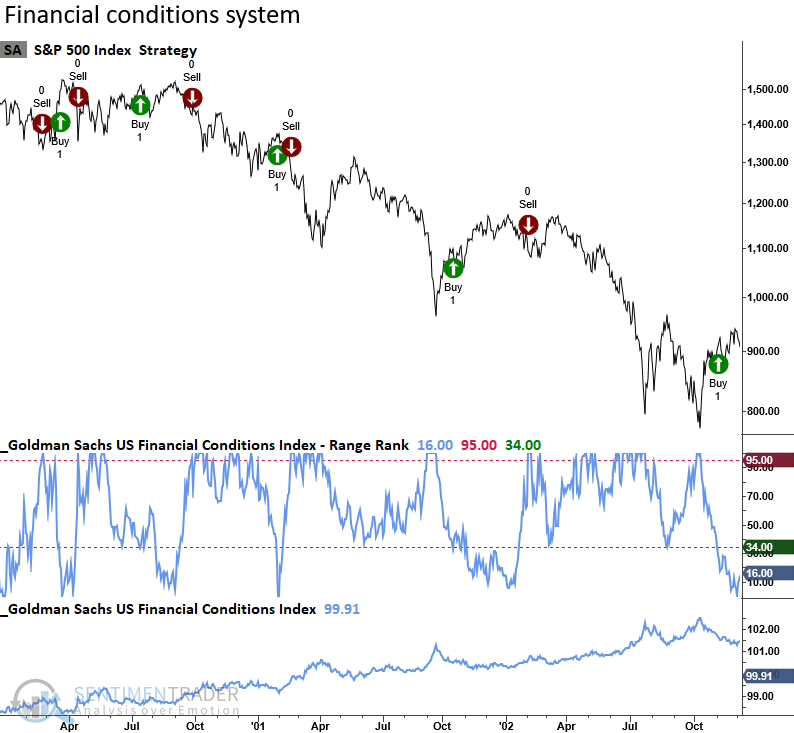
The model applies an 84-day range rank to the Goldman Sachs Financial Conditions Index. When the range rank declines below the 34th percentile and S&P 500 price momentum is positive, the system goes long. Conversely, the model issues a sell signal when the range rank increases above the 95th percentile and the S&P 500 exhibits negative price momentum.
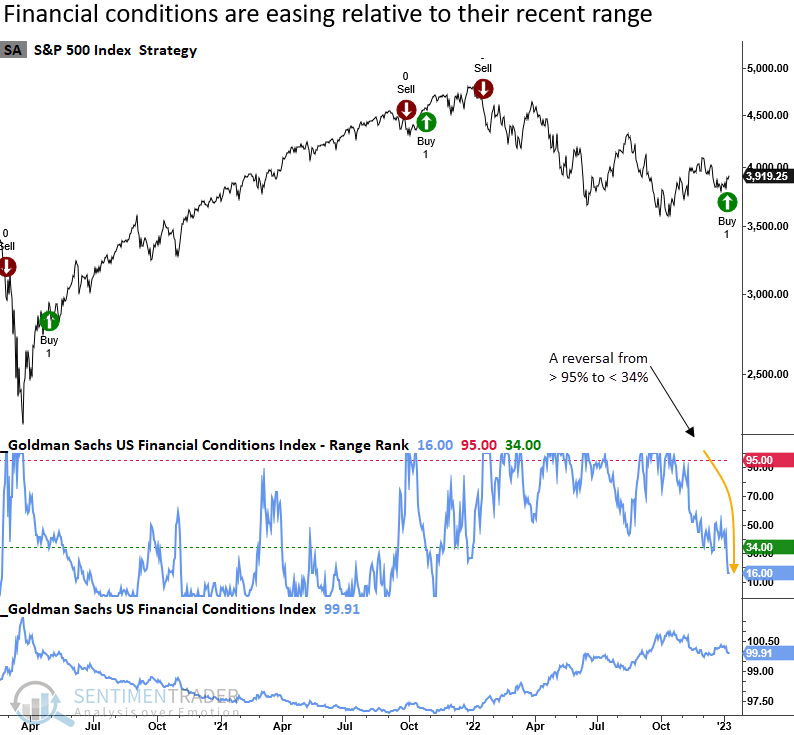
Similar reversals in financial conditions preceded positive returns
When the range rank for the Goldman Sachs Financial Conditions Index reverses from a period of tightening to easing conditions, the S&P 500 shows a positive upward bias with solid z-scores across most time frames. However, measuring results with an outlook table for a binary trading system has limitations.
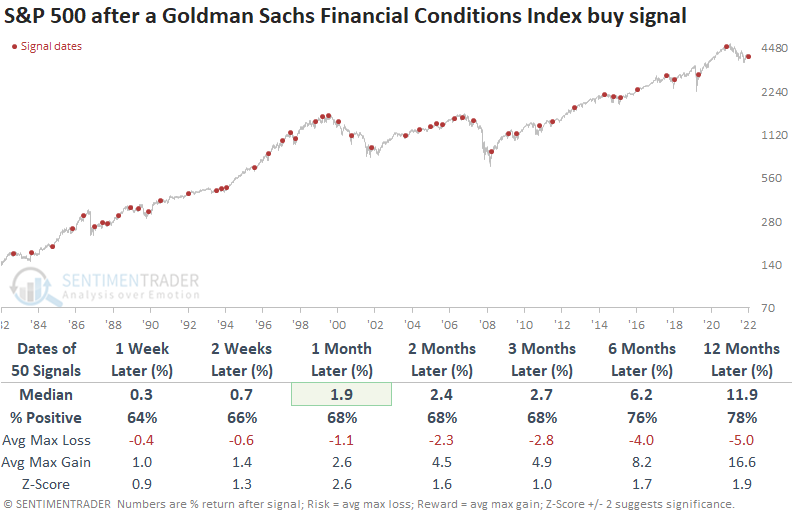
Because the system is either all in or out, annualizing returns for the buy or sell periods is a better performance measure. For instance, when the system issues a buy signal, the S&P 500 annualized at 11.5%, which is 3% more than when the model triggered a sell signal.
If the 8.3% annualized return for sell signals seems high, please remember that the system is not timely around drawdown lows. Significant gains occur between the time the equity market bottoms and a new buy signal, which influences the overall annualized return upward.
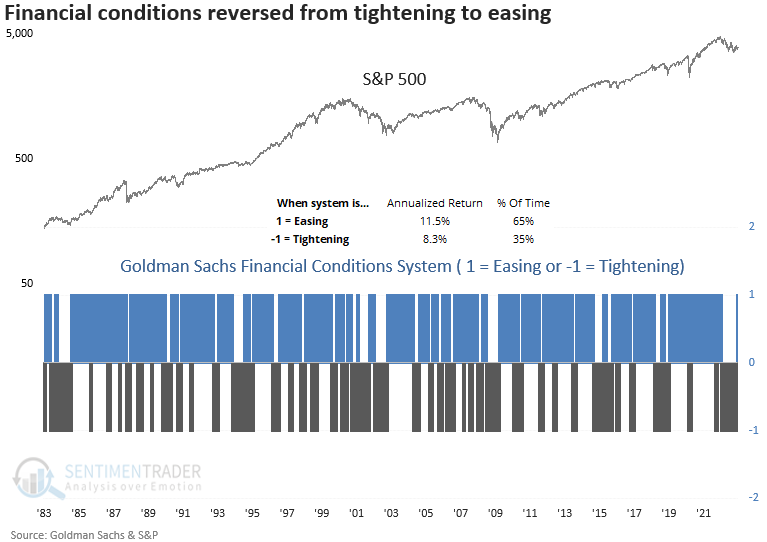
Historical bear market examples
One of the benefits of the financial conditions trading system is that if the model gives a false signal on a countertrend rally in a bear market, it will reverse course, which it did on two occasions in the 2007-09 bear market.
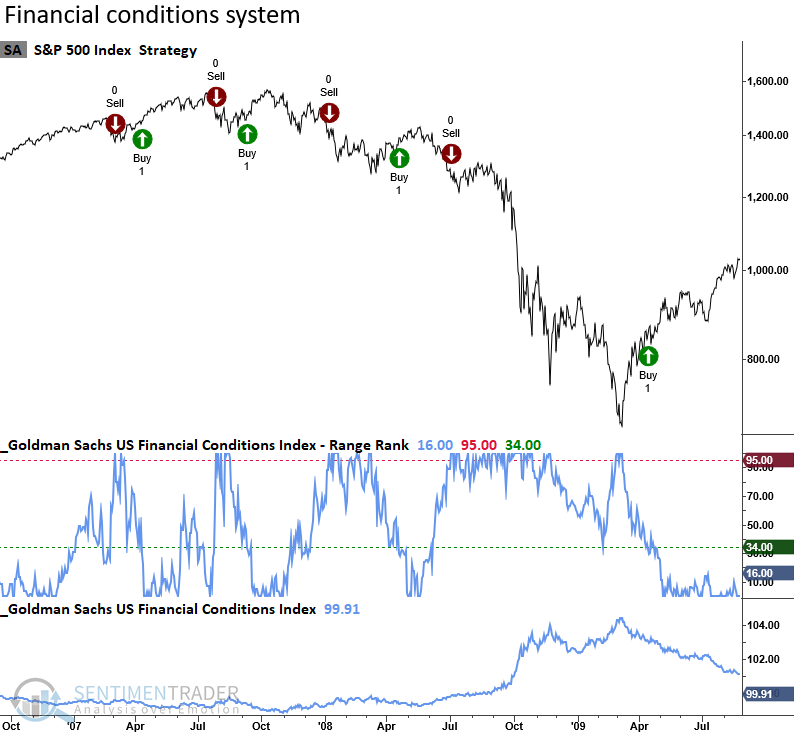
During the 2000-02 bear market, the system generated three buy signals, which the model reversed to avoid the bulk of the notable drawdown.
What the research tells us...
Financial conditions are easing, and that's typically a bullish development for stocks. When the Goldman Sachs Financial Conditions Index declines relative to its current range and price momentum is positive, the S&P 500 trends upward. An assessment of returns under easing conditions shows that the S&P 500 annualizes at 11.5% versus only 8.3% when conditions tighten. As with most binary systems, one should use the outcome as an additional input in a broader model.