
A word of warning on soybeans

Key points
- Soybeans have shown themselves to be one of the most consistently cyclical commodity markets
- Due to the planting cycle in the U.S., the risk to the current year's crop is typically well known by mid-July
- As the risk premium comes out of the market, the price tends to fall
Following a plunge and a weak rebound, soybean prices have resumed a price downtrend
Soybean prices have declined by over 20% in the last year. After plunging sharply for over a year, the price bottomed in December 2024 and staged a weak rebound. Price recently dipped below its 70-day exponential moving average and is in a downtrend.
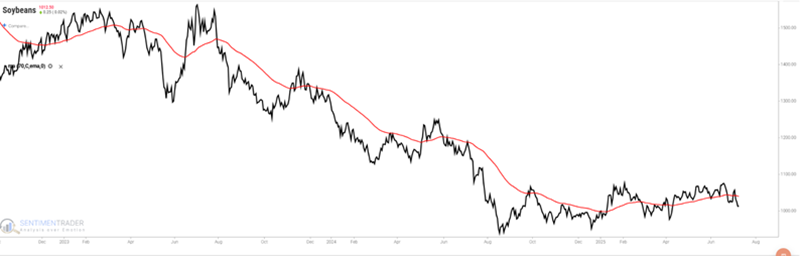
Because soybeans are a highly cyclical market, some pundits expect the next big price move to be up. Perhaps they will ultimately be proven correct. Nevertheless, history strongly suggests that caution (and a willingness to play the short side instead) is in order. Let's examine this history more closely.
Beans are just now entering a period of typical seasonal weakness
The Annual Seasonal Trend chart for soybeans reveals that July, August, and September are typically the weakest months of the year for beans.
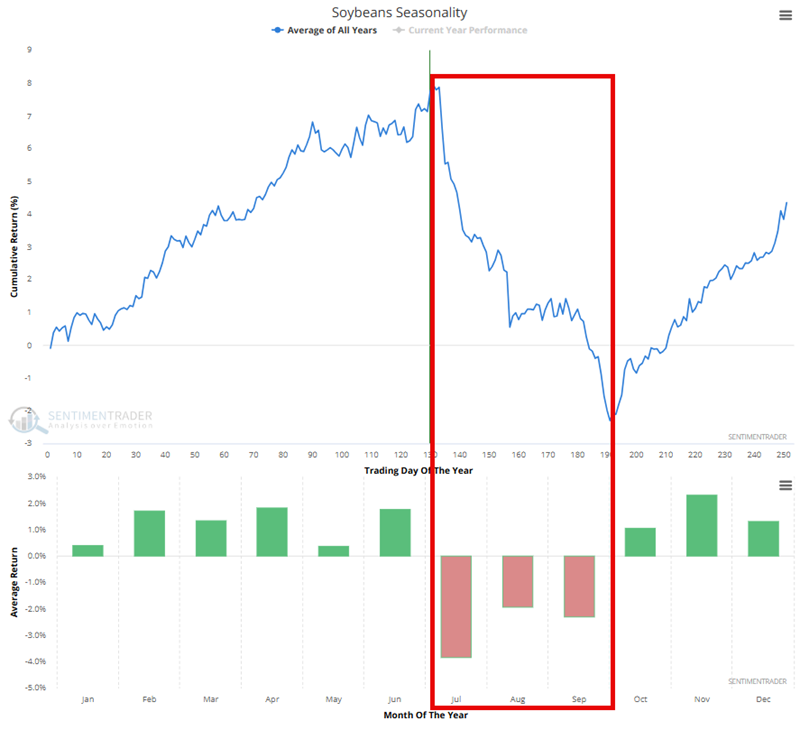
Specifically, the weakest seasonal time of year for beans extends from the close on Trading Day of the Year (TDY) #131 through the close of TDY #191. For 2024, this period extends from the close on 2025-07-14 through 2025-10-07.
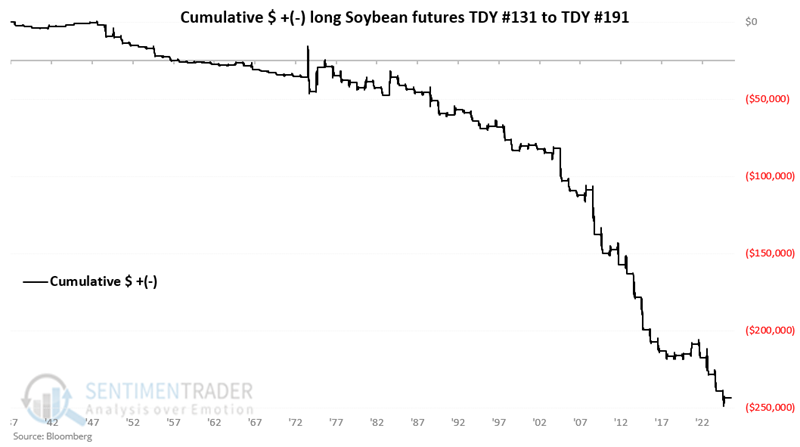
The chart below displays the hypothetical dollar +(-) from holding long one soybean futures contract only during this period every year since 1937. Notice anything?
The table below summarizes soybean performance during this period.
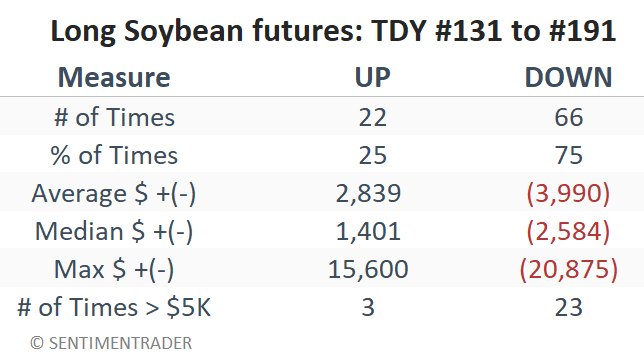
What the research tells us…
As always in the markets, anything is possible. A 25% Win Rate tells us that historically, there is a one-in-four chance that soybeans will show a gain in the next roughly three months. It is also fair to note that during this "bearish" seasonal period, beans gained over $15K in 1974, over $11K in 1983, and over $6K in 202. So there are no guarantees. That said, while those three years saw gains of over $5K, 23 years saw a loss of over $5K for soybeans between TDY #131 and #191. That combined with a 75% loss rate, higher average and median declines, and the fact that price and seasonality are presently in agreement, argues strongly for traders to favor the short side of the soybean market.
In theory, soybeans should continue to decline in price. In reality, each trader must decide when to enter the market on the short side, how much capital they are willing to risk, and where to place a stop-loss order. Remember, setups and indicators - no matter how promising they appear - never relieve you of your responsibility to manage your trades and the capital in your account.