
A warning sign returns as macro deteriorates

Key Points
- The Goldman Sachs Bear Market Probability Index remains ensconced in unfavorable territory
- Our Macro Index Model fell on June 1st into unfavorable territory
- This confluence of factors has triggered another potential warning sign for stocks
Indicator #1: Bear Market Probability
The Bear Market Probability indicator is calculated by Goldman Sachs using five fundamental inputs - the U.S. Unemployment Rate, ISM Manufacturing Index, Yield Curve, Inflation Rate, and P/E Ratio. Each month's reading is ranked versus all other historical readings and assigned a score. In theory, the higher the score, the higher the probability of a bear market in the months ahead.
The chart below displays those months when this indicator stood at 0.72 or higher. The readings occurred in 1972, 1999-2000, 2005-2006, 2017-2018, and 2021. 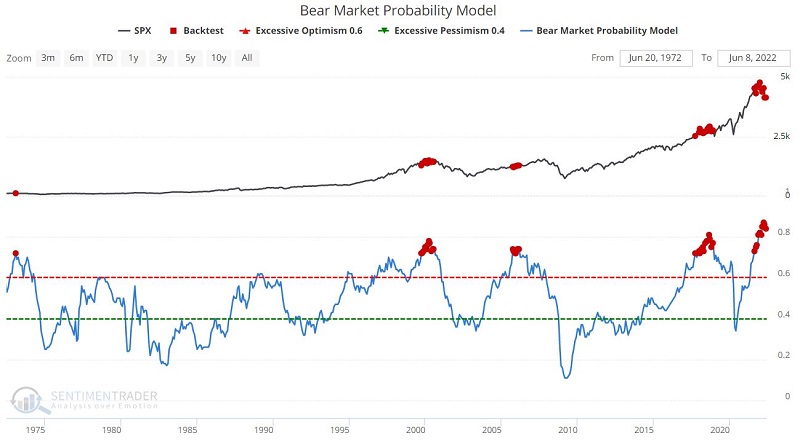

Sometimes, these readings were very timely; in others, they were a bit early. The results might be disappointing if one relies on this model as a precision timing tool. However, if one includes this indicator as part of a "weight of the evidence" approach, the signals can help keep you alert to potential impending dangers.
Indicator #2: Macro Index Model
Our composite economic model - the Macro Index Model - is favorable for stocks and the overall economy when it is above 0.70 and unfavorable when it is below 0.70. For a more detailed discussion of this indicator, see this article. See Dean's article for an in-depth look at the implications of this latest decline.
The chart and table below display the Macro Index Model below 0.70.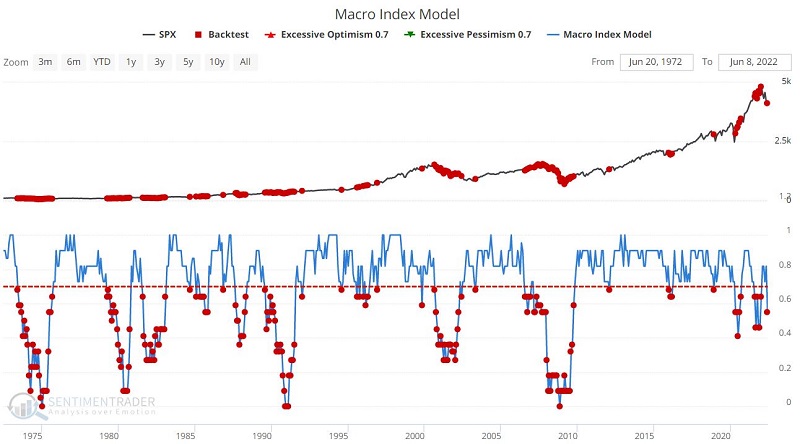

As you can see, stock market performance is typically subdued when the state of the economy is in question.
Bear Market Probability - Macro Index Model
Jason first introduced the combination of these two valuable indicators in this September 2021 article. The chart below displays the net result when the value for the Macro Index Model is subtracted from the Bear Market Probability indicator. It also highlights when the value crossed above 29 for the first time in six months.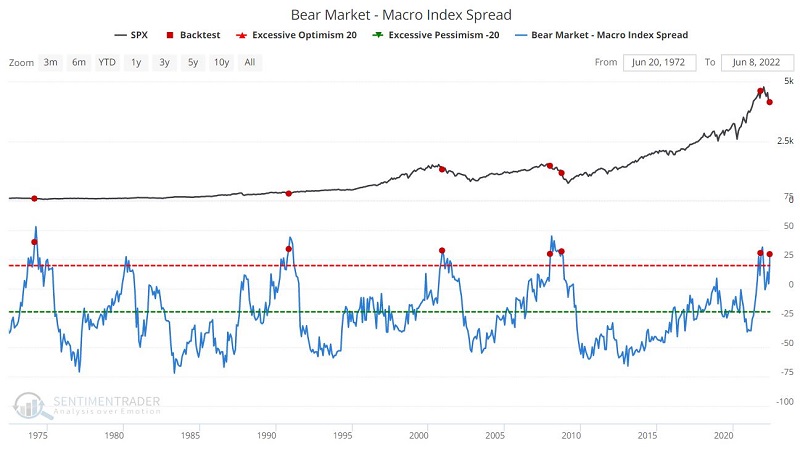
The table below displays a summary of S&P 500 performance following previous signals.
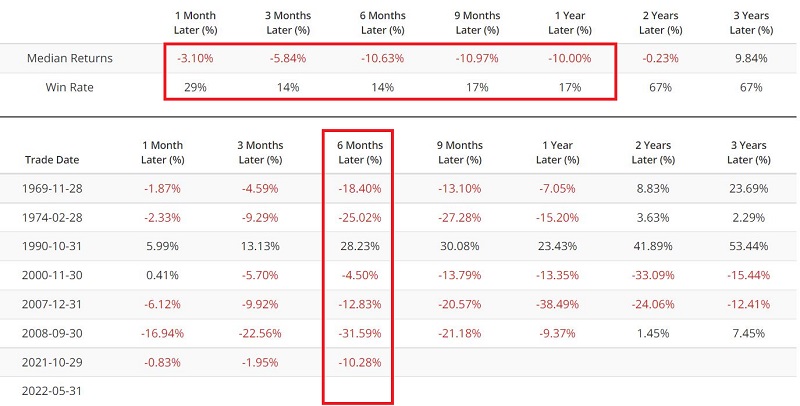
Results during the six months following a signal have been particularly subpar. The exception was 1990, which showed no ill effects as the economy recovered quickly and the stock market soared. But all other readings - including the 10/29/2021 signal - witnessed significant market weakness over the next 12 months.
For an alternative trading approach using slightly different rules, see this article.
What the research tells us…
On June 1st, the Macro Index Model plunged from 0.818 to 0.545, which pushed the Bear Market Probability - Macro Index Model indicator back above 0.29 for the first time in over six months, thus prompting a new warning signal. Will the year ahead follow the 1990 model and shrug off this unfavorable reading? Or will it follow more in line with the other previous signals? The reality is that there is no way to predict with any certainty. But at the very least, this latest reading suggests that investors "Hope for the best, but prepare for the worst."