
A trend-following approach to investing in commodities - Part II

Key points
- Commodities as an asset class have lagged other asset classes in recent years
- Nevertheless, there appears to be great long-term potential for commodities - both in absolute and relative terms
- Broad-based commodity ETFs offer a way for investors to participate in commodities without the risk of trading futures contracts
A secular commodity bull market remains in play
In this recent note, I detailed a trend-following approach to investing in commodities as an asset class. Commodities have trended sideways for the last three years, and investors have focused much more on stocks and Bitcoin-and rightfully so-as they have trended significantly higher. Still, it can be helpful to remember the following:
Jay's Trading Maxim #40a: No style, sector, or index EVER holds a permanent advantage.
The chart below highlights the Bloomberg Commodity Spot Price (BCOMSP) Index's sideways trend in recent years.
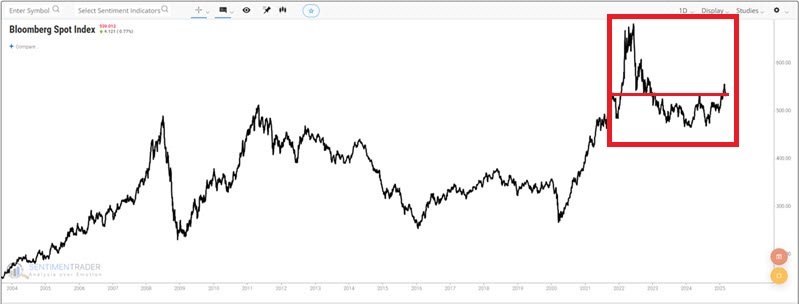
However, there may be more to the story. First, commodities are dirt cheap relative to stocks on a historical basis, as displayed below.
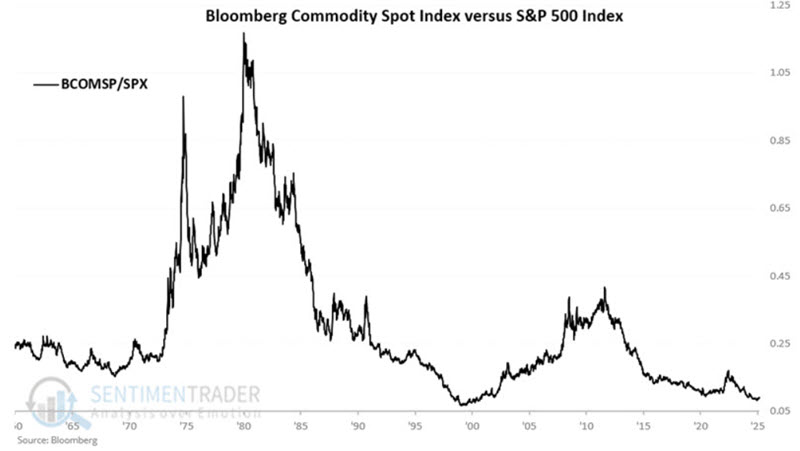
Unfortunately, the chart above offers no clue as to when this trend might reverse to favor commodities - it only suggests strongly that the day WILL ultimately come. However, "under the surface," the tide may be turning.
In this series of articles (here, here, here, and here) from June 2023, I highlighted the 30-year cycle in commodities, specifically the first 15 years of that cycle - which began at the end of June 2023). The chart below highlights BCOMSP action since 2023-06-30. Since that time, the index is up 12%. This pales compared to the S&P 500 (up 31%) and Bitcoin (272%) during that time and explains why commodities have been widely ignored regarding capital allocation.
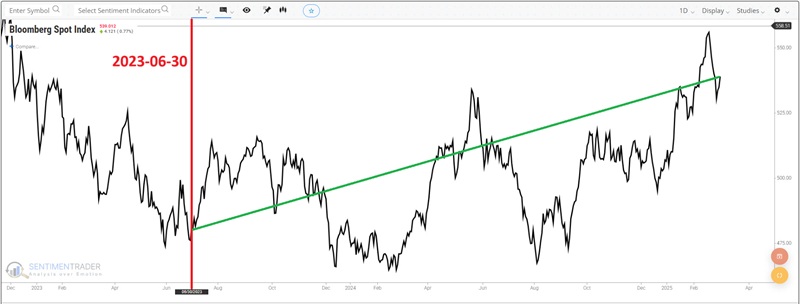
The commodities asset class has been moving in the right direction since the start of the latest 30-year cycle, but not enough to keep up with other asset classes.
There is potential for commodities to vastly outperform other assets in the years ahead (while, again, no assertion is being made that this is the exact moment when that process will begin). Broad-based commodity ETFs may offer investors a simple way to play.
Broad-based commodity ETFs
In this note dated 2025-03-03, I detailed a trend-following approach to investing in commodities as an asset class. This piece will look at several ETFs that might be used to take a position in commodities.
Please note that many commodity-related ETFs track a single commodity, including ticker GLD (which tracks gold), SLV (which tracks silver), USO (which tracks crude oil), and SOYB (which tracks soybeans). However, here, we focus on ETFs that hold a basket of commodities to invest in "commodities as an asset class."
First, note that several other broad-based commodities ETFs are not listed in the tables below, and investors are encouraged to do their own research. Second, note that (in this author's opinion) there is no "one best" commodity ETF. Each has tradeoffs. Investors will have to decide which ones to utilize if they choose to invest.
The key considerations are actual return, average trading volume, expense ratio, and how the ETF allocates to different commodity sectors. The table below displays the average trading volume, expense ratios, and returns since March 2017 for five commodity ETFs.

Things to note:
- PDBC and DBC are the most heavily traded and have had the highest returns since March 2017
- PDBC and BCI do not issue a Schedule K-1 (which some may find advantageous at tax time)
- BCI has the lowest expense ratio
The table below displays the percentage of holdings in each commodity sector for the ETFs listed above.
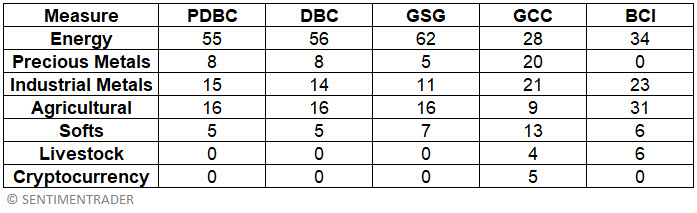
Note that:
- PDBC, DBC, and GSG are heavily weighted toward energies
- GCC is the most broadly diversified in the group
What the research tells us…
No clear-cut first-choice broad-based commodity ETF stands head-and-shoulder above the rest. One possibility for an investor considering allocating capital to the commodity sector would be to pick two (or more) of the above ETFs. One possibility (though not a specific recommendation) would be to put some in PDBC (active fund, higher historical return than most others, and no K-1) and some into GCC (the most diversified choice would theoretically prosper during a broad-based rally in commodity prices).