
A time for caution "Over There"

Key points
- The German and United Kingdom stock markets are soon entering their weakest seasonal period of the year
- They do so as price action for both is weakening
- The combination of weak seasonality and weak price action suggests that traders give the bearish case the benefit of the doubt
Germany is entering a period of seasonal weakness as price action weakens
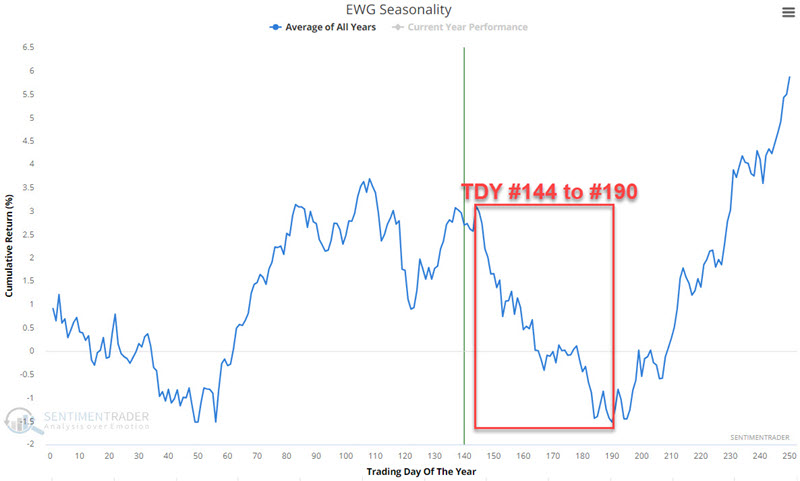
In the Annual Seasonal Trend chart below for iShares MSCI Germany ETF (ticker EWG), we see an unfavorable period that extends from the close of Trading Day of the Year (TDY) #144 through TDY #190. For 2024, this period extends from the close on 2024-07-29 through 2024-10-02.
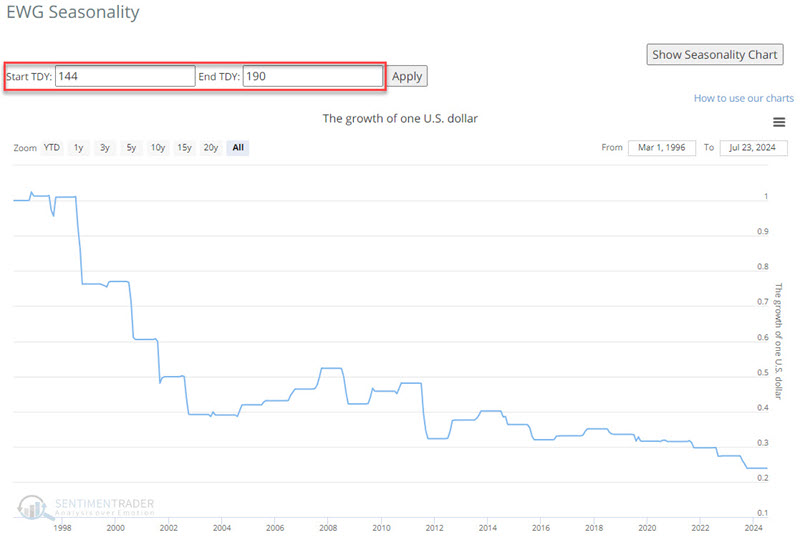
The chart below displays the hypothetical growth of $1 invested in EWG only during this period every year since 1996.
The table below summarizes EWG's performance during this period.
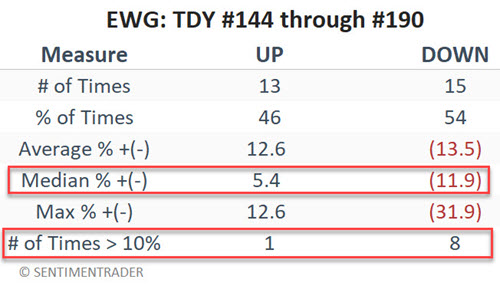
There are several key things to note:
- Wins from losses on a year-to-year basis are roughly a coinflip (46% Win Rate)
- The Median loss has been -11.9% versus +5.4% for winners
- Gains and losses over 10% have skewed 8 to 1 to the losing side
Seasonality is most effective when price action and seasonal tendency align. The chart below shows that ticker EWG topped out in mid-May and has dipped below its 50-day moving average. As long as it holds below the 50-day average, the potential for further weakness based on seasonality is real.
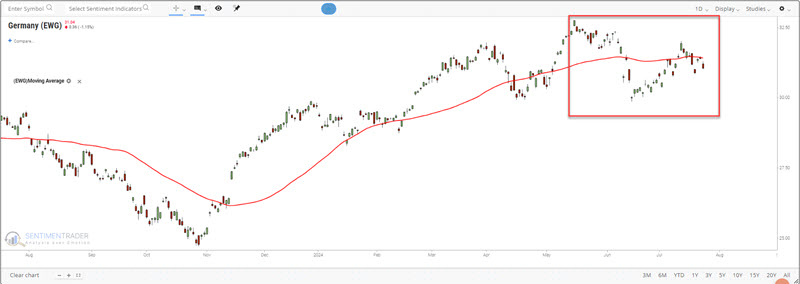
The correct message is not that EWG is likely to lose money in the months ahead. The proper message is that the probability of making money is well below average, and the risk of a significant loss is worrisomely high.
The United Kingdom index is in a similar configuration
In the Annual Seasonal Trend chart below for iShares MSCI United Kingdom ETF (ticker EWU), we see an unfavorable period that extends from the close of Trading Day of the Year (TDY) #144 through TDY #190. For 2024, this period extends from the close on 2024-08-01 through 2024-09-25.
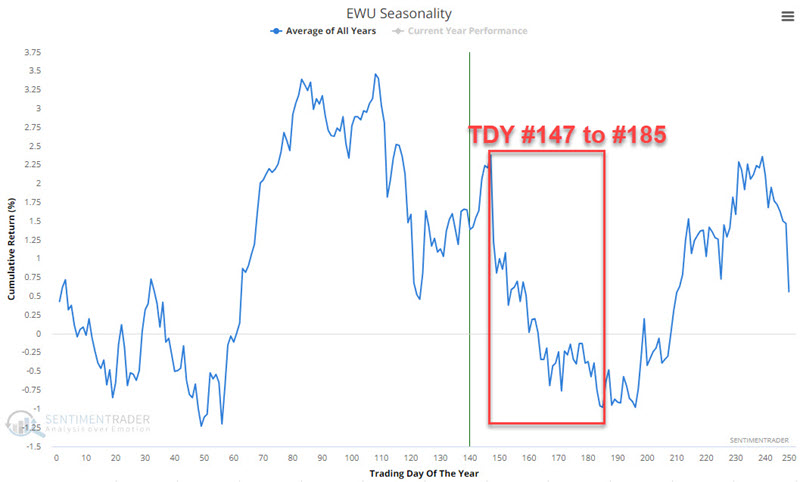
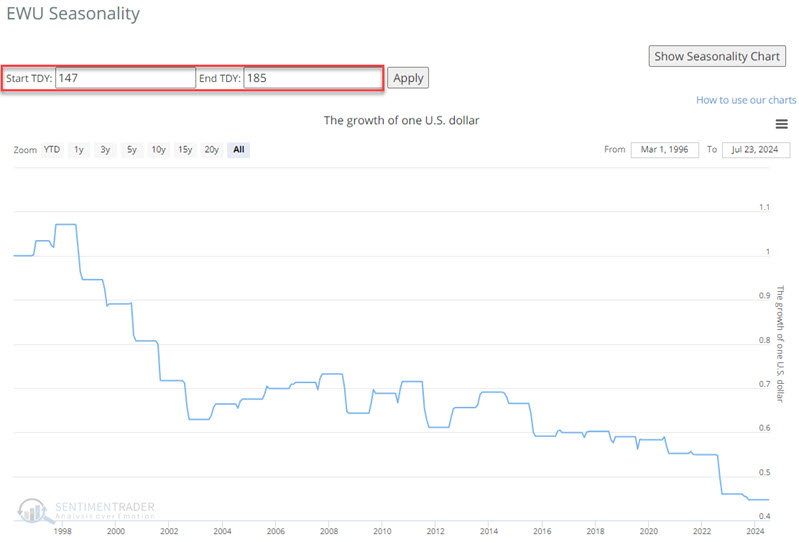
The chart below displays the hypothetical growth of $1 invested in EWU only during this period every year since 1996.
The table below summarizes EWU's performance during this period.
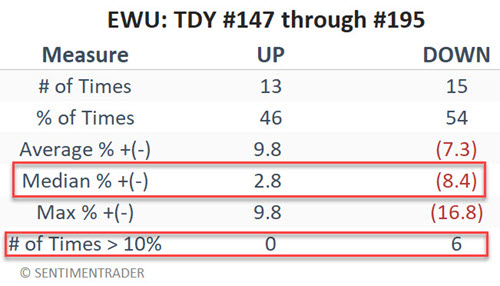
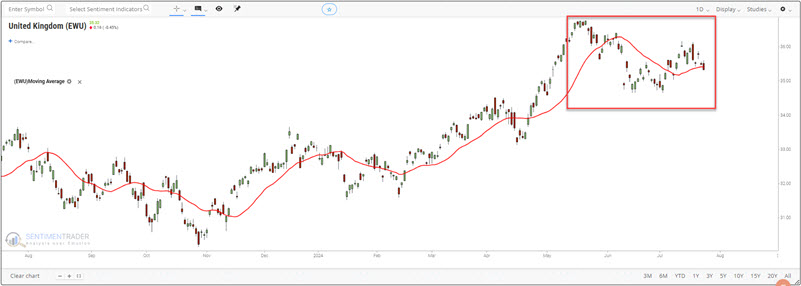
The same notes above for Germany apply here. Year-to-year profitability is a coinflip, but down years tend to be significantly worse relative to up years. Finally, the UK index ETF topped out in May and dipped below its 50-day moving average. Unless price action improves, traders may do well to focus on the bearish case for EWU (or at least to stand aside) as it enters a period of significant seasonal weakness.
What the research tells us…
Are the German and United Kingdom stock markets doomed to decline between next week and late September/early October? Not at all. Both have experienced a 46% Win Rate during the periods highlighted above. The point here is not that these indexes are sure to decline. The fact is that if they do decline, there is the potential for significant loss. For investors, this suggests standing aside; for traders, it could mean attempting to play the short side, with a primary focus on risk management.