
A simple tip for improving covered call results

Key Points
- Covered call writing can allow an investor to generate additional income in their portfolio
- However, many investors do not realize that they may be capping their upside potential while still being exposed to downside risk
- One simple tweak can help an investor get the best of both worlds
Covered call writing
Writing a covered call option on a stock you hold is very simple. You sell ("write") a call option against a stock you already hold at a chosen strike price and a chosen expiration date. Each option is for 100 shares of stock, so an investor holding 100 shares of stock can sell one call option while an investor holding 1,000 shares of stock can sell up to ten call options, and so forth.
The option buyer pays you a premium to induce you to write the call. If the stock price remains below the call option's strike price through options expiration the call option expires worthless, and you keep the entire premium received - and you still hold your stock shares. The premium earned helps to boost your total return on the stock.
On the other hand, if the stock price rises above the call option's strike price, the option may be "exercised," and your stock shares may be "called away" at the strike price.
Lastly, downside risk remains the same - minus the premium received - so an investor who writes calls against their entire position for a given stock may inadvertently establish a significantly unfavorable reward-t0-risk ratio.
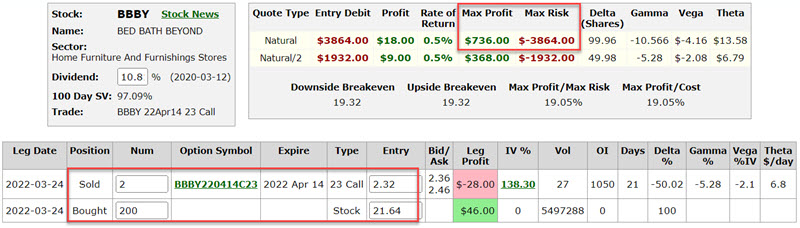
Let's illustrate the possibilities with an example, assuming we own 200 shares of Bed, Bath, and Beyond (BBBY). Let's say we bought 200 shares at $21.64 a share, where the stock is trading right now. We then sell two call options with a strike price of 23, expiring on April 14th for $2.32 each.
The particulars for this trade appear in the screenshot below, and the risk curves (or expected profit/loss based on a given price for BBBY shares as of a given date) appear in the screenshot below that (both courtesy of Optionsanalysis.com).
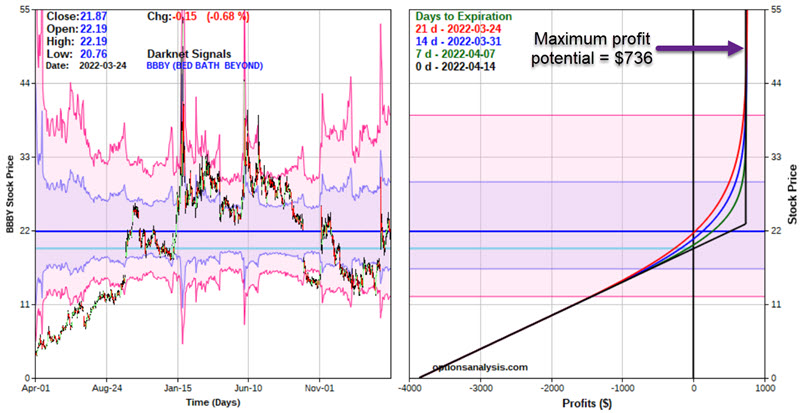
Things to note:
- It costs us $4,328 to buy 200 shares of BBBY at $21.64 a share
- By selling two call options with a strike price of $23 for $2.32 each, we receive $464 in premium (2 options times 100 shares per option x $2.32)
- There are 21 calendar days left until option expiration
- Our breakeven price on the stock during the life of the option is reduced by the amount of premium received ($21.64 purchase price minus $2.32 in premium received = breakeven price of $19.32)
- If BBBY shares remain below $23 a share through option expiration, the two call options will expire worthless, and we keep the $464 in premium received. This amounts to a return of 10.7% on our investment of $4,328 in just 21 days. At this point, we can, if we wish, sell more covered calls and generate even more income
- On the flip side, if BBBY shares are above the strike price of $23 a share when the options expire, the options will be automatically "exercised" against us by the options exchange, and our 200 shares of stock will be called away for $23 a share, regardless of the actual market price for BBBY shares at that time - and therein lies the potential rub
The potential "catch" to selling covered calls
Following the Covid bottom, BBBY became a "meme stock" and rallied from a low of $3.43 a share to as high as $53.90. In fact, during a three-week stretch in January 2021, BBBY rallied from roughly $18 to almost $54 a share. For illustration, let's assume something similar happens in the three weeks between the time we sell our $23 strike price calls and options expiration. Let's imagine that BBBY rallies to $54 by April options expiration. Here are how things would play out.
If we DID NOT sell covered calls:
- $54 - $21.64 a share purchase price times 200 shares = a profit of $6,472
- In other words, in this ideal scenario, we would garner a profit of $6,472 - or about 150% - on our $4,328 investment
If we DID sell 2 April 14 $23 strike price calls at $2.32 apiece:
- We would keep the $464 in premium
- We would sell 200 shares of BBBY at $23 a share for a profit of $272
- The total profit would be $736 ($464 + $272), or 17% on our $4,328 investment
And therein lies the "catch": by selling two covered calls against our 200-share stock position, we agree to forego any profitability above the strike price of $23 a share.
Bottom line: the potential returns from writing covered calls can look very attractive - until you miss out on a huge winner.
The Antidote
Is it possible to achieve the best of both worlds? I believe it is. My simple suggestion is NOT to write call options against your entire stock position. Let's consider this simple scenario:
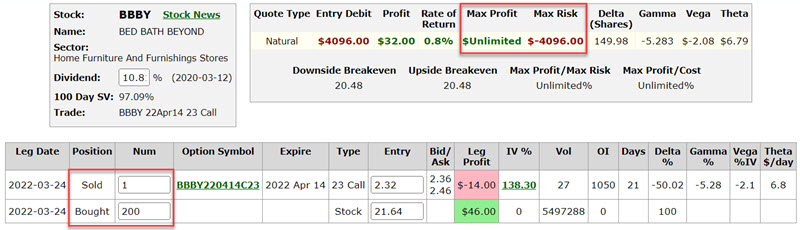
- While holding 200 shares of BBBY (bought at $21.64 a share), we sell ONLY ONE $23 strike price covered call at $2.32
The particulars for this position appear in the screenshots below.
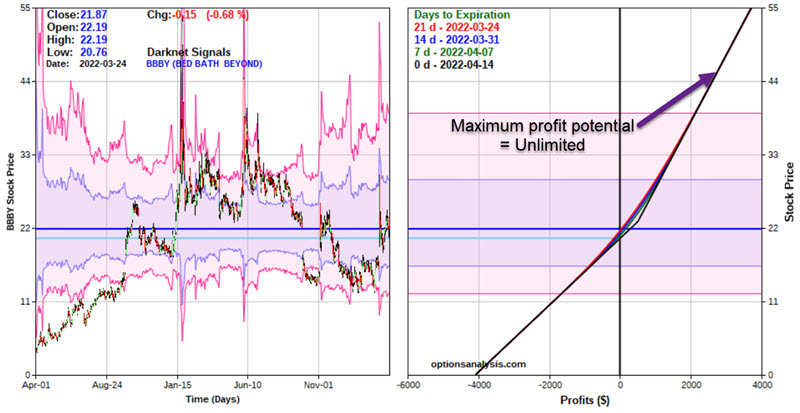
Under this scenario, if BBBY holds below $23 a share through option expiration:
- We keep $232 in premium - a still very lucrative 5.4% in 21 days
On the other hand, if BBBY makes that explosive move to $54 a share:
- We would keep the $232 in premium
- We would sell 100 shares of BBBY at $23 a share for a profit of $136
- We would still hold 100 shares of BBBY at $54 a share for an open profit of $3,236
- Our net profit at the time of option expiration would be $3,604, or +83.3% on our initial $4,328 investment
Bottom line: By being willing to accept less income, we retained unlimited upside potential on half of our position.
What the research tells us…
Selling covered calls allows an investor to generate income. However, one "trick" to consider is NOT selling call options against your entire stock shareholdings. While "selling half" is a reasonable rule of thumb, a trader holding 1,000 shares of stock might consider selling three calls, or five calls, or seven calls (or any number less than 10) depending on how much upside potential you wish to retain.
One exception: If you routinely use profit targets to sell stocks, then selling against your full position can make sense. For example, if you buy 1,000 shares of BBBY at $21.64 and decide that you will sell the entire position if the stock hits $23, then selling ten 23 strike price calls allows you to, a) sell 1,000 shares at your target price, and, b) generate additional income.
Bottom line: Ironically, focusing solely on "generating income" can limit your upside total return potential. Accepting slightly less income can occasionally allow you to hit a big winner that can put you far ahead in the long run.