Products
SentimenTrader Trading Tools
‍
Backtest Engine
My Trading Toolkit
Correlation Analysis
Seasonality
Market Prediction
Indicators & Data API
‍
Proprietary Indicators & Charts
Market Data API
Strategies & Scanner
‍
50+ Trading Strategies
Smart Stock Scanner
Smart Option Scanner
Research Reports
‍
Research Solutions
Reports Library
Free Resources
Simple Backtest Calculator
Simple Seasonality Calculator
The Kelly Criterion Calculator
Sentiment Geo Map
Public Research Reports
Education
Sentiment Indicators
Technical Indicators
Pricing
Company
About
In the News
Testimonials
Client Success Stories
Contact
Log inLoginSign up
< BACK TO ALL REPORTS

A significant surge in new highs

Dean Christians
2023-12-04
The percentage of S&P 500 stocks registering a 21-day high surged above 54%, triggering a buy signal for a TCTM Composite Thrust Model component. After similar signals, the world's most benchmarked index tended to rally over the subsequent year.

Key points:

  • The percentage of S&P 500 stocks registering a 21-day high surged above 54%
  • Similar expansions in new highs led to additional upside momentum for stocks
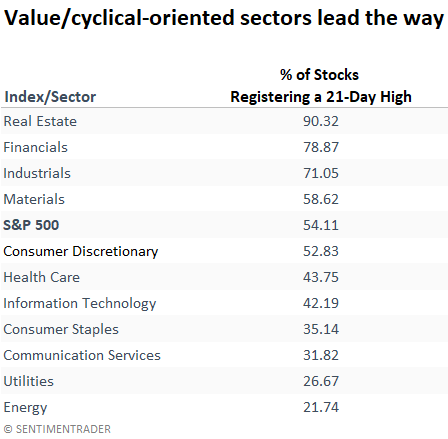
  • Value/cyclical-oriented groups like Financials, Industrials, and Materials drove the expansion 

Increased participation is a positive development for the market 

Just when we thought the S&P 500's fourth-best month in over a decade was reason enough to cheer, the world's most benchmarked index kicked off December by notching the highest expansion in 21-day highs since the fall of 2022.

When the percentage of S&P 500 stocks registering a 21-day high exceeds 54%, like now, it's a good indication of a bullish trend backdrop, which is why this breadth indicator is a component in my TCTM Composite Thrust Model. 

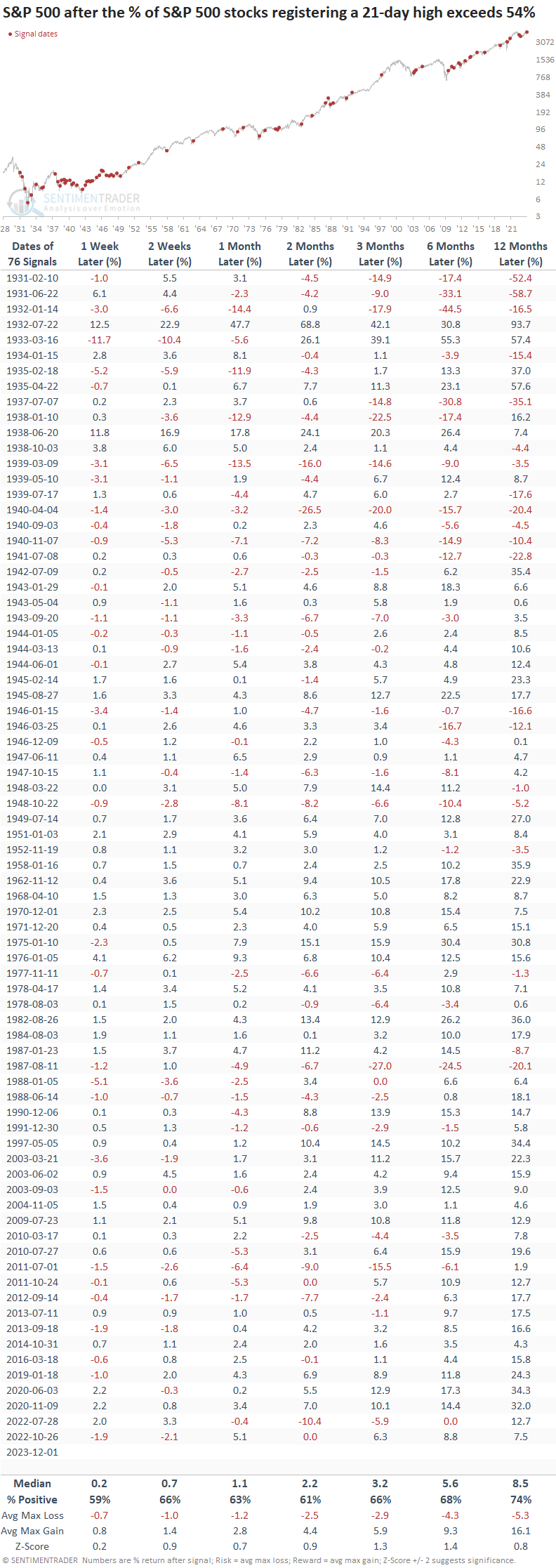
The previous signal triggered an alert in October 2022, leading to an 8.8% gain in the S&P 500 over the subsequent six months.
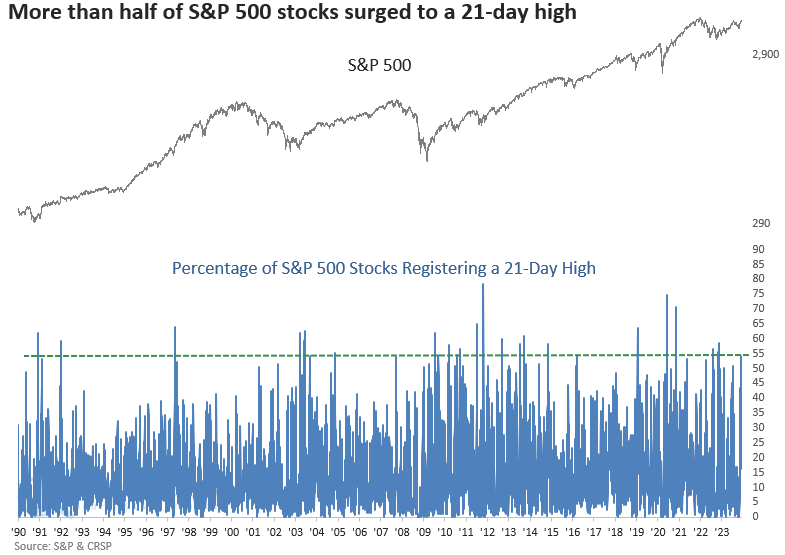
Similar surges in 21-day highs preceded positive returns

When the percentage of S&P 500 stocks hitting a 21-day high exceeds 54%, the expansion in new highs indicates a bullish trend profile.

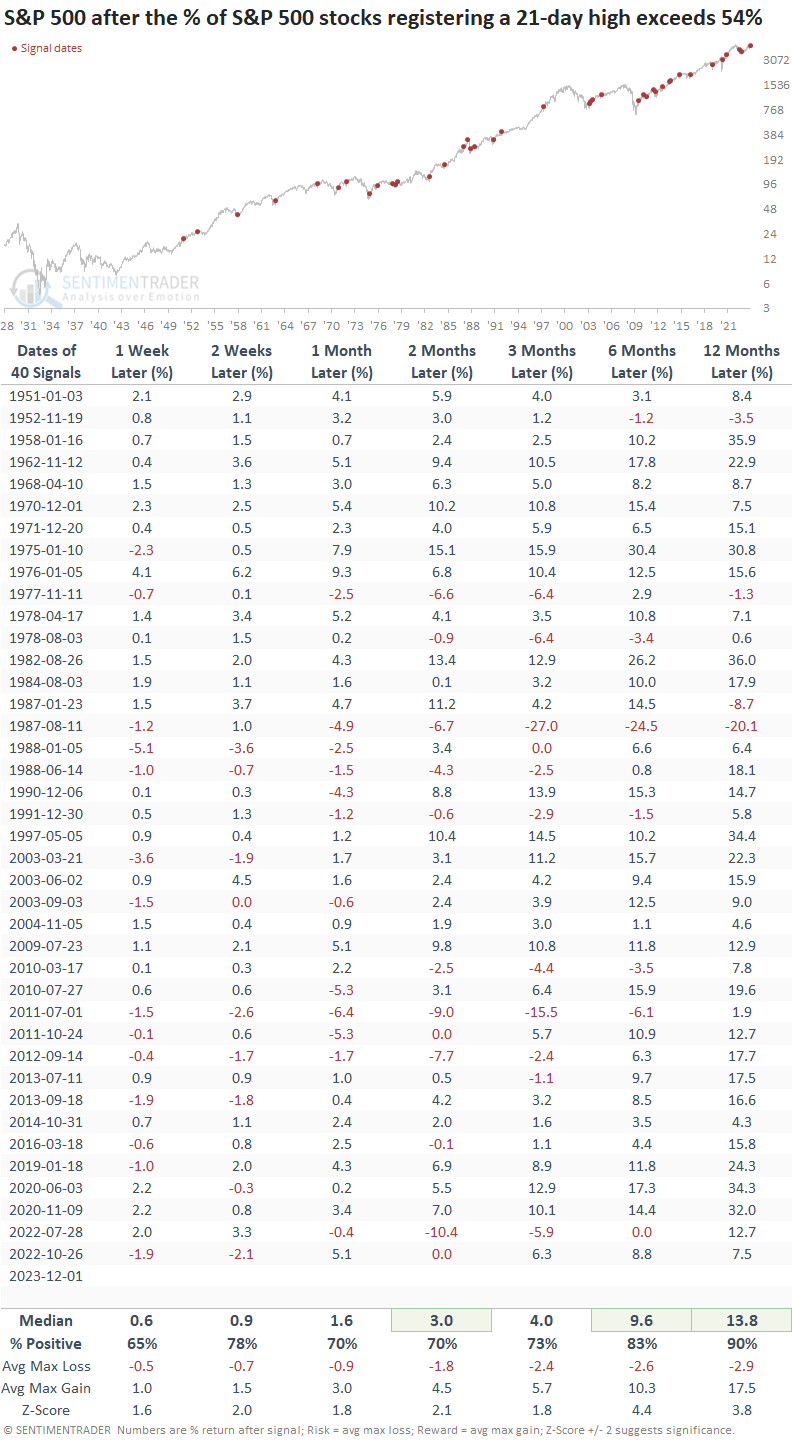
While performance metrics have consistently surpassed study period results since 1931, the overall outlook was adversely affected by the secular bear market of 1929-49. Since 1950, the S&P 500 was higher 90% of the time a year later, with signals before the 1987 crash accounting for two out of the three total losses.
Signals post the 1929-49 secular bear market

Since the 1987 crash, this indicator has a perfect record a year later.
What sectors contributed the most to the increase in new highs?

Value/cyclical-oriented groups fueled the expansion in the new high list. The significant increase in new highs from financial sector stocks is noteworthy, especially given the systemic importance of this group, which tends to underperform before recessions and bear markets. 
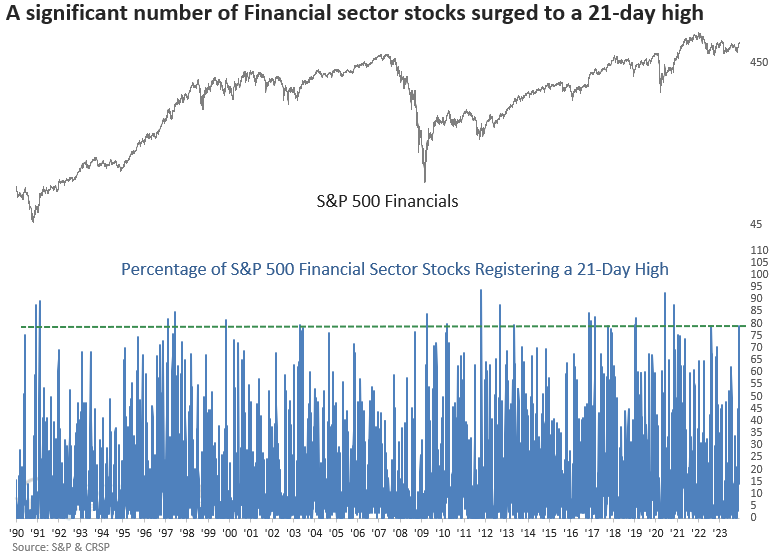
The percentage of S&P 500 Financial sector stocks registering a 21-day high exceeded 78% for only the 14th time since March 2009.
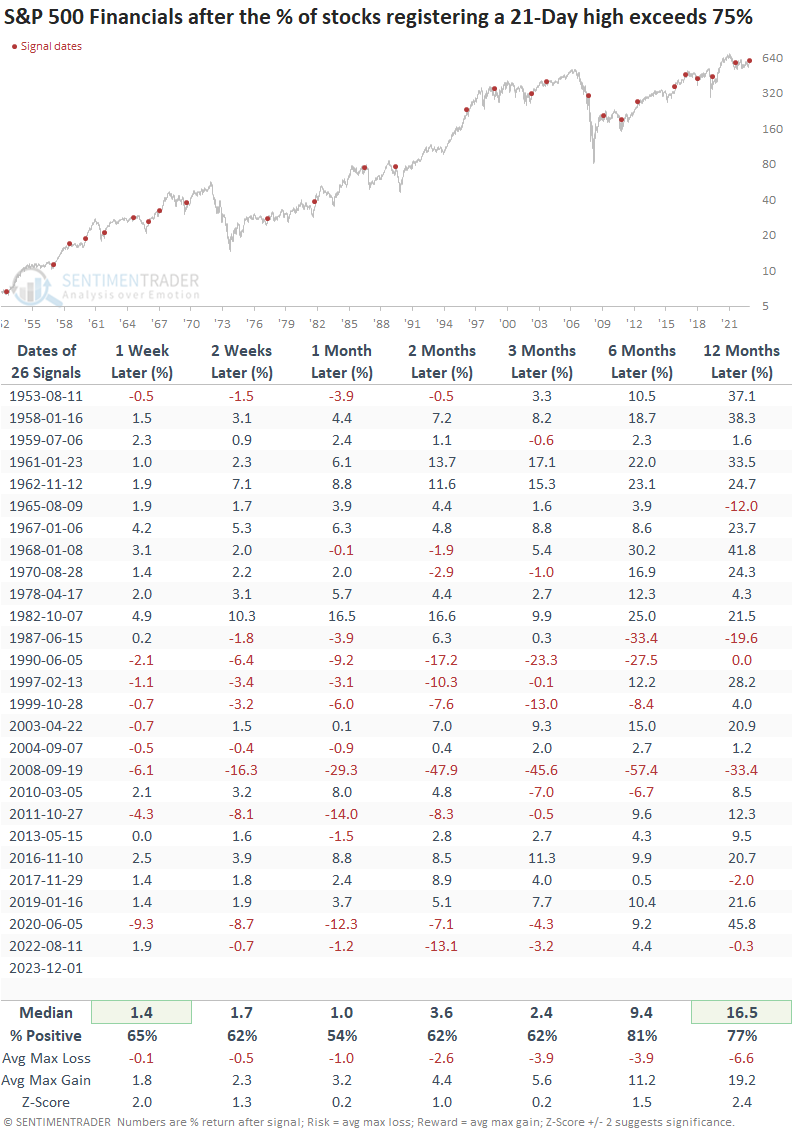
When more than 75% of S&P 500 Financial sector stocks hit a 21-day high, the group showed a reasonable consistent upward bias over time. However, since 1987, results have been less favorable.
The implications for the broad market

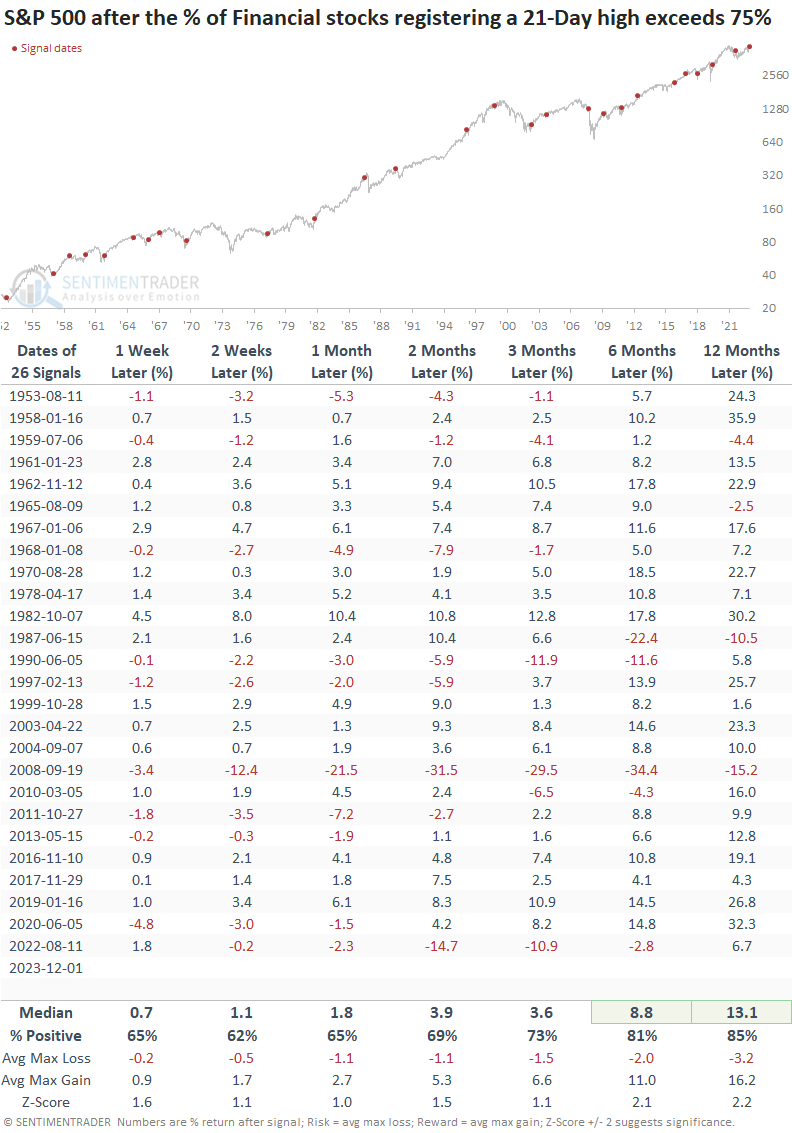
Results for the S&P 500 are solid when 21-day highs in the financial sector expand, like now, especially over the subsequent six and twelve-month horizons.
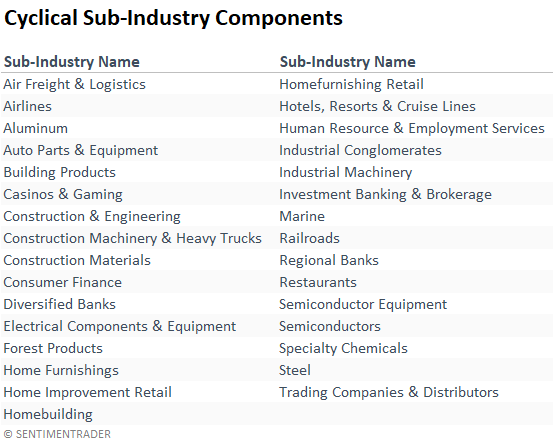
Value/cyclical-oriented industries

The significant number of breakouts in Financial, Industrial, and Material sector stocks was accompanied by almost every cyclical sub-industry group closing at a 21-day high.  
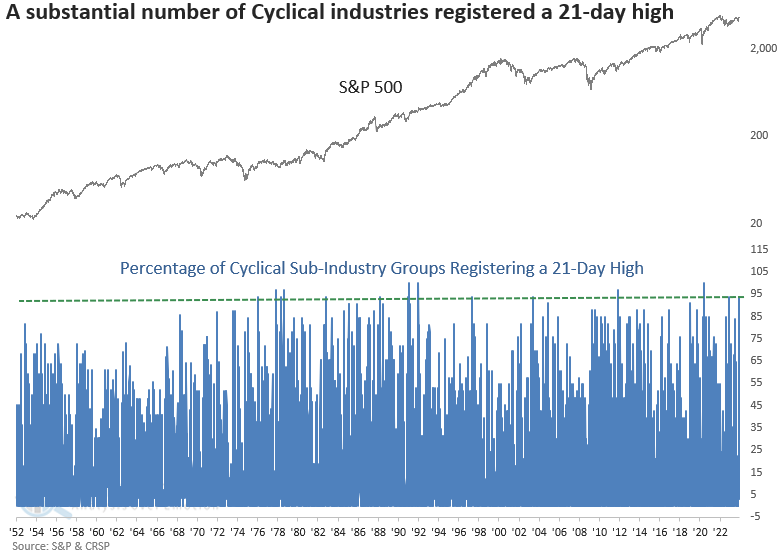
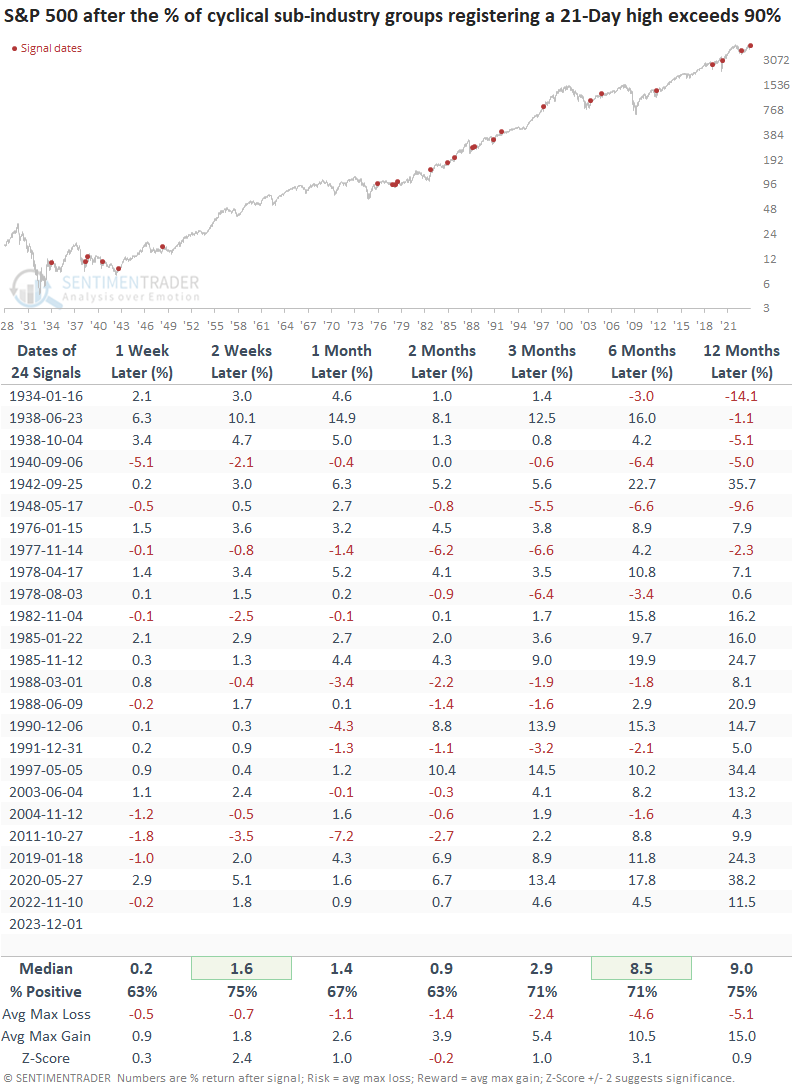
When more than 90% of cyclical sub-industry groups closed at a 21-day high, the S&P 500 was positive at some point over the following year in 23 out of 24 precedents. 
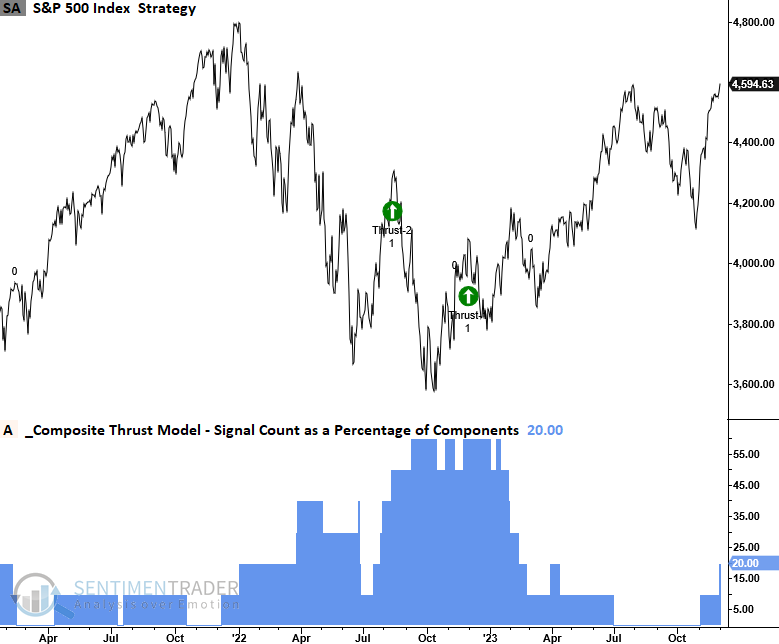
Tactical Composite Trend Model (TCTM)

The TCTM Composite Thrust Model signal count increased to 20% with the surge in 21-day highs.
What the research tells us...

Market breadth indicators are improving, suggesting a broadening of the stock rally with bullish implications. When a significant percentage of S&P 500 stocks register a 21-day high, like now, the world's most benchmarked index tends to rise consistently over the following year. That was especially the case since 1950. As always, nothing goes up in a straight line.

PRODUCTS
SentimenTrader
Trading Tools
Indicators & Data API
‍
Strategies & Scanner
‍
Research Reports
FREE
RESOUrCES
Simple Backtest
Calculator
Simple Seasonality
Calculator
The Kelly Criterion
Calculator
Sentiment Geo Map
‍
Public Research Reports
‍
Education
Sentiment Indicators
‍
Technical Indicators
‍
Pricing
Bundle pricing
‍
FAQ
‍
Announcements
‍
COMPANY
‍
About
‍
In the News
‍
Testimonials
‍
Client Success Stories
CONTACT
‍
General Inquiries
‍
Media Inquiries
‍
Financial Professionals Inquiries
‍
© 2026 Sundial Capital Research Inc. All rights reserved.
Setsail Marketing
TermsPrivacyAffiliate Program
Risk Disclosure: The information and tools provided are for research and analytical purposes only and are not intended as investment advice. Market analysis involves uncertainty, and outcomes may differ from expectations. Users should conduct their own due diligence and consider their individual circumstances before making any financial decisions. Past performance is not necessarily indicative of future results.

Hypothetical Performance Disclosure: Hypothetical performance results have many inherent limitations, some of which are described below. No representation is being made that any account will or is likely to achieve profits or losses similar to those shown; in fact, there are frequently sharp differences between hypothetical performance results and the actual results subsequently achieved by any particular trading program. One of the limitations of hypothetical performance results is that they are generally prepared with the benefit of hindsight. In addition, hypothetical trading does not involve financial risk, and no hypothetical trading record can completely account for the impact of financial risk of actual trading. for example, the ability to withstand losses or to adhere to a particular trading program in spite of trading losses are material points which can also adversely affect actual trading results. There are numerous other factors related to the markets in general or to the implementation of any specific trading program which cannot be fully accounted for in the preparation of hypothetical performance results and all which can adversely affect trading results.

Testimonial Disclosure: Testimonials appearing on this website may not be representative of other clients or customers and is not a guarantee of future performance or success.