
A short-term warning from an obscure seasonal quirk

Key Points
- My favorite quote regarding seasonality is from Michael Santoli, who claims that "Seasonality is climate, not weather"
- i.e., seasonality tells you what has tended to happen during a given period in the past; it does not tell you what is going to happen the next time around
- The proper way to use seasonality is to help you identify "possibilities" (or, in some cases, "probabilities")
- Investors might keep a wary eye on price action as an obscure seasonal quirk hangs over the market during the next two months
May and June of 2nd year of Democratic president term
Here is what we will consider:
- The performance of the Dow Jones Industrial Average during May and June during each year (post-election, mid-term, pre-election, election) of a Democratic president's first term
I warned you this one was obscure.
The chart below shows the cumulative % + (-) achieved by the Dow if held long only during May and June of each year of a Democratic president's first term.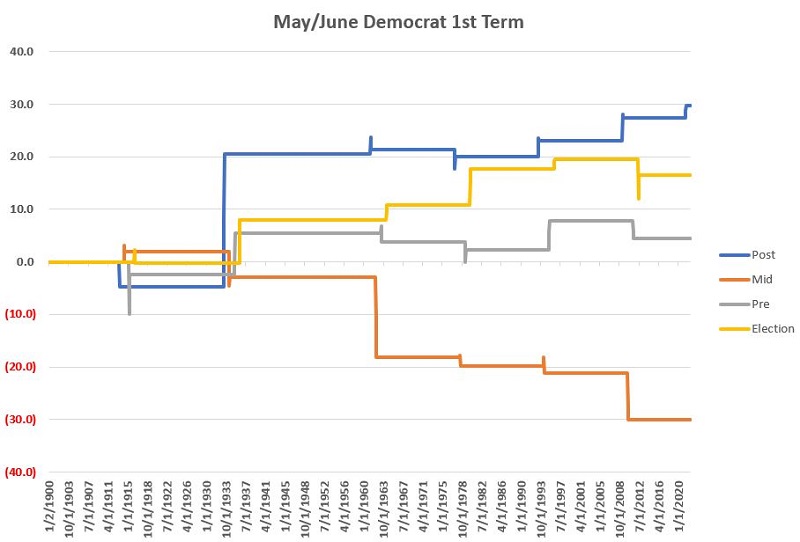
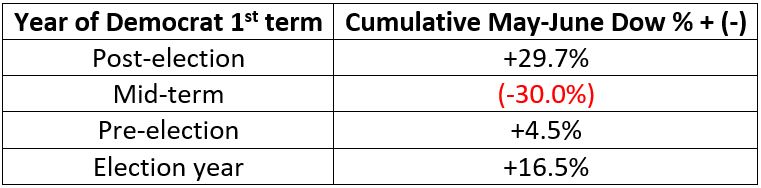
Note that all years showed a May/June gain EXCEPT the mid-term year - which showed a significant cumulative decline.
The table below shows a summary of performance.
A closer look at Mid-term May/June
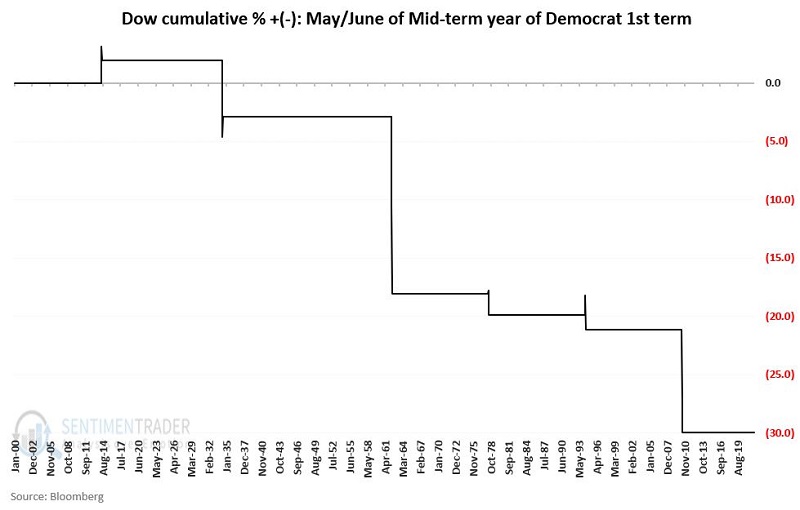
The chart below shows the cumulative % + (-) achieved by the Dow if held long only during May and June of the mid-term election year of each Democratic president's first term.
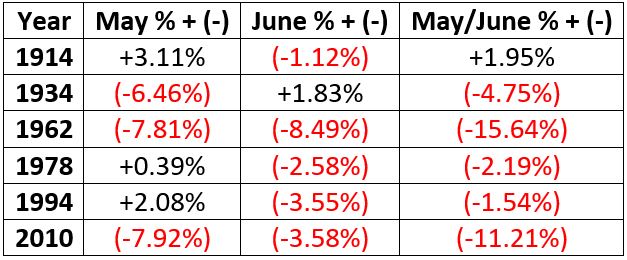
The table below shows a summary of year-by-year performance.
What the research tells us…
Seasonality is a signpost, nothing more, nothing less. The best way to use seasonality is to consider it with other indicators, especially price-based indicators. To put it simply, if seasonality suggests weak price action AND price action is showing weakness, then extreme caution may be in order.
Given the stock market weakness we have seen so far in 2022, this seasonal quirk suggests that things may worsen before they get better. Suppose an investor has been thinking about hedging their stock market positions. This odd quirk indicates that the time to do that may be close at hand, particularly if the major indexes fail to climb back above their respective 200-day moving averages.
At the same time, this is a tiny sample and size, and the reality is that no investor should rely too heavily on this odd statistical quirk.
Remember folks, climate not weather.