
A short-term trading opportunity in high yield bonds

Key points:
- High-yield bonds are entering a favorable seasonal period
- The period combines the end of the year with the first few days of the new year
- ETFs offer investors a simple way to play
The end-of-year seasonal high-yield window
The window that we will consider begins on the close of Trading Day of Year (TDY) #240 and extends through the close on the 3rd trading day of the new year. For 2022, this period begins at the close on December 14th and extends through the close on January 5th of 2023.
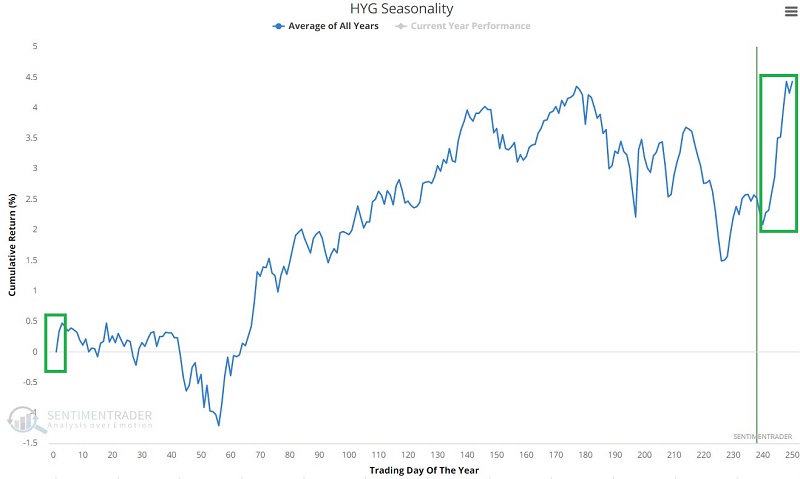
The chart below displays the annual seasonal trend for iShares iBoxx $ High Yield Corporate Bond ETF (HYG) and highlights the seasonal window in question.
To create the longest test period possible, we will initially use daily total return data for Vanguard High Yield Corporate Fund (VWEHX), which began trading in 1980. The chart below displays the cumulative growth of $1 invested in VWEHX only from TDY #240 through TDY #3 of the following year each year, starting in 1980.
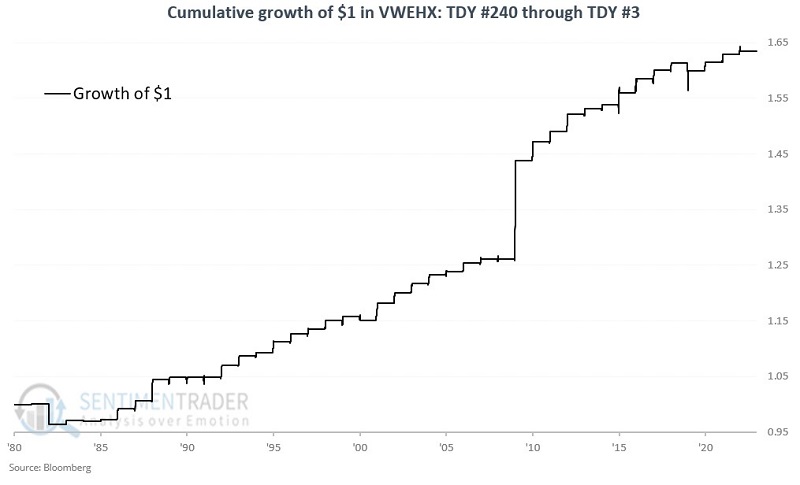
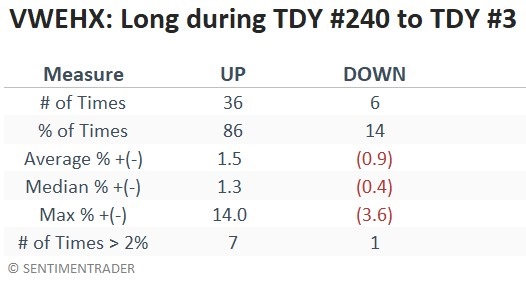
During these windows, the fund gained 36 times and retreated only 6 times. Its average gain wasn't exceptional, but remember this is a bond fund where volatility tends to be lower.
Trading this seasonal window with an ETF
Vanguard has certain switching restrictions, which may make it challenging to trade short-term with VWEHX. So, let's turn our attention to an ETF alternative. iShares iBoxx $ High Yield Corporate Bond ETF (HYG) is a heavily-traded ETF that tracks the iBoxx USD Liquid High Yield Index. HYG began trading in 2007.
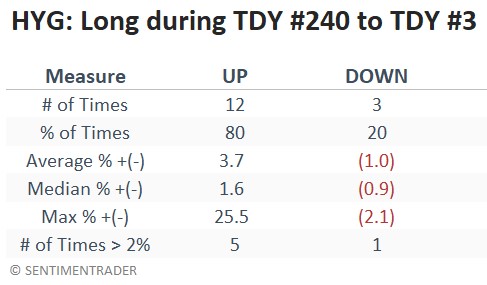
The chart below displays the cumulative growth of $1 invested in HYGX only from TDY #240 through TDY #3 of the following year each year, starting in 2007.
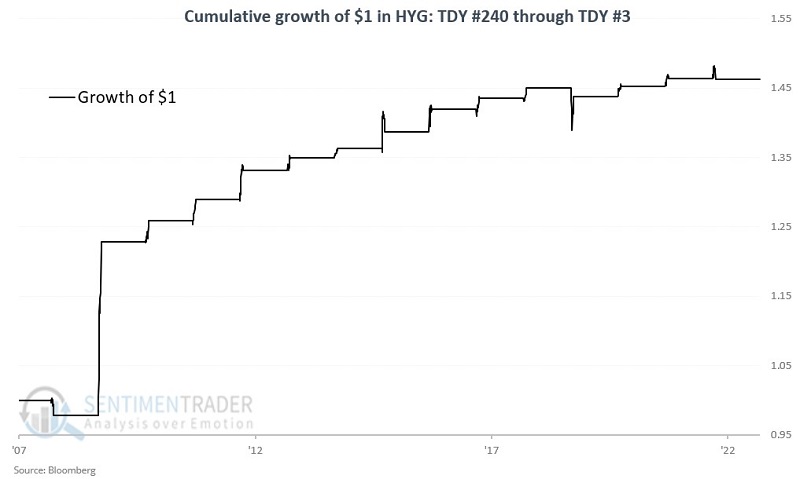
HYG gained 12 times during these windows versus only 3 losses, and its average gain was large relative to its average loss.
What the research tells us…
The good news regarding this seasonal trend is the consistent nature of positive returns and the historical lack of significant downside risk. The bad news is that in many individual years, the results are not eye-popping. Likewise, there is no guarantee that a given seasonal trend will perform as hoped/expected during any given year.