Products
SentimenTrader Trading Tools
‍
Backtest Engine
My Trading Toolkit
Correlation Analysis
Seasonality
Market Prediction
Indicators & Data API
‍
Proprietary Indicators & Charts
Market Data API
Strategies & Scanner
‍
50+ Trading Strategies
Smart Stock Scanner
Smart Option Scanner
Research Reports
‍
Research Solutions
Reports Library
Free Resources
Simple Backtest Calculator
Simple Seasonality Calculator
The Kelly Criterion Calculator
Sentiment Geo Map
Public Research Reports
Education
Sentiment Indicators
Technical Indicators
Pricing
Company
About
In the News
Testimonials
Client Success Stories
Contact
Log inLoginSign up
< BACK TO ALL REPORTS

A reversal in momentum for S&P 500 members suggests the bounce continues

Dean Christians
2022-03-23
A trading model that uses the Moving Average Convergence Divergence (MACD) indicator for S&P 500 members triggered a buy signal with an 80% win rate.

Key points:

  • The number of S&P 500 members with a MACD indicator above zero reversed higher
  • The reversal comes after a period where most stocks exhibited weak trend momentum 
  • The S&P 500 rallied 80% of the time after other signals

A model that uses the MACD indicator to identify broad-based trend momentum reversals  

The MACD indicator model identifies when the number of members with a MACD indicator above zero reverses from < 30% to > 50% in 15 sessions or fewer.  

With slightly different parameters, the same model triggered a buy signal for the energy sector on 1/6/22. 

If you're interested in learning more about the MACD indicator, click here.
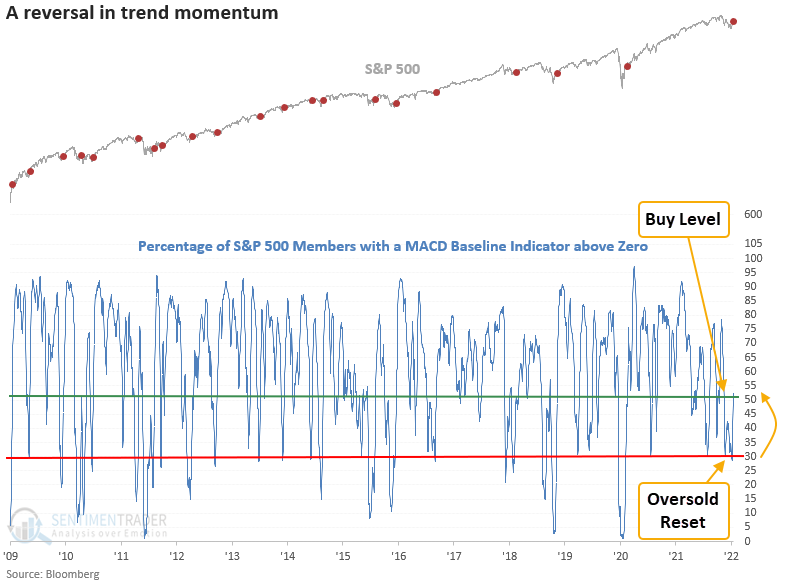
Similar reversals in trend momentum preceded gains 80% of the time

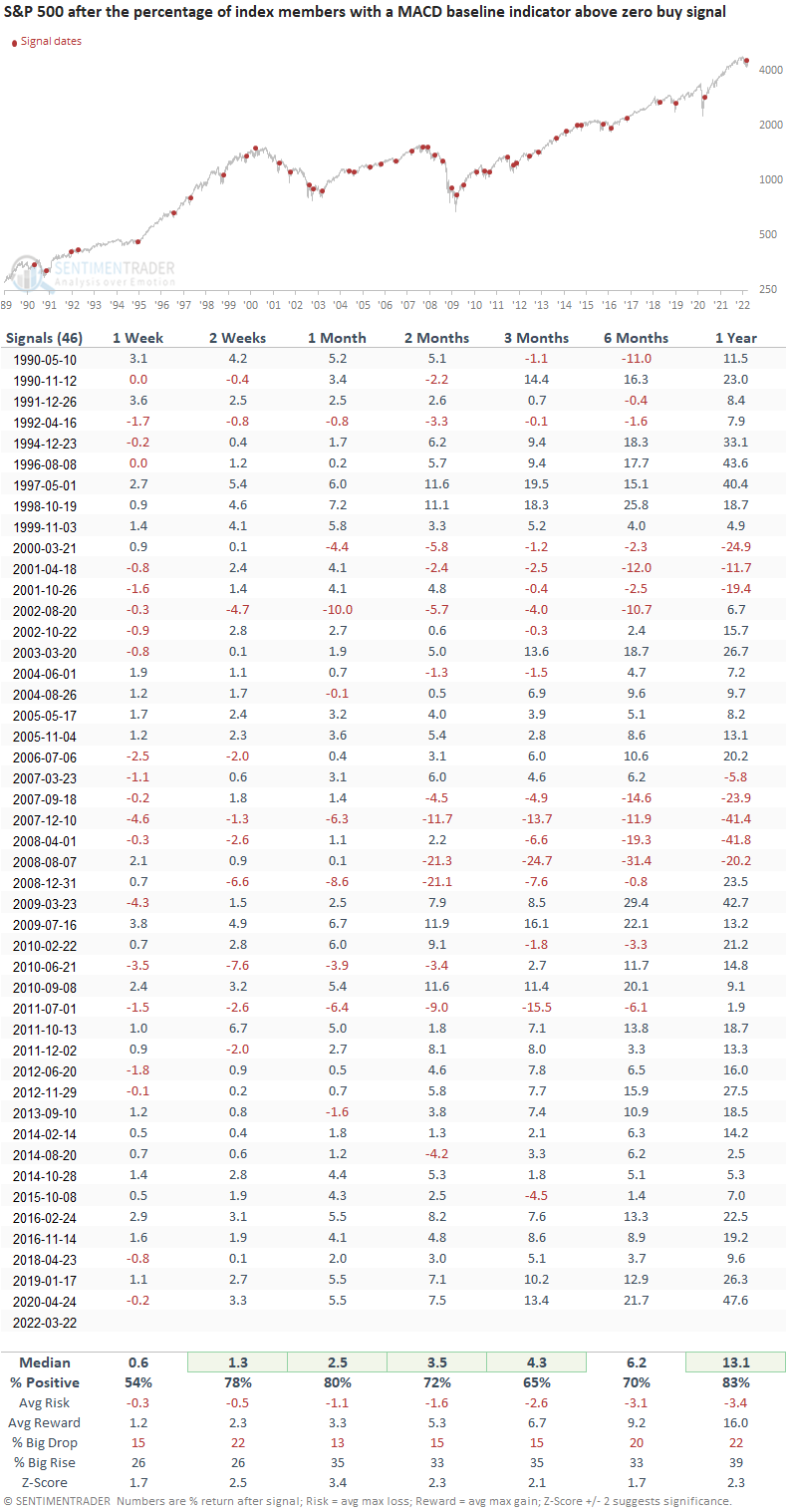
This signal triggered 46 other times over the past 32 years. After the others, S&P 500 future returns, win rates, and risk/reward profiles were solid across all time frames. Suppose you're looking for some perspective on whether we should continue to play the relief rally. In that case, the 4 and 6-week time frames offer the best outlook. The 1-month window provides the best risk-reward in our outlook table. However, when I run an optimization, it shows a 30-day holding period works best. Remember, the Fed doesn't meet again until early May. So, we have a 6-week window whereby the market could grind higher, notwithstanding some backing and filling after the recent surge.
What could we use as a risk control mechanism given the current market environment

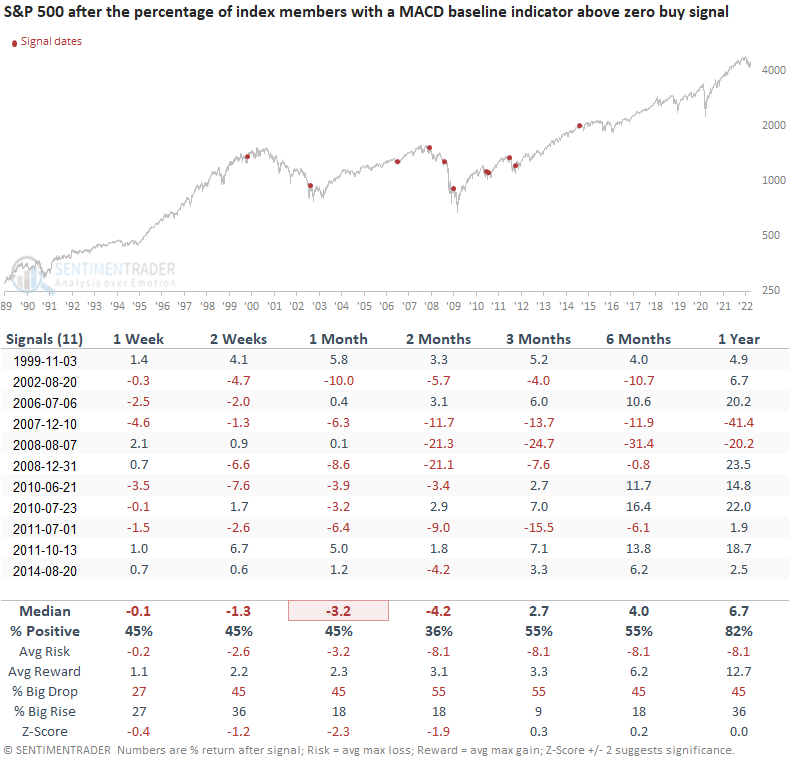
Let's conduct a study to identify a potential stop for the trading signal. I will keep the optimal days-in-trade holding period of 30 days and run an additional optimization to determine the best level for a stop based on the MACD percentage. The test returned 43% as the optimal parameter for a risk control exit. The outlook table shows 11 instances that hit the risk control parameter before the 30 day holding period ended. So, 76% of the signals achieved the optimal days-in-trade holding period. If we look at the 2-month time frame, which is the first window past the optimal holding period, it shows a median drawdown of 4.2%. However, some of the bear market instances show significantly worse drawdowns.
What the research tells us...

When the percentage of S&P 500 members with a MACD indicator above zero reverses from < 30% to > 50% in 15 sessions or fewer, the positive momentum will likely generate more positive momentum. Similar setups to what we're seeing now have preceded solid returns, win rates, and risk/reward profiles across all time frames, especially in the 1-month window. Suppose the MACD percentage crosses below 43 before the expiration of the optimal holding period. In that case, we should be mindful of a failed signal.

PRODUCTS
SentimenTrader
Trading Tools
Indicators & Data API
‍
Strategies & Scanner
‍
Research Reports
FREE
RESOUrCES
Simple Backtest
Calculator
Simple Seasonality
Calculator
The Kelly Criterion
Calculator
Sentiment Geo Map
‍
Public Research Reports
‍
Education
Sentiment Indicators
‍
Technical Indicators
‍
Pricing
Bundle pricing
‍
FAQ
‍
Announcements
‍
COMPANY
‍
About
‍
In the News
‍
Testimonials
‍
Client Success Stories
CONTACT
‍
General Inquiries
‍
Media Inquiries
‍
Financial Professionals Inquiries
‍
© 2026 Sundial Capital Research Inc. All rights reserved.
Setsail Marketing
TermsPrivacyAffiliate Program
Risk Disclosure: The information and tools provided are for research and analytical purposes only and are not intended as investment advice. Market analysis involves uncertainty, and outcomes may differ from expectations. Users should conduct their own due diligence and consider their individual circumstances before making any financial decisions. Past performance is not necessarily indicative of future results.

Hypothetical Performance Disclosure: Hypothetical performance results have many inherent limitations, some of which are described below. No representation is being made that any account will or is likely to achieve profits or losses similar to those shown; in fact, there are frequently sharp differences between hypothetical performance results and the actual results subsequently achieved by any particular trading program. One of the limitations of hypothetical performance results is that they are generally prepared with the benefit of hindsight. In addition, hypothetical trading does not involve financial risk, and no hypothetical trading record can completely account for the impact of financial risk of actual trading. for example, the ability to withstand losses or to adhere to a particular trading program in spite of trading losses are material points which can also adversely affect actual trading results. There are numerous other factors related to the markets in general or to the implementation of any specific trading program which cannot be fully accounted for in the preparation of hypothetical performance results and all which can adversely affect trading results.

Testimonial Disclosure: Testimonials appearing on this website may not be representative of other clients or customers and is not a guarantee of future performance or success.