Products
SentimenTrader Trading Tools
‍
Backtest Engine
My Trading Toolkit
Correlation Analysis
Seasonality
Market Prediction
Indicators & Data API
‍
Proprietary Indicators & Charts
Market Data API
Strategies & Scanner
‍
50+ Trading Strategies
Smart Stock Scanner
Smart Option Scanner
Research Reports
‍
Research Solutions
Reports Library
Free Resources
Simple Backtest Calculator
Simple Seasonality Calculator
The Kelly Criterion Calculator
Sentiment Geo Map
Public Research Reports
Education
Sentiment Indicators
Technical Indicators
Pricing
Company
About
In the News
Testimonials
Client Success Stories
Contact
Log inLoginSign up
< BACK TO ALL REPORTS

A rare occurrence where equities and the dollar fall together

Dean Christians
2025-04-14
For just the 9th time in history, the S&P 500 and the Dollar Index (DXY) fell more than 7% over three months, an unusual sign that investors did not flock to the US Dollar during an equity drawdown. Historical parallels suggest elevated risk for equities may persist.

Key points:

  • Over the past three months, the S&P 500 and the Dollar Index (DXY) have weakened simultaneously
  • The Dollar Index (DXY), the S&P 500, and most sectors displayed lackluster returns and consistency
  • A broad global index performed even worse than the world's most benchmarked index

When stocks and the dollar fall in tandem, it often reflects a repatriation trade

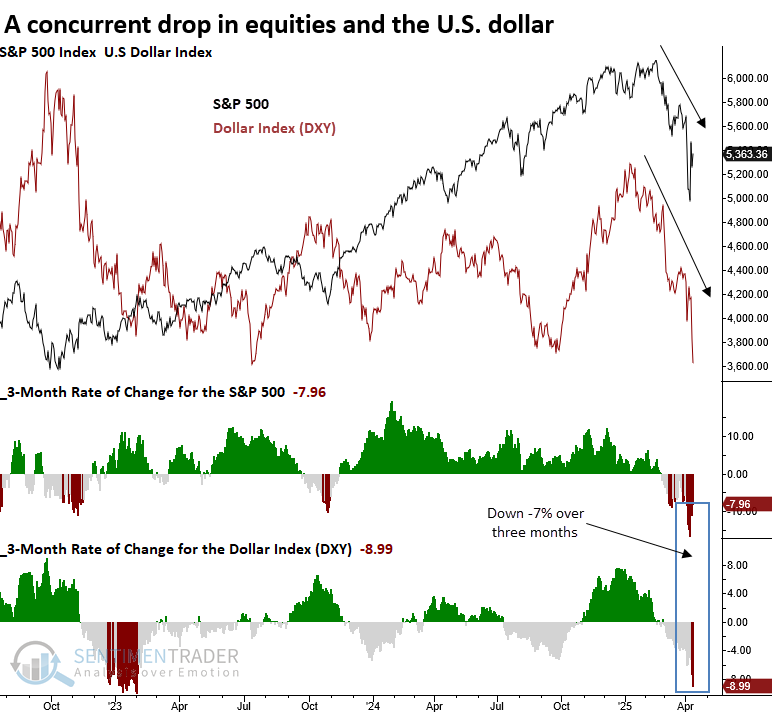
Over the past three months, the S&P 500 and the U.S. Dollar Index (DXY) have experienced notable declines, fueling a familiar round of narratives questioning the end of U.S. exceptionalism and speculating about the dollar's reserve currency status. Although the headlines lean dramatic, the underlying dynamics, while rare, appear more routine. 

We're likely witnessing a repatriation flow, a common feature during global equity market stress when investors seek the safety of their home country. This time, the trigger is a tariff tantrum, as rising trade tensions have injected uncertainty into global markets.

The S&P 500 and the Dollar Index (DXY) declined by -7% over three months, the first such instance after a high in the world's most benchmarked index.
This study serves more as a market observation than a direct trading signal, offering historical context to the current environment. 

Similar concurrent declines in stocks and the dollar suggest risk remains high

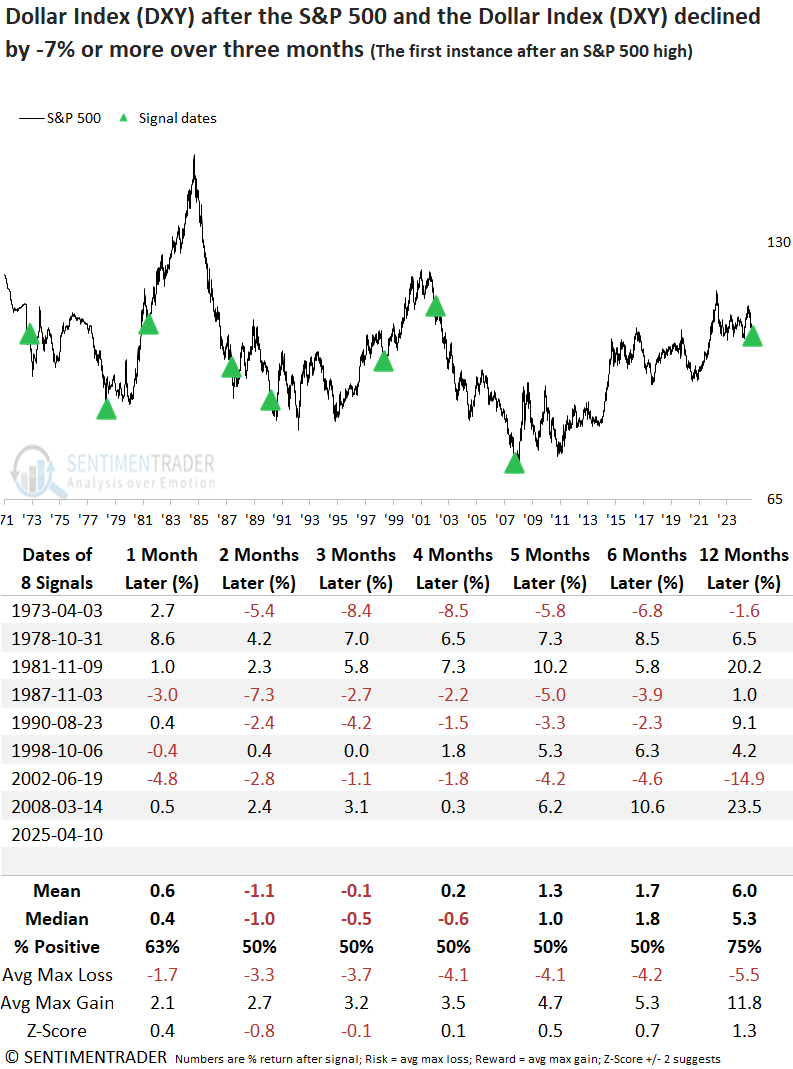
Given that fluctuations in the dollar often influence stock prices, especially for large-cap multinational companies, let's see how the dollar reacts after it and the S&P 500 dropped as they have over the last three months.

In the six months that followed, the dollar showed no consistent pattern, behaving much like a coin toss. However, a year later, it was higher in 75% of the cases.  
What about stocks?

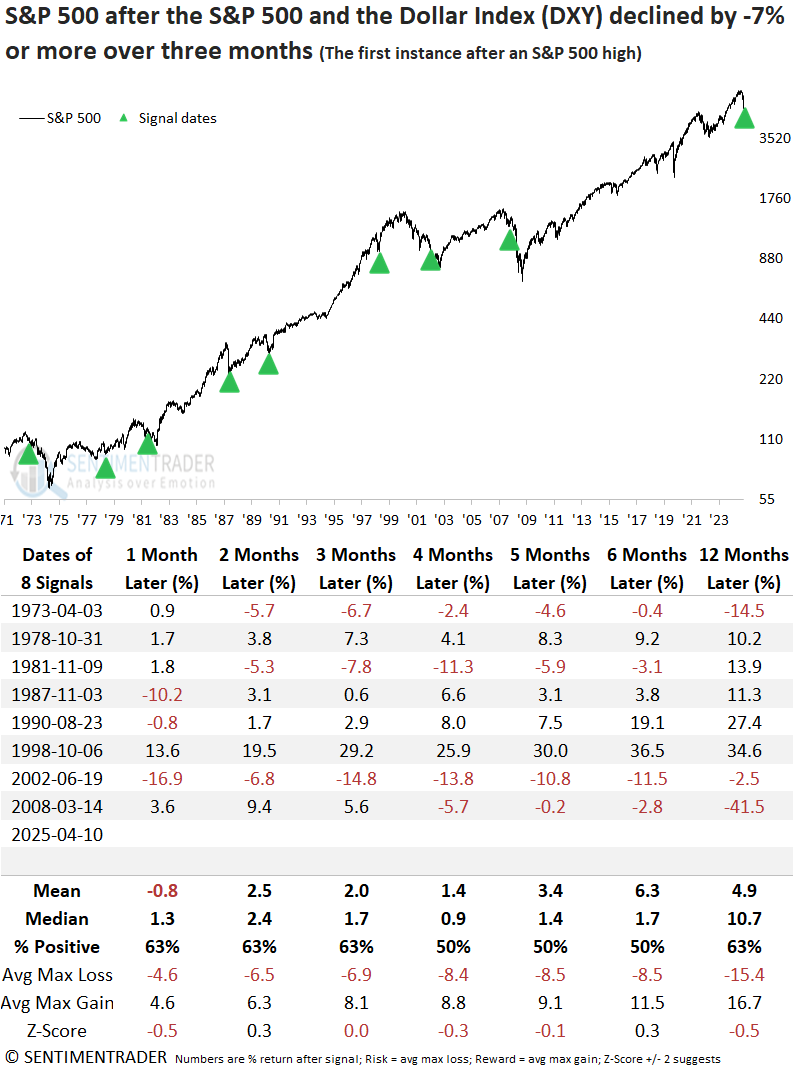
The S&P 500 exhibited a modest rally during the first three months, but momentum faded, with the index advancing in just half of the instances between months four and six. In six of the eight historical parallels, the world's most benchmarked index went on to post a lower low. Only 1978 and 1998 coincided with a bottom.
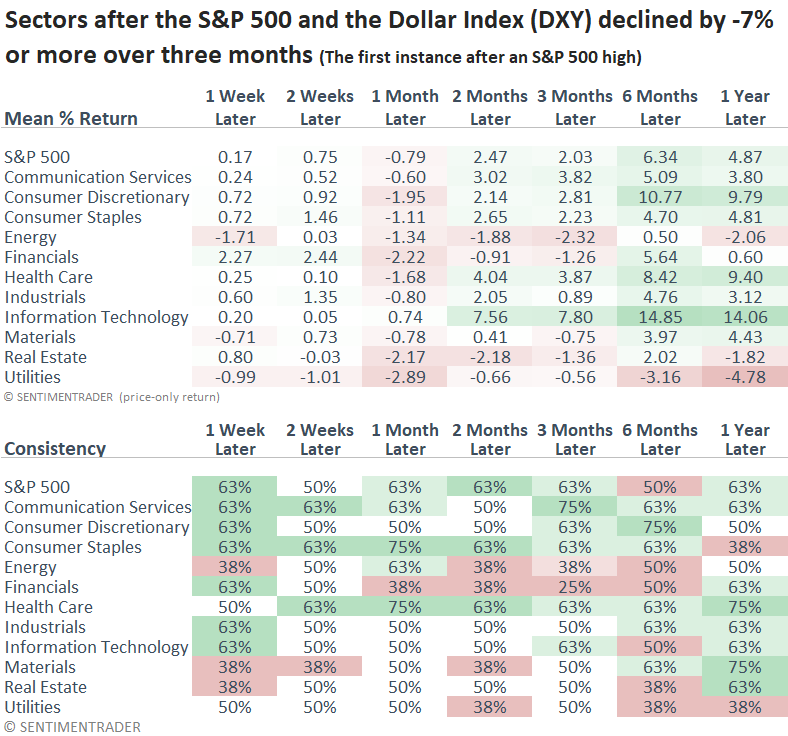
Sector performance was mixed in the initial three months. A year later, however, technology outperformed all other groups, potentially due to its global reach and the tailwind of a weaker dollar. 
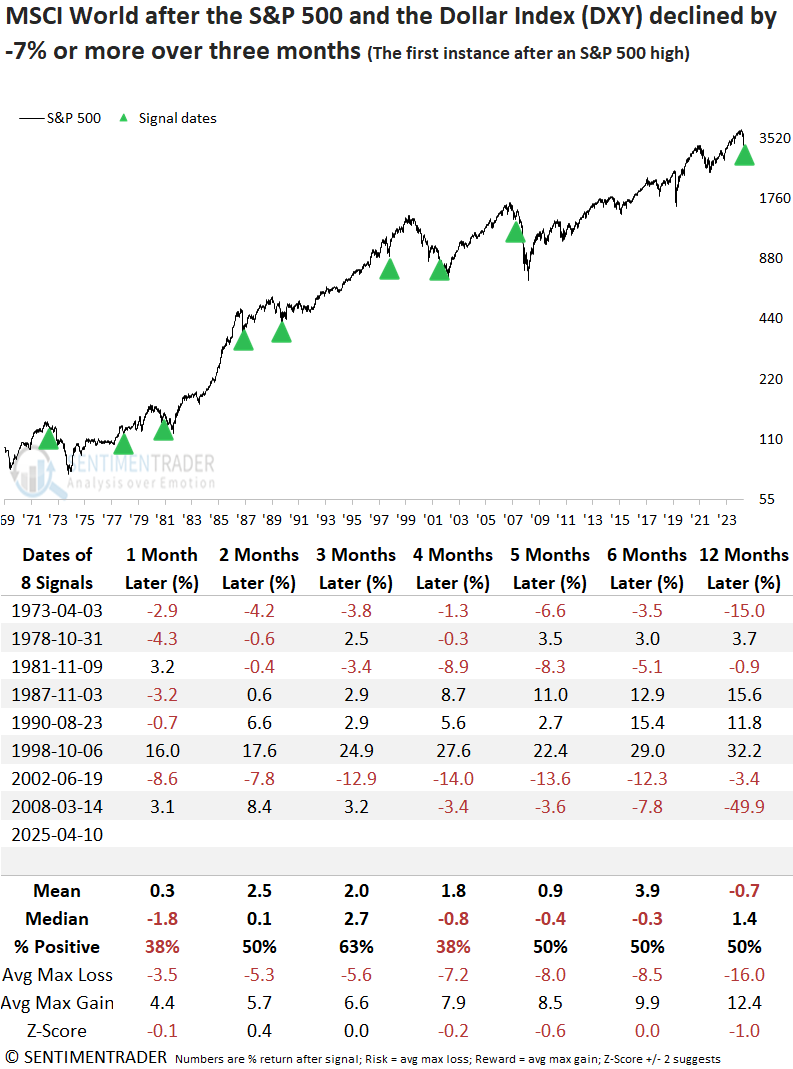
From a global standpoint, there wasn't much opportunity overseas when viewed through the lens of a broad index. The MSCI World Index underperformed the S&P 500, suggesting that the simultaneous decline in the S&P 500 and the dollar stemmed from a systemic issue. 
What the research tells us...

Over the past three months, the S&P 500 and the U.S. dollar have declined in unison, a rare and notable development given that the dollar typically strengthens during risk-off periods when equity markets retreat. A falling dollar alongside a falling stock market tends to occur during periods of uncertainty, often pointing to market stress or geopolitical tensions that trigger capital repatriation, not the dollar's demise. With six of the last eight instances resulting in a lower low for the S&P 500, maintaining a cautious stance and waiting for a more favorable entry point appears prudent.

PRODUCTS
SentimenTrader
Trading Tools
Indicators & Data API
‍
Strategies & Scanner
‍
Research Reports
FREE
RESOUrCES
Simple Backtest
Calculator
Simple Seasonality
Calculator
The Kelly Criterion
Calculator
Sentiment Geo Map
‍
Public Research Reports
‍
Education
Sentiment Indicators
‍
Technical Indicators
‍
Pricing
Bundle pricing
‍
FAQ
‍
Announcements
‍
COMPANY
‍
About
‍
In the News
‍
Testimonials
‍
Client Success Stories
CONTACT
‍
General Inquiries
‍
Media Inquiries
‍
Financial Professionals Inquiries
‍
© 2026 Sundial Capital Research Inc. All rights reserved.
Setsail Marketing
TermsPrivacyAffiliate Program
Risk Disclosure: The information and tools provided are for research and analytical purposes only and are not intended as investment advice. Market analysis involves uncertainty, and outcomes may differ from expectations. Users should conduct their own due diligence and consider their individual circumstances before making any financial decisions. Past performance is not necessarily indicative of future results.

Hypothetical Performance Disclosure: Hypothetical performance results have many inherent limitations, some of which are described below. No representation is being made that any account will or is likely to achieve profits or losses similar to those shown; in fact, there are frequently sharp differences between hypothetical performance results and the actual results subsequently achieved by any particular trading program. One of the limitations of hypothetical performance results is that they are generally prepared with the benefit of hindsight. In addition, hypothetical trading does not involve financial risk, and no hypothetical trading record can completely account for the impact of financial risk of actual trading. for example, the ability to withstand losses or to adhere to a particular trading program in spite of trading losses are material points which can also adversely affect actual trading results. There are numerous other factors related to the markets in general or to the implementation of any specific trading program which cannot be fully accounted for in the preparation of hypothetical performance results and all which can adversely affect trading results.

Testimonial Disclosure: Testimonials appearing on this website may not be representative of other clients or customers and is not a guarantee of future performance or success.