Products
SentimenTrader Trading Tools
‍
Backtest Engine
My Trading Toolkit
Correlation Analysis
Seasonality
Market Prediction
Indicators & Data API
‍
Proprietary Indicators & Charts
Market Data API
Strategies & Scanner
‍
50+ Trading Strategies
Smart Stock Scanner
Smart Option Scanner
Research Reports
‍
Research Solutions
Reports Library
Free Resources
Simple Backtest Calculator
Simple Seasonality Calculator
The Kelly Criterion Calculator
Sentiment Geo Map
Public Research Reports
Education
Sentiment Indicators
Technical Indicators
Pricing
Company
About
In the News
Testimonials
Client Success Stories
Contact
Log inLoginSign up
< BACK TO ALL REPORTS

A massive number of stocks rallied 4% or more

Dean Christians
2023-11-15
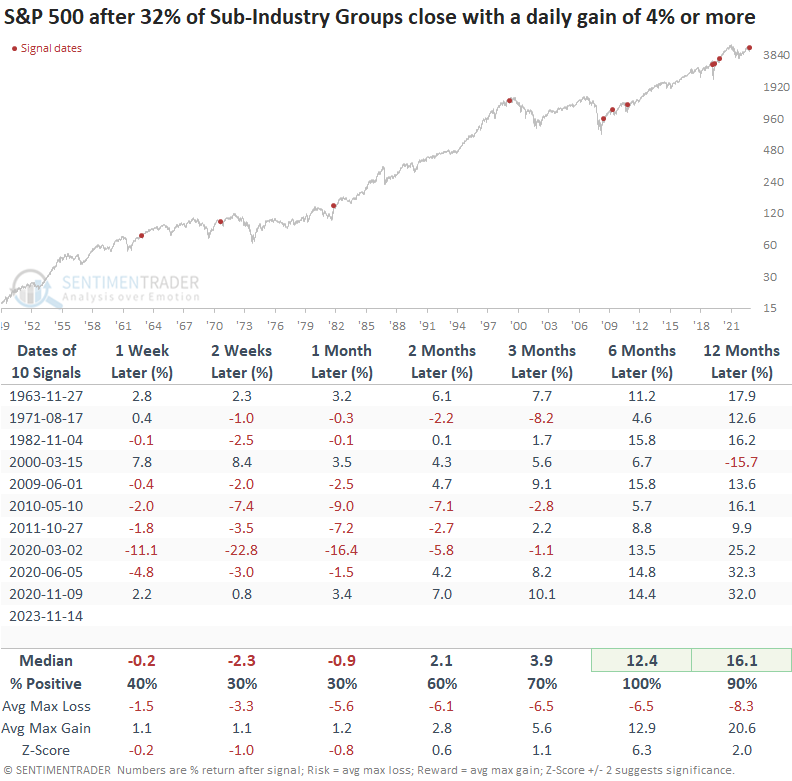
On Tuesday, the stock market experienced a notable shift as more than 25% of stocks and 32% of sub-industry groups closed with gains exceeding 4%. After similar surges, the S&P 500 was higher over the following six months every time.

Key points:

  • Over 25% of stocks and 32% of sub-industry groups closed with a daily gain of 4% or more on Tuesday
  • Similar one-day surges tended to mark an inflection point with bullish implications for the S&P 500
  • Precedents above the 200-day struggled initially but were higher over the following six months every time

One day does not make a trend, but this is compelling

The stock trading service Stockbee, operated by Pradeep Bonde, provides some interesting and unusual market breadth data on his website for free. You can also find Pradeep on Twitter/X under the following name. @pradeepbonde 

One breadth series measures the number of stocks with a daily gain of 4% or more. The scan currently contains over 6300 stocks. 

On Tuesday, the percentage of stocks with a daily gain of 4% or more surged to 25%, reaching the highest level since the stock market low in the fall of 2022.
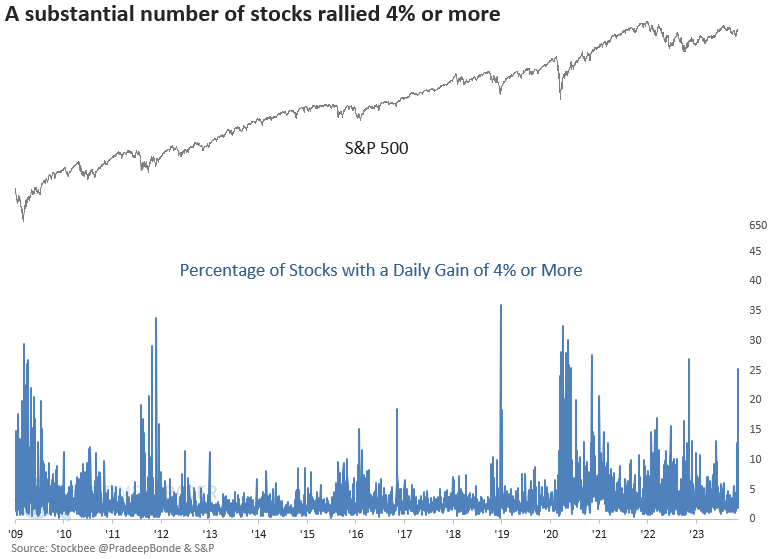
Significant one-day upside explosions in stocks are bullish 

While the sample size is small, whenever 25% of stocks close up 4% or more in a single session, the S&P 500 rallied 100% of the time over the subsequent three, six, and twelve months.

The 2011 instance is the only precedent that saw a significant drawdown in the first two months, with a max loss of -9.8%.
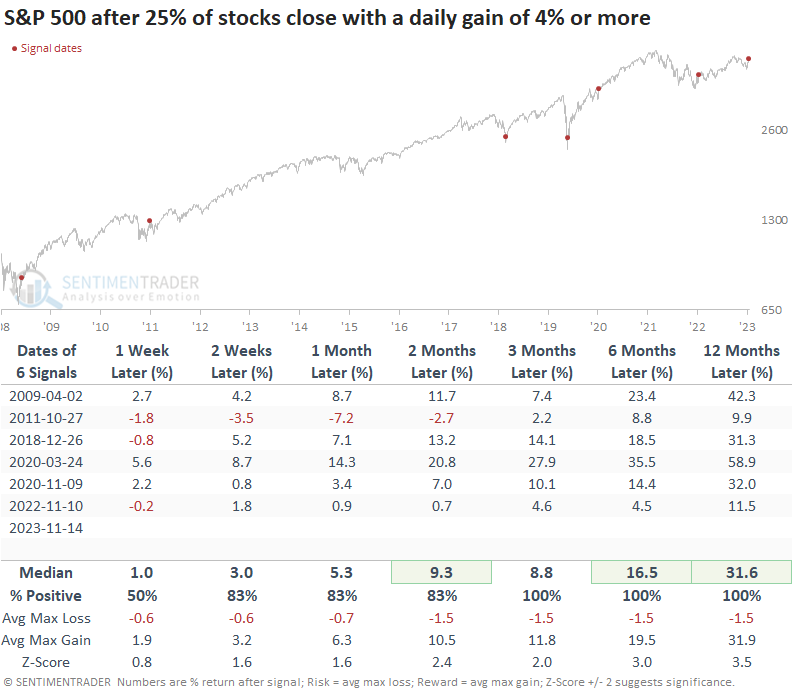
A larger sample size

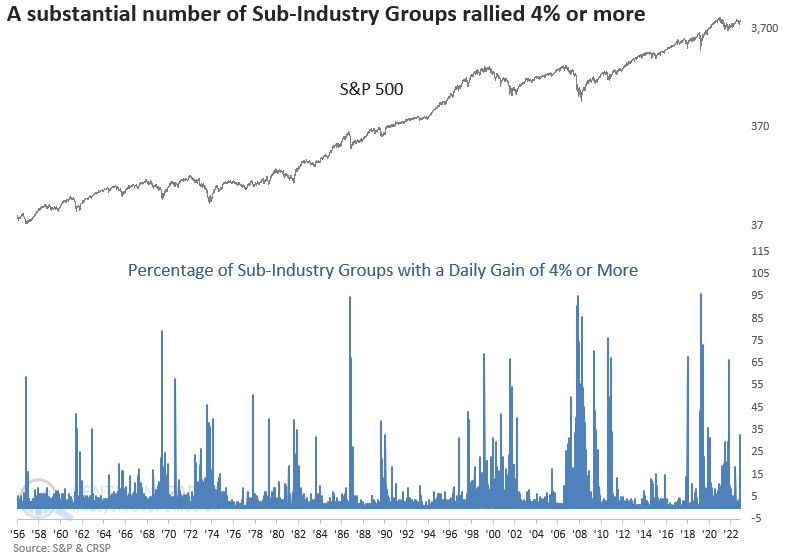
Employing sub-industry data to broaden the sample size reveals that on Tuesday, more than 32% of sub-industry groups experienced a gain of 4% or more, marking the 38th occurrence of such an event since 1957 when screening out repeats. 
Whenever 32% of sub-industry groups registered a daily gain exceeding 4%, the S&P 500 showed a solid tendency to rally across all time horizons. 

Except for 2008, most of the bear market precedents occurred near the end of the drawdown phase. And, every instance in the 2000-02 drawdown was profitable three months later.
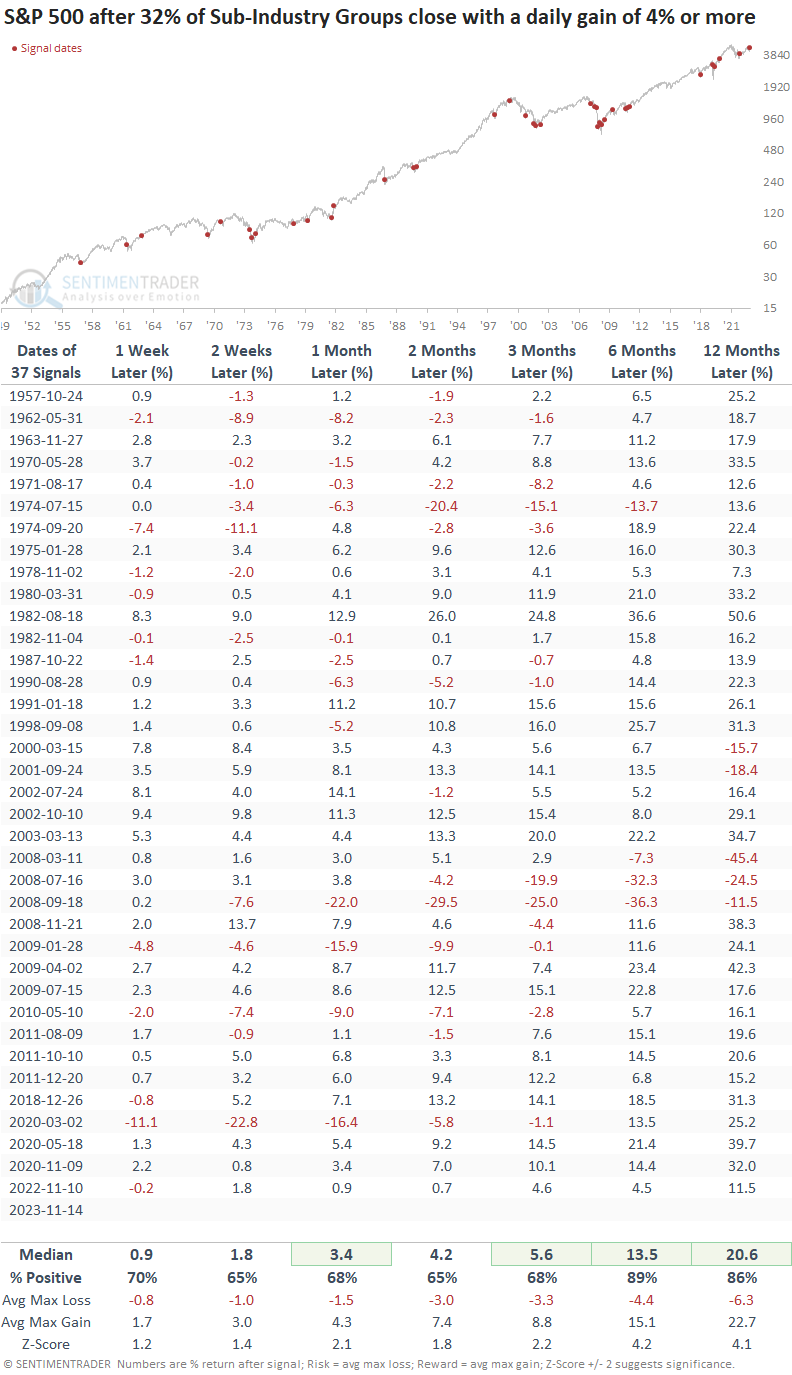
Signals in a long-term uptrend

If I isolate signals that occurred when the S&P 500 was trading above its 200-day average for context similar to now, the large-cap index struggled over the subsequent month. However, history suggests the near-term weakness is a buying opportunity. Six months later, the S&P 500 was higher every time.
What the research tells us...

Stocks exploded higher on Tuesday after a relatively benign CPI report. The surge saw over 25% of stocks rise by 4% or more, a level historically associated with a positive turning point for equity markets. Comparable upswings presaged a 100% win rate for the S&P 500 over the subsequent three, six, and twelve months. An analysis using sub-industry data over a significantly extended period confirms the bullish outlook, especially when the S&P 500 is in an uptrend like now. If history rhymes, traders should use any short-term weakness to add market exposure.

PRODUCTS
SentimenTrader
Trading Tools
Indicators & Data API
‍
Strategies & Scanner
‍
Research Reports
FREE
RESOUrCES
Simple Backtest
Calculator
Simple Seasonality
Calculator
The Kelly Criterion
Calculator
Sentiment Geo Map
‍
Public Research Reports
‍
Education
Sentiment Indicators
‍
Technical Indicators
‍
Pricing
Bundle pricing
‍
FAQ
‍
Announcements
‍
COMPANY
‍
About
‍
In the News
‍
Testimonials
‍
Client Success Stories
CONTACT
‍
General Inquiries
‍
Media Inquiries
‍
Financial Professionals Inquiries
‍
© 2026 Sundial Capital Research Inc. All rights reserved.
Setsail Marketing
TermsPrivacyAffiliate Program
Risk Disclosure: The information and tools provided are for research and analytical purposes only and are not intended as investment advice. Market analysis involves uncertainty, and outcomes may differ from expectations. Users should conduct their own due diligence and consider their individual circumstances before making any financial decisions. Past performance is not necessarily indicative of future results.

Hypothetical Performance Disclosure: Hypothetical performance results have many inherent limitations, some of which are described below. No representation is being made that any account will or is likely to achieve profits or losses similar to those shown; in fact, there are frequently sharp differences between hypothetical performance results and the actual results subsequently achieved by any particular trading program. One of the limitations of hypothetical performance results is that they are generally prepared with the benefit of hindsight. In addition, hypothetical trading does not involve financial risk, and no hypothetical trading record can completely account for the impact of financial risk of actual trading. for example, the ability to withstand losses or to adhere to a particular trading program in spite of trading losses are material points which can also adversely affect actual trading results. There are numerous other factors related to the markets in general or to the implementation of any specific trading program which cannot be fully accounted for in the preparation of hypothetical performance results and all which can adversely affect trading results.

Testimonial Disclosure: Testimonials appearing on this website may not be representative of other clients or customers and is not a guarantee of future performance or success.