Products
SentimenTrader Trading Tools
‍
Backtest Engine
My Trading Toolkit
Correlation Analysis
Seasonality
Market Prediction
Indicators & Data API
‍
Proprietary Indicators & Charts
Market Data API
Strategies & Scanner
‍
50+ Trading Strategies
Smart Stock Scanner
Smart Option Scanner
Research Reports
‍
Research Solutions
Reports Library
Free Resources
Simple Backtest Calculator
Simple Seasonality Calculator
The Kelly Criterion Calculator
Sentiment Geo Map
Public Research Reports
Education
Sentiment Indicators
Technical Indicators
Pricing
Company
About
In the News
Testimonials
Client Success Stories
Contact
Log inLoginSign up
< BACK TO ALL REPORTS

A historic week of selling pressure as investors panic

Jason Goepfert
2023-03-13
In the month following the four-month surge off the October low, investors have dumped stocks en masse several times. That does not negate the importance of the last four months. With three out of five days seeing more than 90% of S&P 500 stocks decline, this is a bout of selling pressure that saw gains six months later every time but once.

Key points:

  • More than 90% of S&P 500 stocks declined during 3 of the past 5 trading days
  • This is a historic bout of selling pressure that preceded gains in the index over the next six months
  • Heavy selling pressure following 4-month thrusts off a bottom did not tend to negate those bottoms

A historic bout of intense selling pressure

A month ago, we saw that the 4-month period following the October bottoms had been rife with breadth thrusts. And then we saw that the first 95 days have been most correlated to nascent bull markets that tended to persist. Those argued that outside of some shorter-term volatility, the evidence leaned toward a 6-12 month continuation of the rally.

Since then, it's been a very tough go.

On consecutive days, and for three out of the past five sessions, more than 90% of stocks in the S&P 500 suffered declines. The only times investors have behaved like this in recent years were in March 2020 and June 2022.
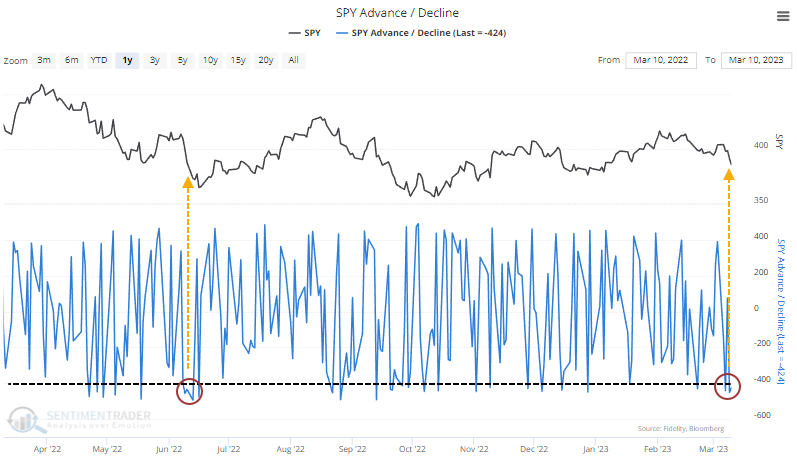
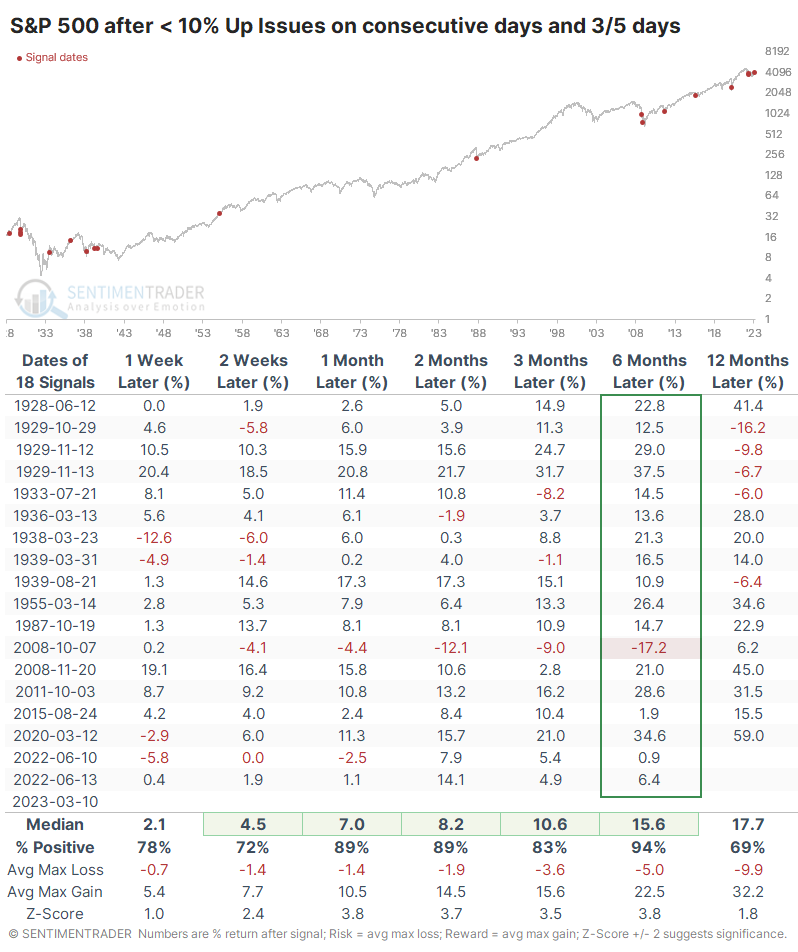
This is a rare cluster of such severe selling pressure, with previous bouts preceding gains in the S&P over the next six months every time but once. Granted, that "once" was during the teeth of the financial crisis and led to more than a 30% drawdown. It still showed a gain a year later, but a 30% haircut in the interim would have tested even the most ardent bull.
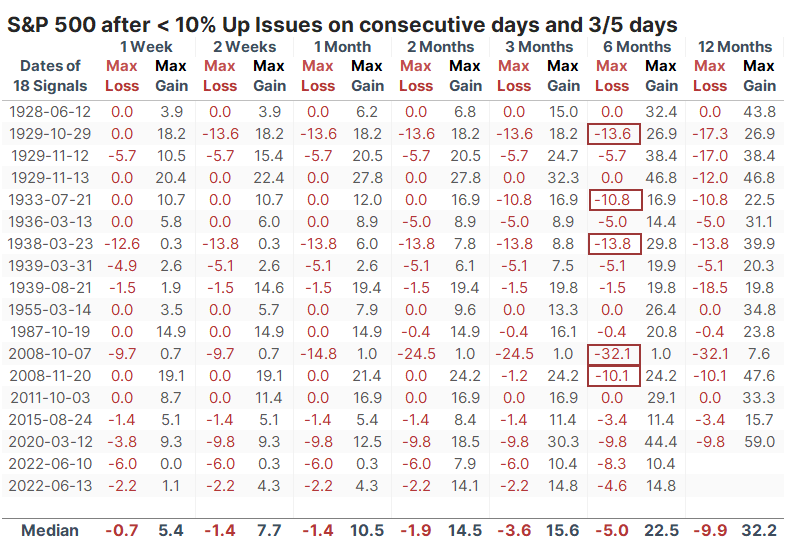
Only five signals suffered more than a 10% drawdown at any point within the next six months. Two of those were just barely and led to significant gains. The failure in October 2008 was the only one that didn't see double-digit upside within the next six months.
A failure of the 4-month bottom?

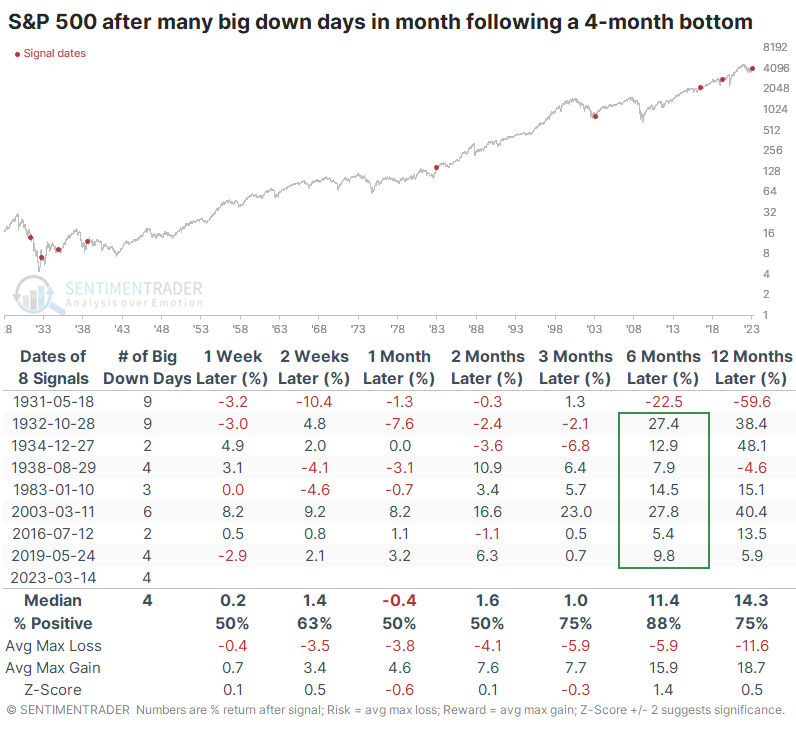
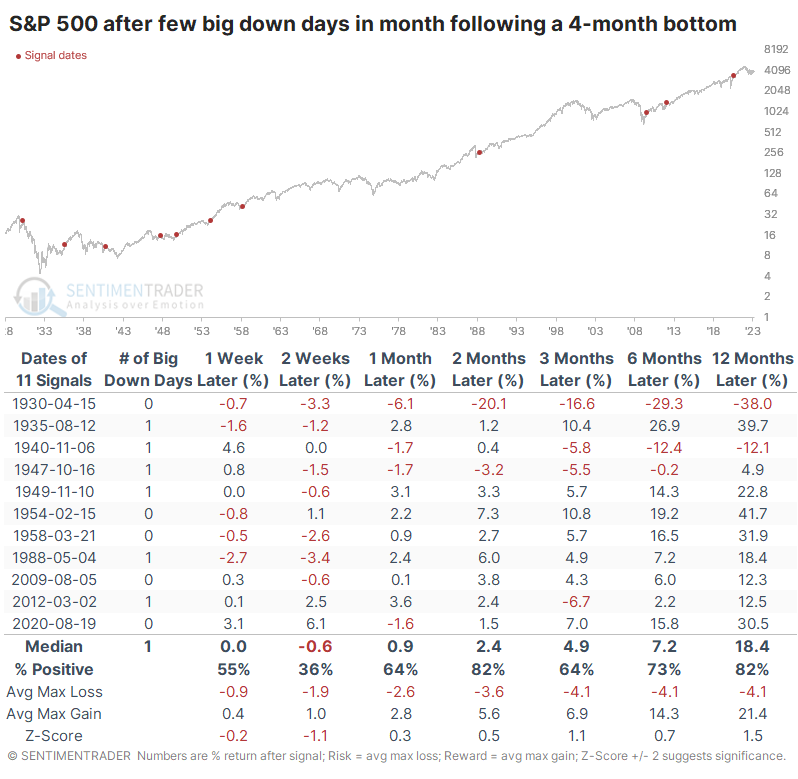
If we go back to that study of 4-month bottoms, we'll look for the ones with the most days with either 80% Up Issues or Up Volume. Then, we'll filter those that suffered the most big down days (with less than 20% Up Issues or Up Volume) over the following month. For the current signal, the month isn't up until Tuesday, but it will rank among the worst reactions no matter what happens today or tomorrow.

There weren't many, especially outside of the hyper-volatile 1930s. But except for the absolute failure in 1931, they all enjoyed a positive return six months later. In other words, a bevy of big down days in the month following a major 4-month rebound did not cancel out the positive implications from the initial bottoming phase except for that one instance.
Now, let's look at the opposite scenario. These are times when investors never really rushed for the exits en masse in the month following a 4-month bottom. After these, returns were quite good, especially since 1950. What this shows us is that it wasn't necessary, or even particularly desirable, to see a lack of volatility in the month following a four-month surge off a bottom.
What the research tells us...

There is no shortage of gloom and doom, with investors' focus now shiftly hysterically to a potential bank run. There is always the potential that this is a repeat of the October 2008 type of signal noted above. It seems wildly unlikely, but many "wildly unlikely" things have transpired over the past three years. Based on historical behavior, it's much more likely that this is just another round of intense selling panic in which patient investors will find an opportunity to lower their cost basis for longer-gain gains.

PRODUCTS
SentimenTrader
Trading Tools
Indicators & Data API
‍
Strategies & Scanner
‍
Research Reports
FREE
RESOUrCES
Simple Backtest
Calculator
Simple Seasonality
Calculator
The Kelly Criterion
Calculator
Sentiment Geo Map
‍
Public Research Reports
‍
Education
Sentiment Indicators
‍
Technical Indicators
‍
Pricing
Bundle pricing
‍
FAQ
‍
Announcements
‍
COMPANY
‍
About
‍
In the News
‍
Testimonials
‍
Client Success Stories
CONTACT
‍
General Inquiries
‍
Media Inquiries
‍
Financial Professionals Inquiries
‍
© 2026 Sundial Capital Research Inc. All rights reserved.
Setsail Marketing
TermsPrivacyAffiliate Program
Risk Disclosure: The information and tools provided are for research and analytical purposes only and are not intended as investment advice. Market analysis involves uncertainty, and outcomes may differ from expectations. Users should conduct their own due diligence and consider their individual circumstances before making any financial decisions. Past performance is not necessarily indicative of future results.

Hypothetical Performance Disclosure: Hypothetical performance results have many inherent limitations, some of which are described below. No representation is being made that any account will or is likely to achieve profits or losses similar to those shown; in fact, there are frequently sharp differences between hypothetical performance results and the actual results subsequently achieved by any particular trading program. One of the limitations of hypothetical performance results is that they are generally prepared with the benefit of hindsight. In addition, hypothetical trading does not involve financial risk, and no hypothetical trading record can completely account for the impact of financial risk of actual trading. for example, the ability to withstand losses or to adhere to a particular trading program in spite of trading losses are material points which can also adversely affect actual trading results. There are numerous other factors related to the markets in general or to the implementation of any specific trading program which cannot be fully accounted for in the preparation of hypothetical performance results and all which can adversely affect trading results.

Testimonial Disclosure: Testimonials appearing on this website may not be representative of other clients or customers and is not a guarantee of future performance or success.