
A financial conditions system shifts to risk-off

Key points:
- The Goldman Sachs Financial Conditions Index shifted higher, indicating a tightening in financial conditions
- Returns for the S&P 500 are more unfavorable when financial conditions tighten rather than ease
- The most significant risk comes in the first few weeks of a tightening signal
Financial conditions tighten, suggesting a less favorable environment for stocks
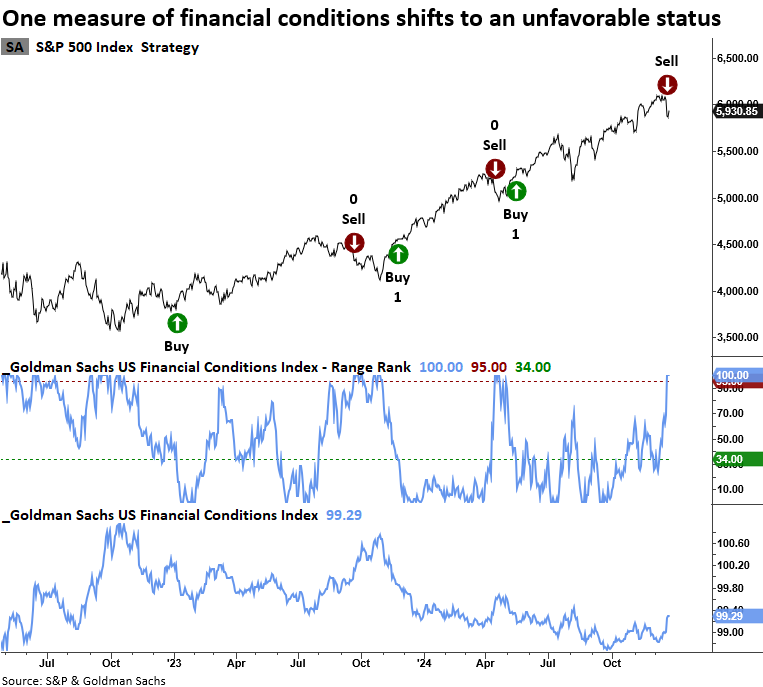
A system that measures when the Goldman Sachs Financial Conditions Index eases or tightens relative to its range triggered a risk-off signal as macro factors in the composite shifted to a more unfavorable status.
Historically, tighter financial conditions have aligned with a more challenging landscape for equities.
Goldman Sachs Financial Conditions Index Components:
- policy rate
- long-term riskless bond yield
- corporate credit spread
- equity valuations
- trade-weighted exchange rate
As shown in the chart below, this marks the third risk-off signal since stock indexes bottomed in the fall of 2022. The previous two occurrences were relatively brief, with the S&P 500 finding a bottom 26 and 4 days later. Because trend-following systems like this one are vulnerable to whipsaw signals, it's prudent to use this model as part of a broader weight-of-evidence framework.
How the system works
The model applies an 84-day range rank to the Goldman Sachs Financial Conditions Index. When the range rank declines below the 34th percentile, and price momentum for the S&P 500 is positive, the system goes long. Conversely, the model issues a sell signal when the range rank increases above the 95th percentile and the S&P 500 exhibits negative price momentum.
The S&P 500 tends to stagnate when financial conditions tighten
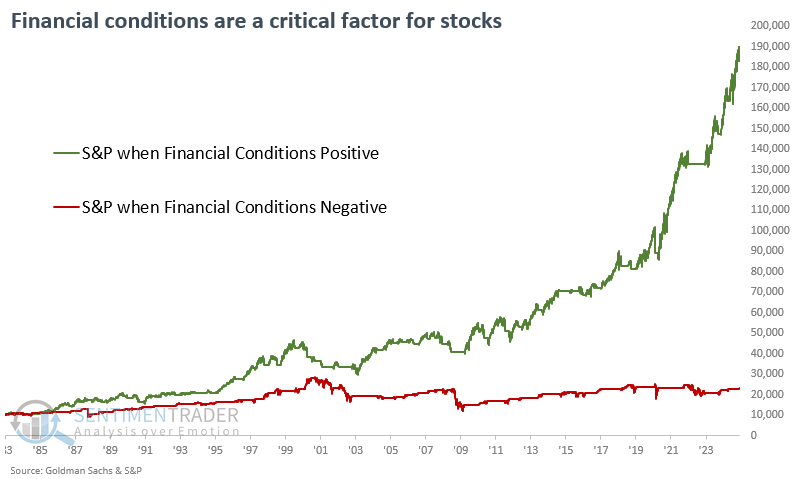
When examining a binary all-in or all-out model, the most suitable way to gauge the strategy's validity is by assessing the performance of an initial capital outlay.
Utilizing the range rank rules, a $10,000 investment in the S&P 500 increases to $183,000 when financial conditions ease. Conversely, tightening conditions result in significantly smaller growth, with the initial investment reaching only $23,000.
A shift to tighter financial conditions preceded a negative short-term outlook
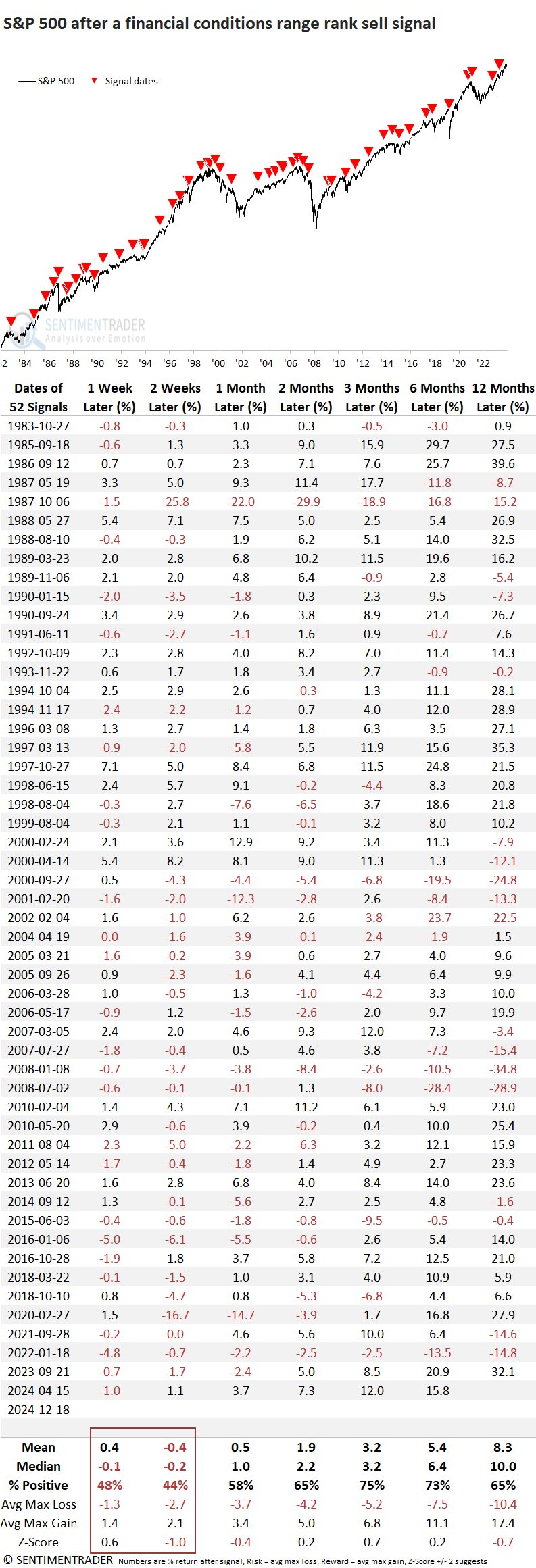
Although I use the financial conditions system as a binary model, analyzing sell signals with an outlook table shows that the most significant risk often materializes within the first two weeks. This trend has intensified over the past few decades, with 25 of 28 signals recording losses at some point during the initial weeks.
What the research tells us...
A trading system that uses the Goldman Sachs Financial Conditions Index to assess whether financial conditions are easing or tightening relative to its recent range triggered a sell signal, indicating tightening financial conditions that have historically correlated with a less favorable backdrop for equities. This tightening scenario has disproportionately impacted the average stock, as recently highlighted in several reports discussing diminishing market participation. Although the bullish case for stocks remains intact, it's less compelling than before, making disciplined risk management practices all the more critical for traders.
Note: I'll be on a holiday break until the New Year. Wishing you all happiness and success in the year ahead-cheers!