
A Few More Hopeful Indicator Signals

Key points:
- The character of the market changed recently, with several breadth, interest rate, and price action warnings
- Nevertheless, as long as the major indexes hold above their longer-term averages, investors and traders can look for favorable indicator signals
- Recent favorable signals have been flashed by industry group action, crude oil relative to gold, and consumer confidence
Industry % in Bear Market hits a key level
As the name implies, our Industry % in Bear Market indicator shows the percentage of 23 industries that are trading more than 20% below their 52-week highs. This is an important indicator of overall market health. Ironically, a rising trend can represent good news or bad news. When the percentage of industries that are 20% or more below their respective 52-week highs reaches a significant level, it means one of two things. Either a) the overall market is plunging into a broad bear market, or b) a serious intermediate decline may have just about run its course. Unfortunately, there is no way to know for sure which event is taking place solely from this indicator's action. We need confirmation or denial from other indicators, and from watching subsequent price action. Regardless, it is useful to know when this indicator crosses a key level.
The chart below highlights those dates when the 20-period moving average for the Industry % in Bear Market indicator crossed above 10% for the first time in 3 months.
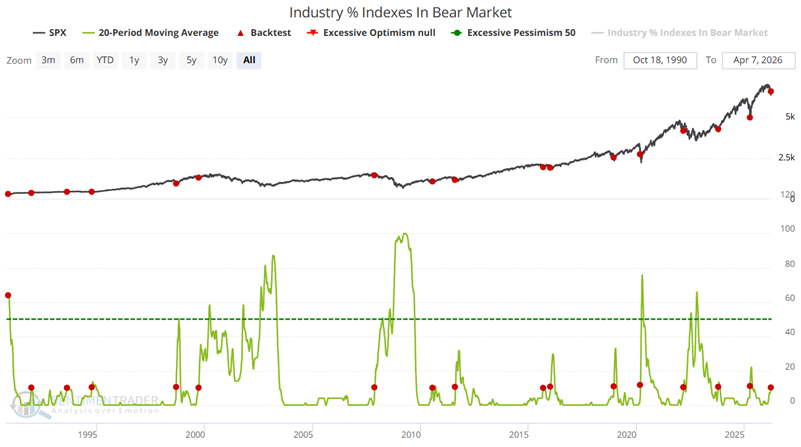
The table below summarizes subsequent S&P 500 action. The key thing to note is the overall reliability for periods of 1 month to 1 year.

The table below displays results on a signal-by-signal basis. Here we see why this indicator should not be relied upon as a standalone trading model. We see significant market declines following the November 2007 and March 2022 signals.
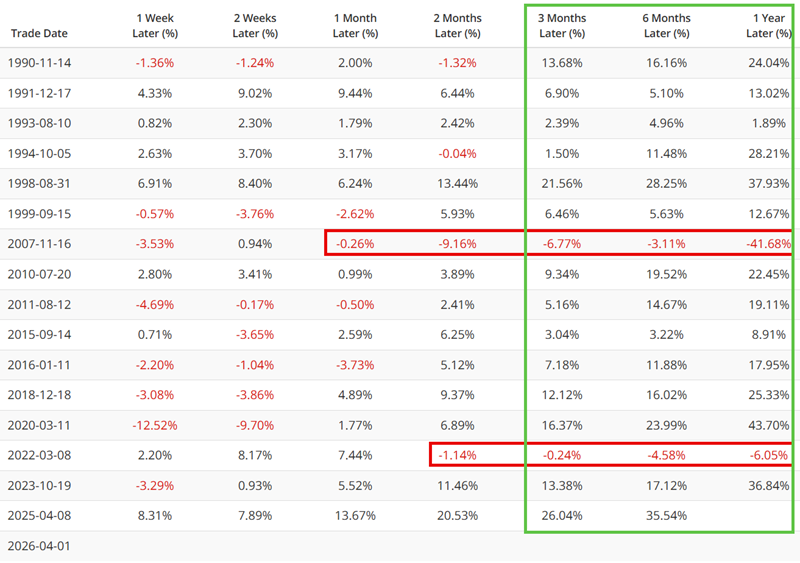
Still, based on historical results - and given that the S&P 500 has popped its head back above its 200-day moving average, it appears reasonable to place the recent signal from this indicator on the favorable side of the weight of the evidence ledger (However, if the S&P 500 drops back below its 200-day moving average, we can call that designation into question).
The WTI/Gold Ratio remains low despite the spike in crude oil
The WTI/Gold Ratio measures the relationship between West Texas Intermediate crude oil and gold prices. Calculated as the price of a barrel of WTI oil divided by the price of an ounce of gold, this ratio reflects the value of an industrial commodity relative to a safe-haven asset. A rising ratio suggests that oil is becoming more expensive relative to gold, which can signal strong global economic growth and high energy demand. A declining ratio indicates that gold is outperforming oil, which may signal economic weakness, geopolitical risk, or investor flight to safety.
The chart below highlights all dates when the WTI/Gold Ratio indicator was below 0.037.
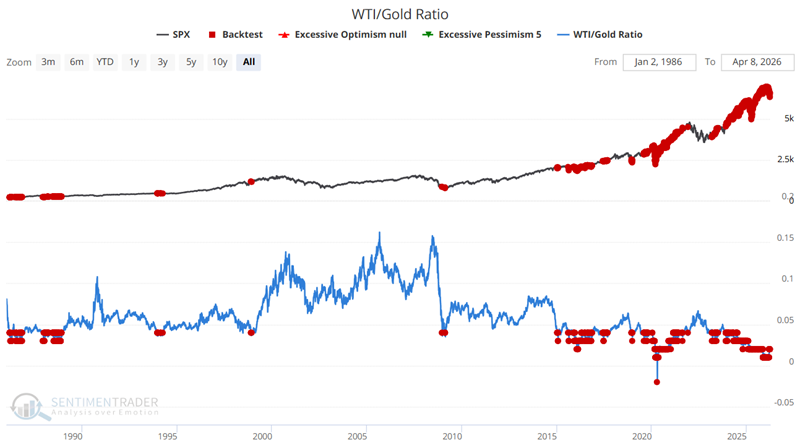
We see in the chart above that, after occurring only occasionally in previous decades, crude oil has been priced relatively low compared to gold over the last 10 years. Interestingly, the stock market has spent most of the last 10 years moving higher. Coincidence? Maybe, maybe not. We don't view this indicator as a direct stock market indicator, nor as a standalone trading model. But the fact remains that constrained energy prices tend to be a boon for the economy, and the stock market loves a strong economy (actually, the stock market likes just about any kind of economy other than a recession).
The table below summarizes S&P 500 performance following WTI/Gold Ratio readings below 0.037 (where we still stand, despite the recent spike in crude oil and sell-off in gold bullion).

Low oil prices relative to gold do not guarantee a stock bull market. Nevertheless, based on the historical 1-Year 96% Win Rate and 18.05% Median Return, the current reading does lend weight to the favorable side of the ledger for stocks.
Low Consumer Confidence is typically a favorable sentiment sign
The one thing that never changes is human nature. When people perceive the current state of affairs as unfavorable, they invariably adopt a negative attitude. Once it becomes entirely obvious that things are good, the average person adopts a positive attitude. It is this type of thinking that creates the opportunity to use sentiment as a contrarian indicator.
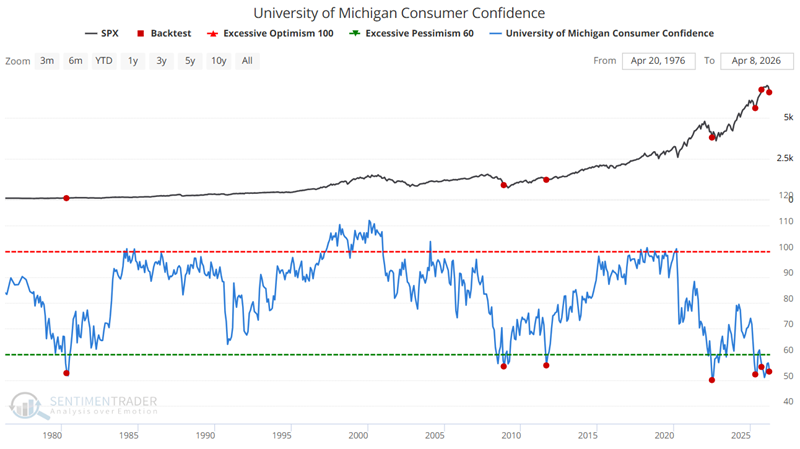
The chart below highlights all months when the University of Michigan Consumer Confidence Index was below 58 (on a scale of 0 to 100).
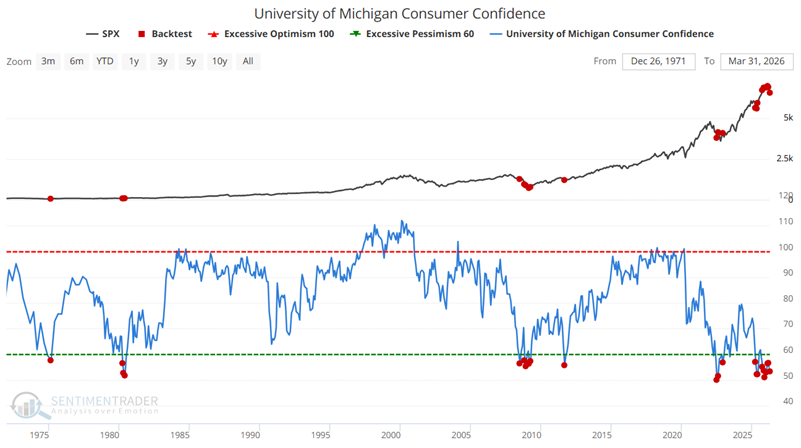
We can observe that some of the "signals" (red dots) were "early" relative to a stock market low. Nevertheless, we can note in the table below that, 9 months or more after each signal, the S&P 500 was higher 90% or more of the time, with significant, above-average gains.

Will the current flurry of red dots in recent months prove to be an exception to the rule? We cannot rule it out. In the table of signal-by-signal results below, we see the disastrous performance following the June 2008 signal highlighted in red.
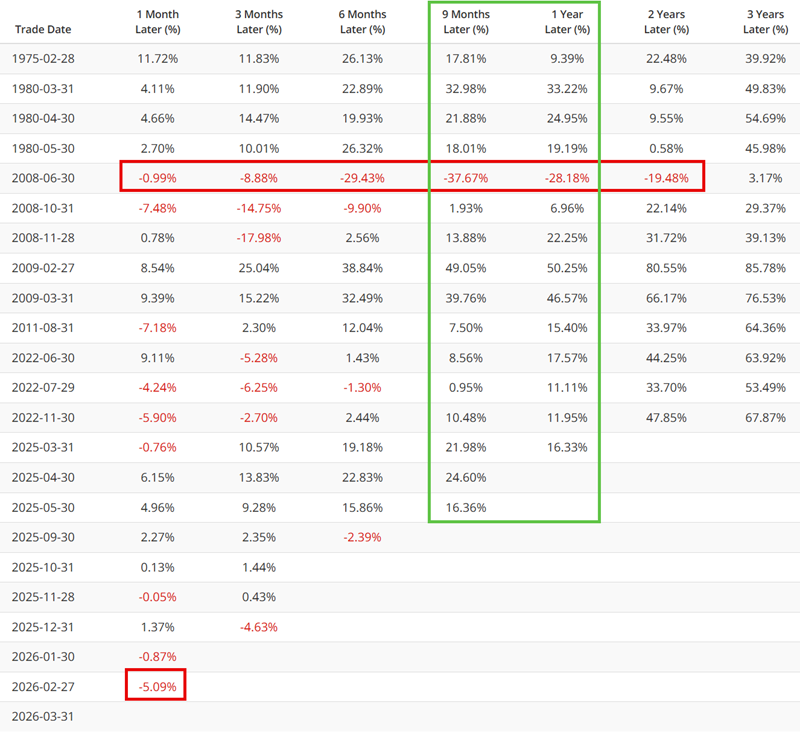
But if we are playing the odds, the recent dour consumer sentiment still suggests favoring the bullish side of the argument. In fact, the most recent reading was even a little further on the extreme side.
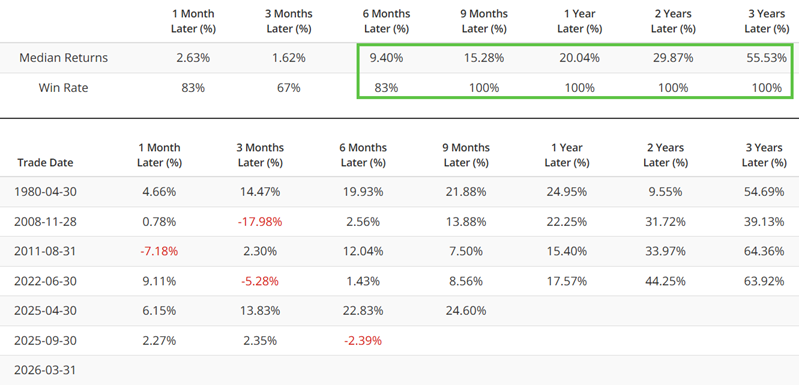
The chart below shows only those times when the U of M Consumer Confidence Index was 56 or lower.
The tables below show subsequent S&P 500 action, both summarized and on a signal-by-signal basis.
What the research tells us…
None of the indicator signals detailed above qualify as something that we rely upon as a "trade signal generator." Nevertheless, because we rely on a weight-of-the-evidence approach, these signals offer value. The character of the stock market has changed in recent months, with a few more risk warnings emerging. Likewise, the recent decline by the Dow Industrials, S&P 500, and Nasdaq 100 indexes below their respective 200-day moving averages served as a "show across the bow." Now that these indexes have popped back above their respective e long-term average - and as long as they hold there - we would once again lend more weight to favorable indicator signals such as those detailed above.