
A bullish-to-bearish reversal in uptrends for global indexes

Key points:
- Global indexes saw medium-term uptrends decline sharply in just a few days
- Similar breadth-based reversals suggest a global index could struggle over the next three months
- The MSCI World Index ex USA and S&P 500 followed a similar path, struggling over a medium-term basis
The participation problem spreads around the globe
Over the last few weeks, we've highlighted the deteriorating market breadth environment under the surface of domestic indexes, indicating that fewer and fewer stocks exhibit positive price trend characteristics.
This participation problem has now spread globally, with the percentage of all country indexes trading above their respective 50-day average, cycling from above 70% to below 25% in only three sessions.
The previous instance occurred in August 2023, when global and domestic indexes were in the early stages of a 10% or greater correction.
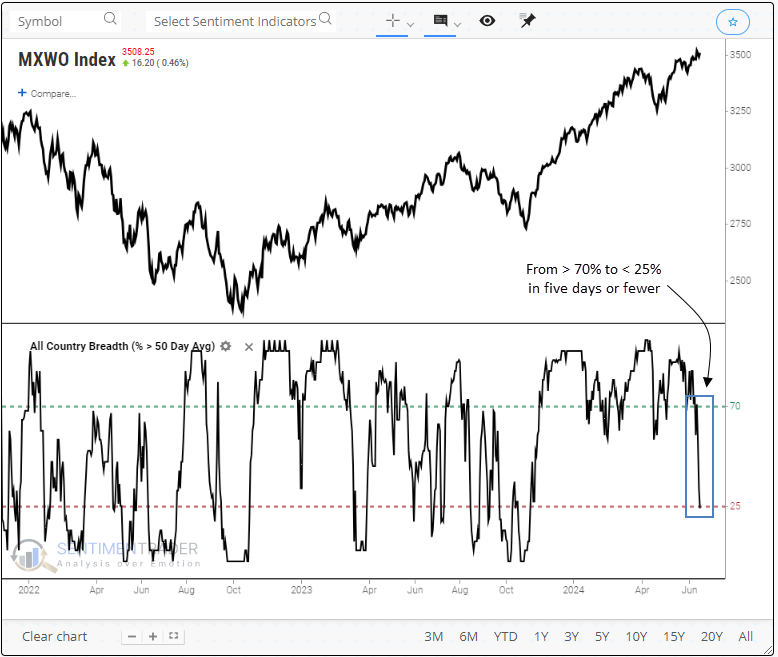
Similar breadth-based reversals suggest a broad global index could struggle
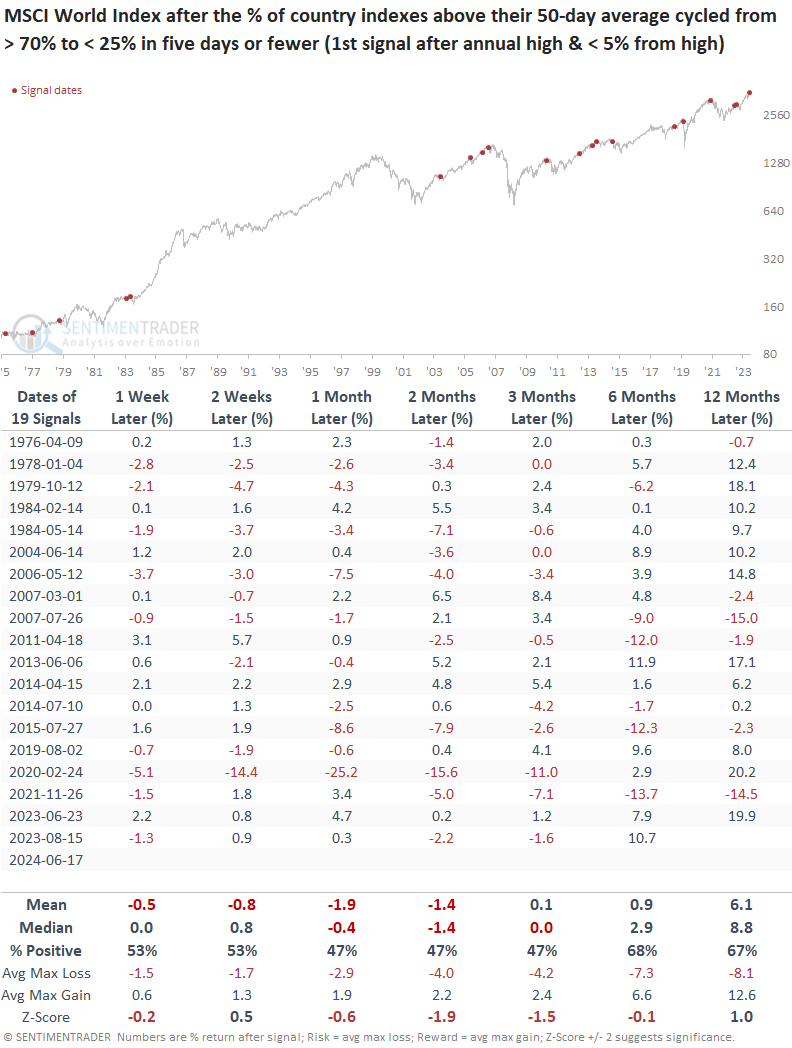
Whenever the percentage of country indexes above their 50-day average cycled from above 70% to under 25% in five days or fewer, the MSCI World Index struggled over the following three months. At some point over that same time frame, the global benchmark displayed a loss in 16 out of 19 instances.
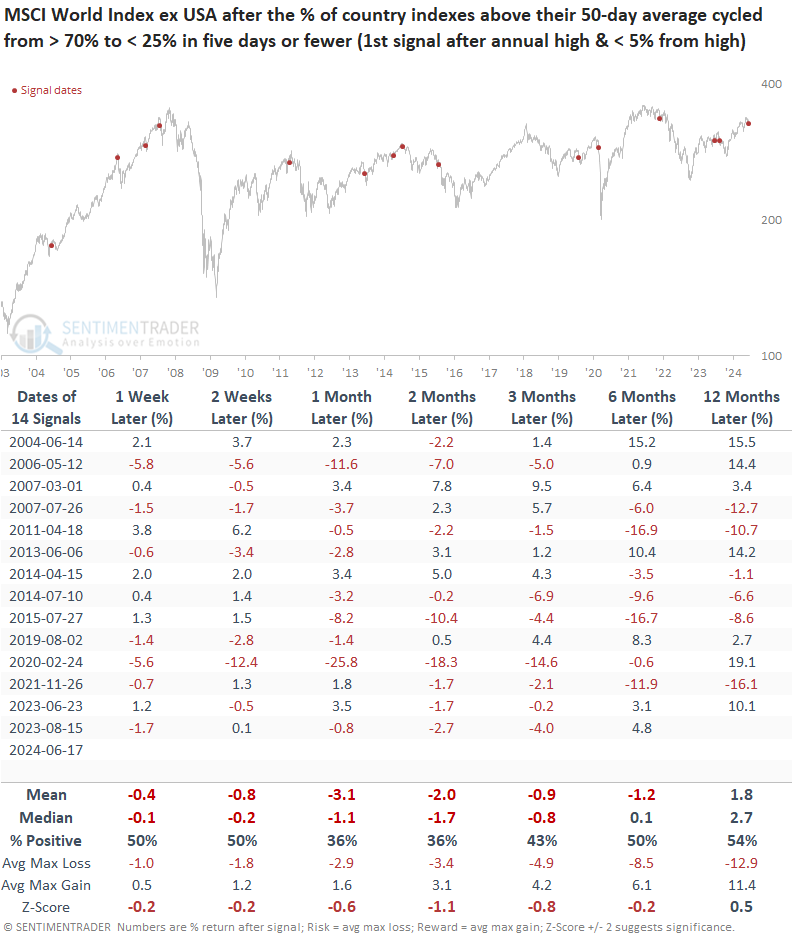
Despite the reduced number of signals caused by data limitations, I thought it worthwhile to analyze the outlook for a global index that excludes the United States, given the USA's superior performance relative to international equities over the last 16 years.
Given that most signals occurred during a period when technology-driven growth stocks outperformed, it's unsurprising that this index, which excludes the USA, has struggled over various time frames following similar breadth reversals.
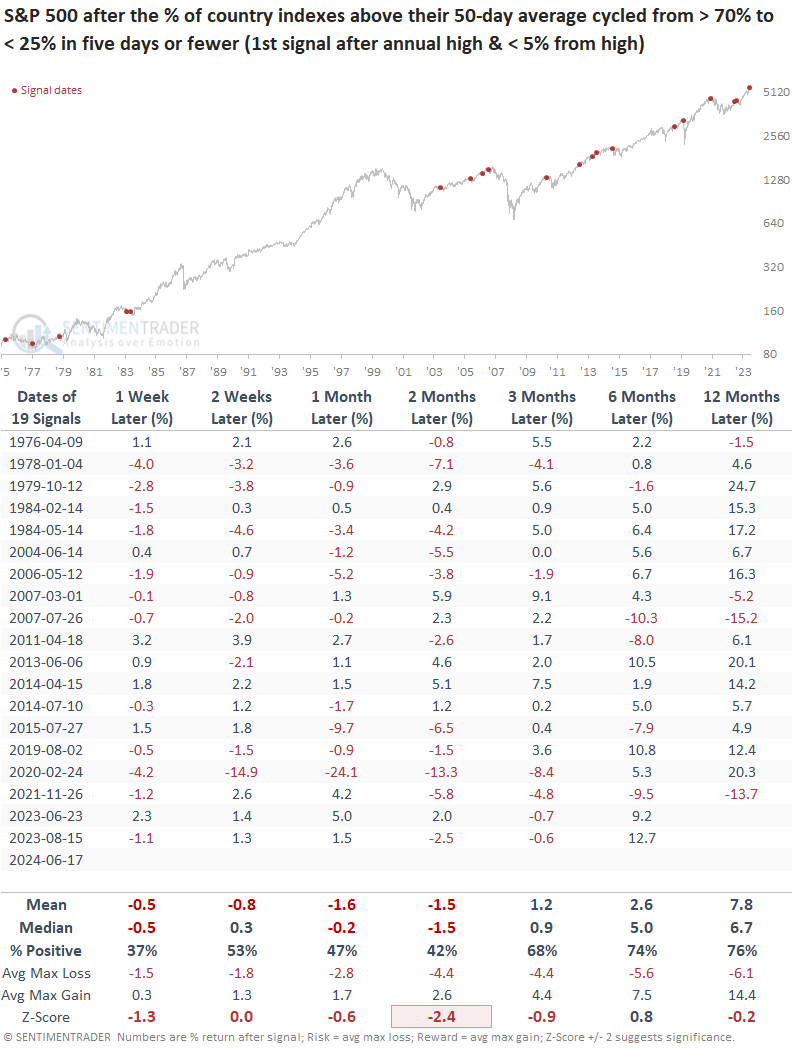
When global indexes experienced a participation problem, the S&P 500's returns and win rates tended to be lackluster in the following few months. This observation mirrors recent trends we've noted in domestic indexes.
What the research tells us...
The participation problem we've been highlighting over the last few weeks for domestic indexes has spread around the globe, with fewer and fewer international indexes holding above their respective 50-day averages. Similar breadth-based reversals tended to produce negative returns and unfavorable win rates for broad-based global indexes and the S&P 500 over a medium-term horizon. While these historical tendencies usually lead to a consolidation/pullback, it's hard to make a case for something more significant, with 90% of global indexes trading above their respective 200-day averages.