
A bullish skew in NYSE breadth

Key points:
- The NYSE advance-decline ratio increased by a significant amount over consecutive sessions near a high
- Similar breadth skews preceded outstanding returns for the S&P 500 over the subsequent six months
- Historically, the equal-weighted S&P 500 has tended to outperform the cap-weighted version
An expansion in participation bodes well for the uptrend
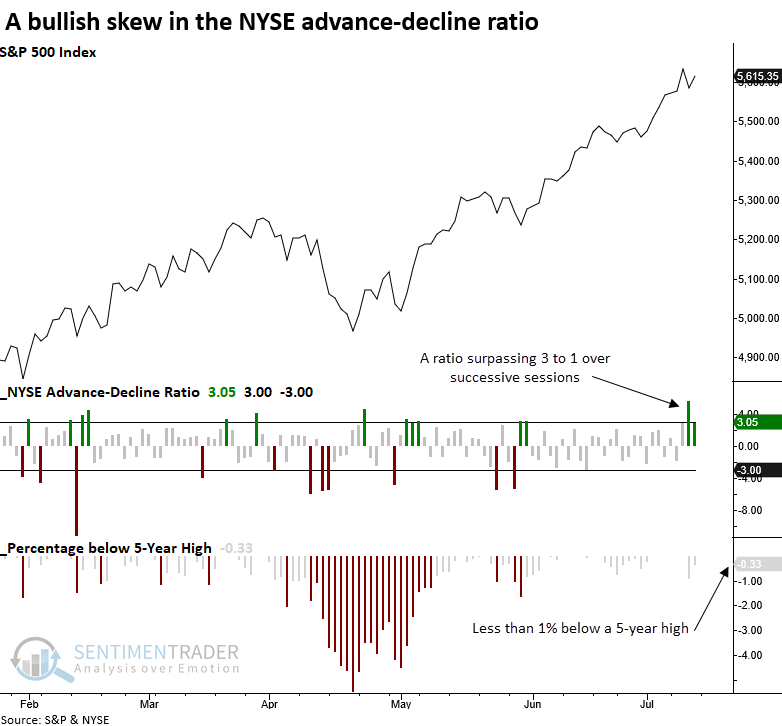
Following a dovish CPI report last week, investor optimism shifted, breathing new life into previously overlooked stocks and enhancing participation across various market capitalizations.
For only the 26th time since 1936, advancing issues on the NYSE outpaced declining issues by a ratio of 3 to 1 over successive trading sessions, with the S&P 500 hovering within 1% of a 5-year high.
The two previous instances occurred in February and May of this year, leading to solid gains thus far.
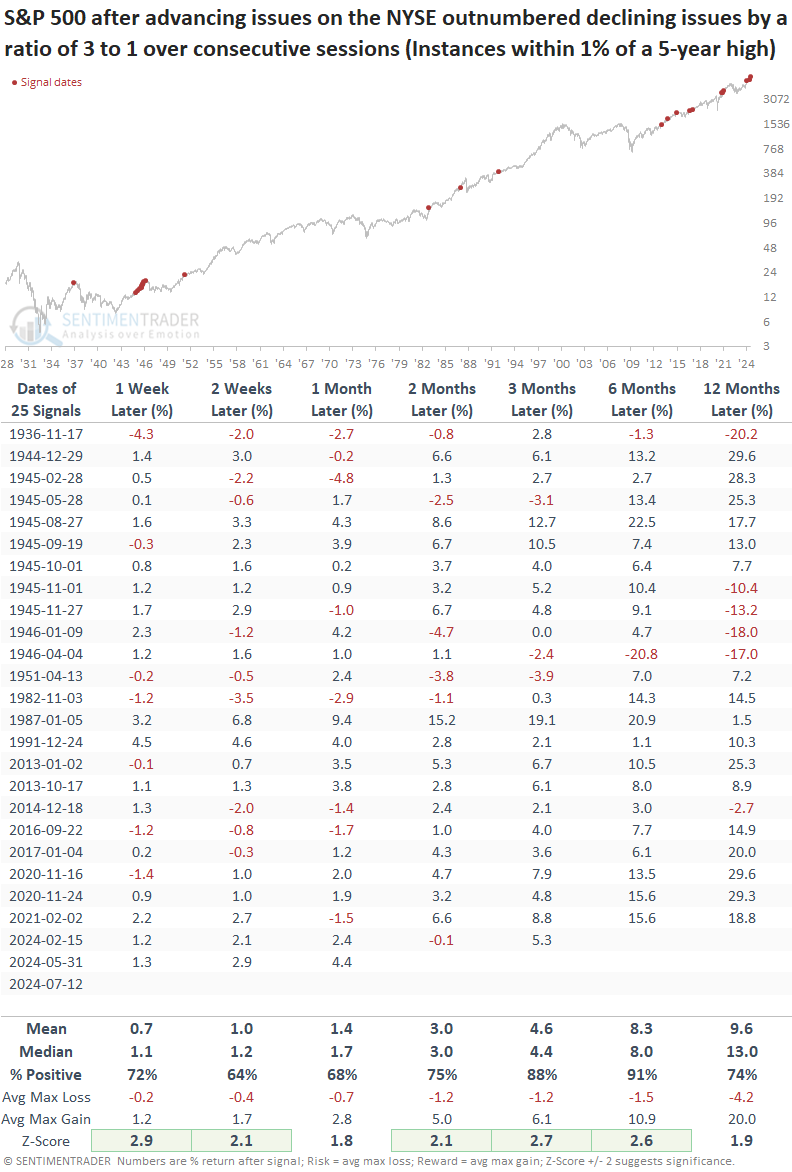
Similar breadth skews preceded excellent returns
Whenever advancing issues on the NYSE exceeded declining issues by a ratio of 3 to 1 over consecutive sessions with the S&P 500 within 1% of a 5-year high, the world's most benchmarked index displayed outstanding returns and consistency over the following six months.
Furthermore, the outlook has been increasingly bullish since 1951, with several periods demonstrating a perfect 100% win rate.
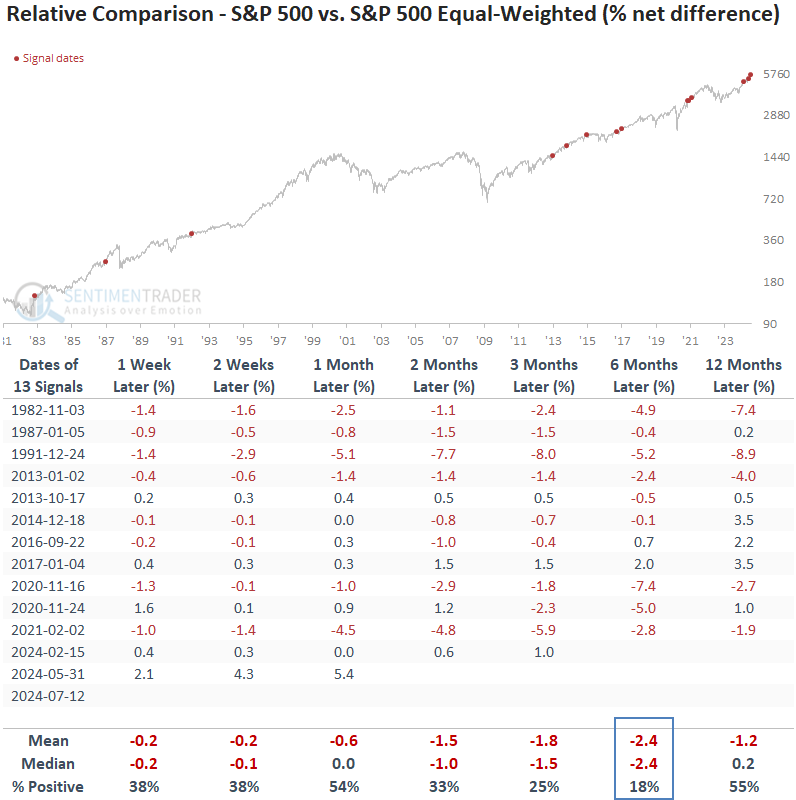
While a comparison between the S&P 500 and the S&P 500 Equal-Weighted Index contains fewer precedents due to data limitations, the outlook table suggests investors should be open to the possibility that the average stock outperforms the cap-weighted benchmark in the next six months. Over this period, the equal-weighted S&P 500 outperformed the cap-weighted version 82% of the time.
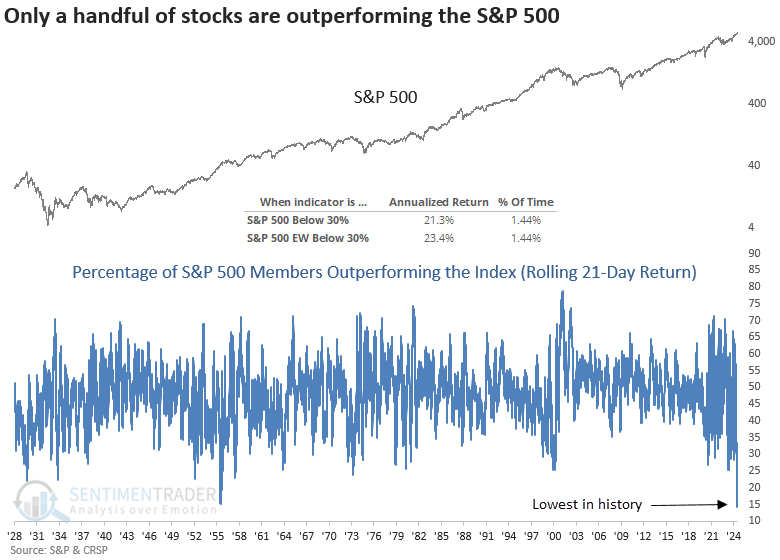
A potential rubberband snapback scenario
On July 5th, the percentage of S&P 500 stocks outperforming the S&P 500 Index over a rolling 21-day period fell to the lowest in history. In the past, whenever this indicator drops under 30%, the equal-weighted S&P 500 index has generated an annualized return of 23%, exceeding the cap-weighted return of 21%.
What the research tells us...
Following a favorable CPI report last week, stocks across all market capitalization surged over two days, culminating in a favorable skew in the advance-decline ratio on the NYSE. Comparable market breadth dynamics near a 5-year high produced outstanding results for the S&P 500. While an expansion in participation typically favors the equal-weighted S&P 500 over the cap-weighted version, we must remember that significant sector or style rotations more often than not occur at major bottoms or tops in the broad market, not during steady uptrends. A recent example would be 2022 when the equal-weighted S&P 500 outperformed as the Technology sector weighed on the S&P 500.