
A bullish or bearish close below the 50-day average

Key points:
- The S&P 500 closed below its 50-day moving average after an extended period above the average
- Similar win streak price patterns suggest the S&P 500 could struggle in the near term
- Traders should buy the dip as the S&P 500 was higher 86% of the time over the next three months
An extended duration above a moving average indicates a bullish trend
According to my calculation, the S&P 500 has crossed below its 50-day moving average 742 times since 1928. However, as we constantly emphasize in nearly every research note, context is critical when assessing historical patterns.
The S&P 500 closed below its 50-day moving average after registering at least 95 consecutive trading days above the average for only the 22nd time since 1928.
The ability of a stock or index to sustain itself above a moving average for a prolonged period is indicative of bull markets, not bear markets.
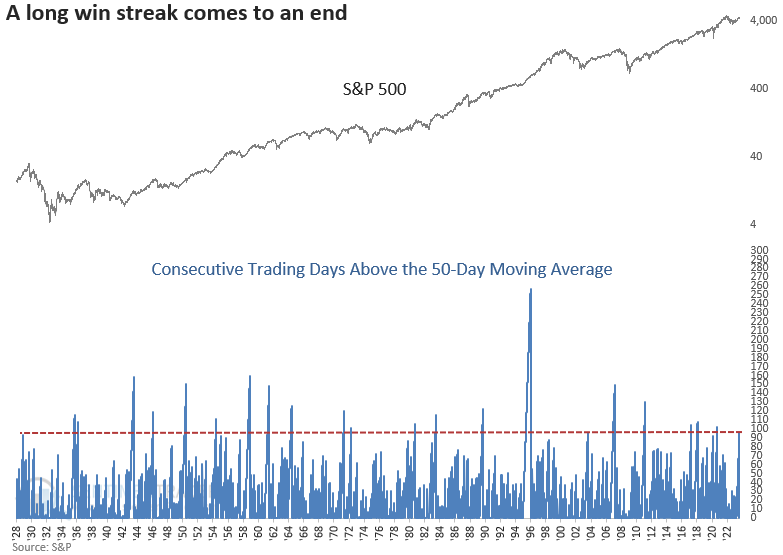
Similar win streak patterns led to positive returns for the S&P 500
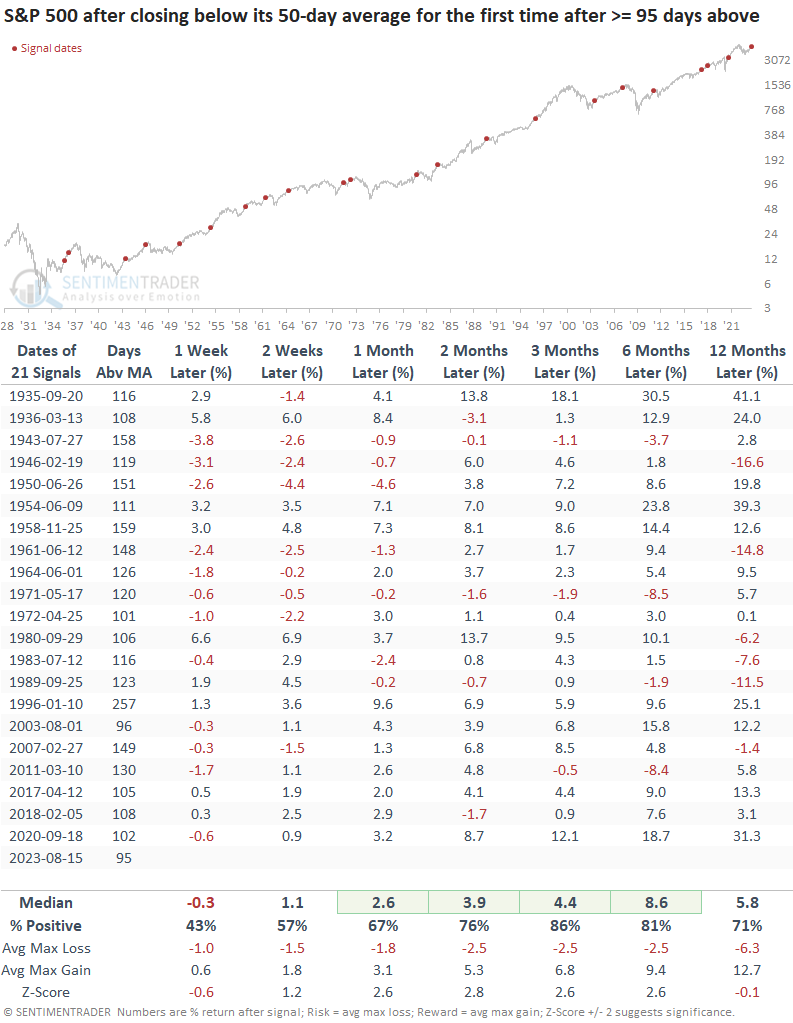
In instances where the S&P 500 closed below its 50-day average after achieving at least 95 consecutive trading days above the average, the world's most benchmarked index tends to struggle in the very near term. However, traders should utilize any further downside to accumulate stocks. Three months later, the S&P 500 was higher 86% of the time.
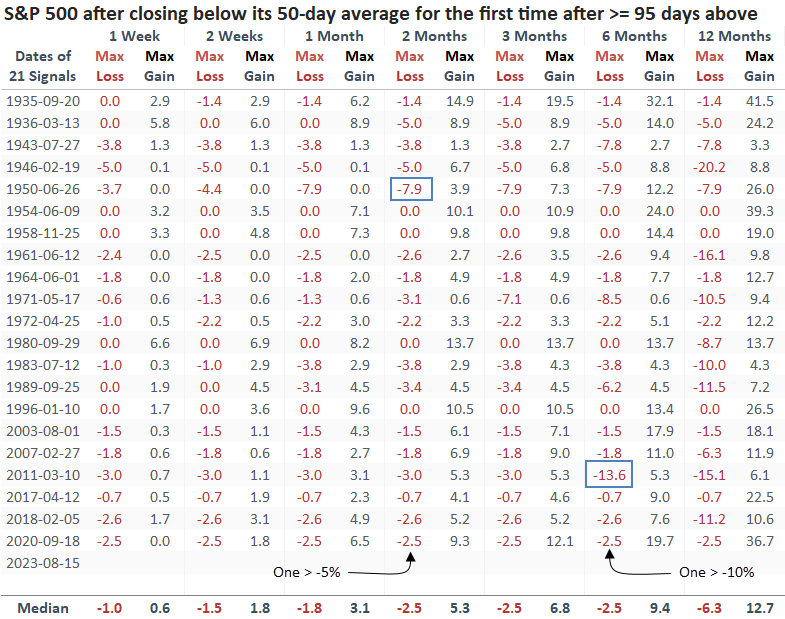
Signals that occurred prior to significant tops like 1946, 1972, 1980, and 2007 showed a max gain over the next six months of 8.8%, 5.1%, 13.7%, and 11%, respectively. In all four cases, the S&P 500 closed at new highs after breaking below the 50-day average.
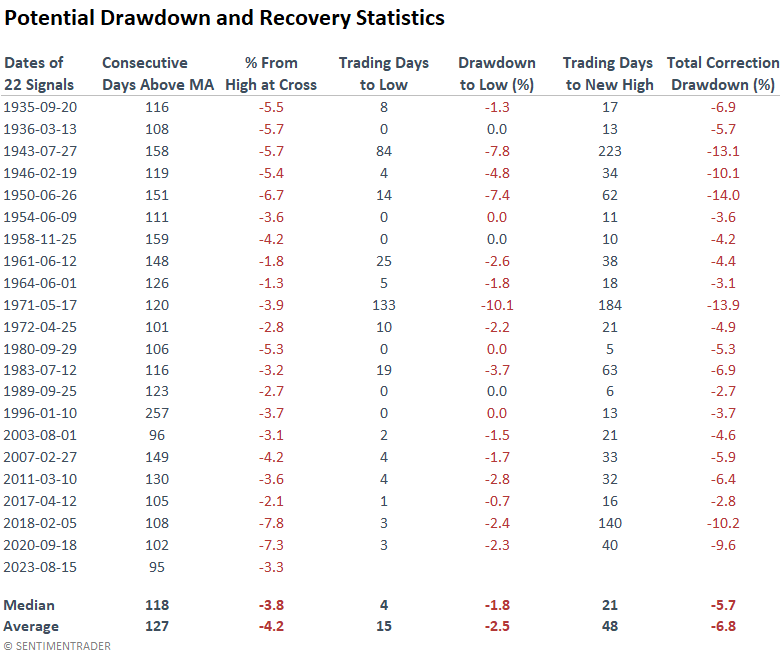
Corrections associated with a close below the 50-day average, similar to the present situation, show a median loss of -5.7% and an average loss of -6.8%. So, if history rhymes, a drawdown of a little over -6% could see the S&P 500 fall to roughly 4300, a reasonably typical bull market correction. The S&P 500's recovery to a new high after slipping beneath the 50-day average typically spans from one to two months later.
What the research tells us...
The S&P 500 closed below its 50-day moving average for the first time after sustaining itself above the average for 95 trading days. After similar win streak signals, the S&P 500 was higher 86% of the time over the next three months. However, history suggests the index could fall further before turning higher. So, traders should get ready to buy the dip.